





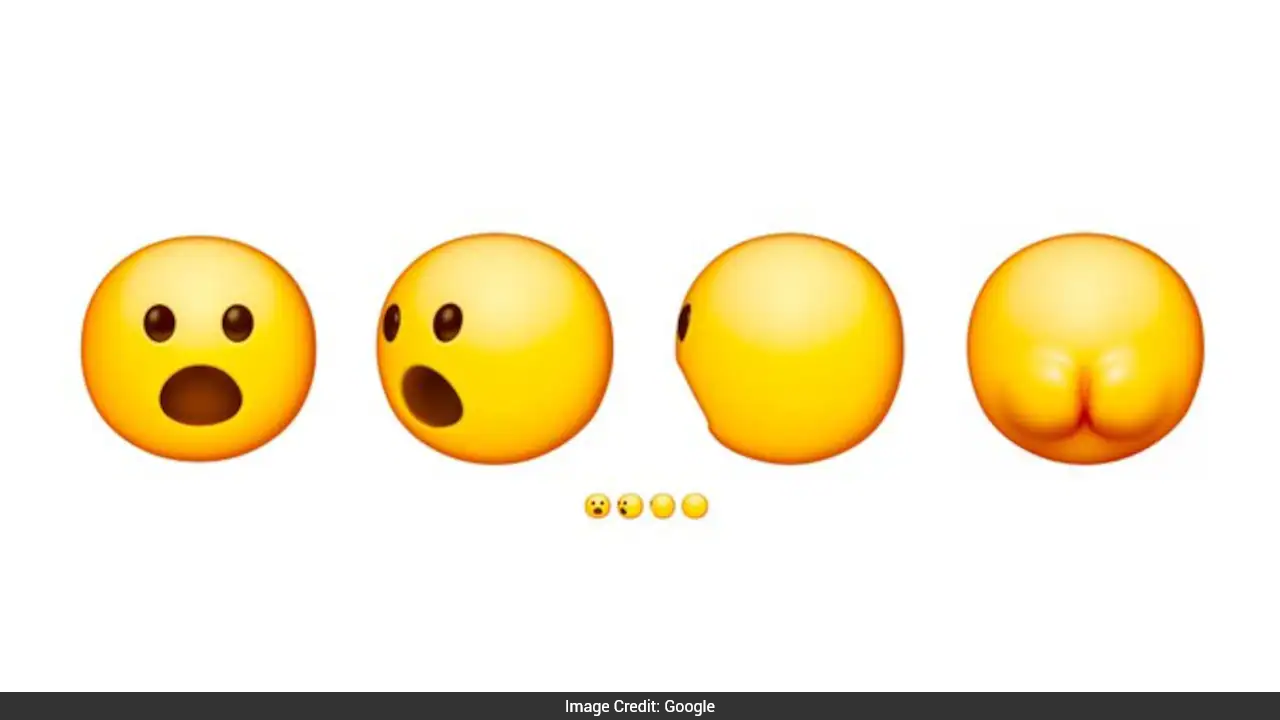
As people increasingly rely on digital conversations, emojis have become a popular way to express emotions much more succinctly. They have transformed simple text messages into more expressive conversations by helping people communicate feelings without words. While most emojis are 2D, Google recently introduced Noto 3D, transforming traditional flat emojis into three-dimensional characters with more depth, texture, and personality. The new collection of 3D emojis included a hilarious redesign that gives the iconic shocked face emoji a butt.
In a blog post titled, ‘Bringing Emoji into the Next Era of Expression,' Google explained the challenges that designers had to face in converting the original 2D versions of emojis into 3D.
"For years, emoji have done the emotional heavy lifting our keyboards couldn't. But the way we talk online doesn't look like it did a decade ago, and neither should our emoji," Google stated.
“In 2D illustration, you only have to solve for a single vantage point. In 3D, there's nowhere to hide. Once we started imagining the 360-degree view of our assets, we started confronting questions Unicode never warned us about: What does the back of a smiley face look like?” the company said.
Google shared four images showing its shocked face emoji rotating from front to back, with the final image revealing a pair of butt cheeks sculpted into the back of its head. The company, however, clarified that the design was just a joke. “Just kidding! Butt, IMAGINE!” read the caption.
The Noto 3D collection will begin rolling out on Pixel phones later in 2026 before expanding to other Google apps and supported Android devices. Google also confirmed the designs will be open source.
Evolution Of Emojis
Emojis, also known as pictographs, logograms, ideograms or smileys, trace their origins to the 1980s. During that time, computer scientist Scott Fahlman suggested that emoticons such as ":-)" and ":-(" could potentially replace language. In 1999, a Japanese designer created the first set of emojis for a mobile company, laying the foundation for their global adoption.
In 2007, a software internationalisation team at Google petitioned the Unicode Consortium, a nonprofit organisation that maintains text standards across computers, to recognise emojis. By 2011, emojis had gained popularity around the world after Apple introduced an official emoji keyboard to iOS, making them accessible in many countries.
Track Latest News Live on NDTV.com and get news updates from India and around the world

