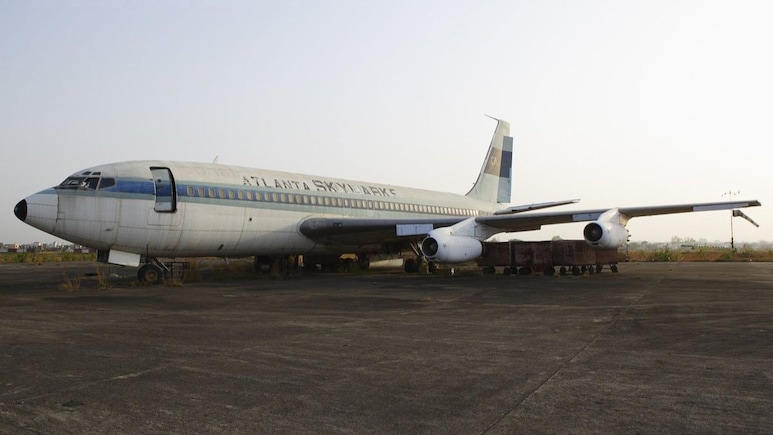
- Boeing 720 made emergency landing at Nagpur airport in 1991 and never left
- The aircraft violated safety norms by parking only 90m from the runway instead of 150m
- Dispute over parking fees and ownership delayed removal, accruing Rs 7 crore dues
On July 21, 1991, a Boeing 720 operated by Continental Aviation Private Limited (CAPL) made an emergency landing at Dr Babasaheb Ambedkar International Airport after reportedly developing engine trouble.
Ordinarily, such incidents are followed by repairs and departure within days. But this aircraft never left.
Instead, it remained parked near the runway, slowly gathering dust as weeks turned into years and then decades.
About Boeing 720
The Boeing 720, introduced in 1960 as a lighter, shorter-fuselage derivative of the successful 707, was designed for medium-range routes of 150 to 3,200 nautical miles with seating for up to 156 passengers.
Featuring aerodynamic wing improvements like full-span leading-edge flaps and greater sweep for better short-field performance, it initially used Pratt & Whitney JT3C turbojets before the 720B variant adopted quieter JT3D turbofans, enabling higher cruising speeds around 530 knots and a production run of 154 aircraft until 1967.
Fun Fact : Nagpur Airport is Home to India's Only Boeing 720! 🇮🇳
— AviationAll (@AviationAll_) April 18, 2026
Registered VT-ERS, it Operated for Continental Aviation Private Limited in India before Being Abandoned in Nagpur 1991 Onwards as its Owner Sam Verma Shut the Airline Down
📸C.P. Satyajit (https://t.co/1NM0KnUQDg) pic.twitter.com/5xblTN465u
Primarily operated by U.S. carriers like United and Eastern Airlines, it filled a niche until the trijet 727 superseded it, with the last commercial service ending around 2010. Led Zeppelin, an English rock band, also had a famous customised Boeing 720 called 'The Starship.'
A Global Jet With A Forgotten Past
Long before it became Nagpur's most peculiar landmark, the aircraft had a rich international career.
Delivered in 1961 to Eastern Air Lines in the United States, the Boeing 720 moved across operators in Europe and America before eventually ending up in India under CAPL ownership.
From Runway Asset To Safety Hazard
The real problem was not just that the aircraft stayed - it was where it stayed.
In 1993, the plane was moved just 90 metres away from the runway. Aviation safety norms require a minimum distance of 150 metres for any obstruction.
I just found out that
— Chris Croy (@ChrisCroy) October 12, 2021
1. For 24 years every pilot who landed at the airport in Nagpur, India had to be warned about the Boeing 720 sitting next to the runway.
2. That it was my dad's fault.
This is the story of my dad's junkyard jet. pic.twitter.com/yxw2qjLQHX
This meant that for years, every aircraft landing at Nagpur did so with a potential hazard sitting within the risk zone.
A source quoted by The Times of India explained the danger clearly: "There are chances that at times, an aircraft may deviate during landing. If there is any object on the sides, it poses a grave threat."
Despite this, the aircraft remained in place with little oversight until stricter regulatory checks were introduced years later.
Bureaucracy And A Rs 7 Crore Dispute
If you are wondering why the plane was never removed?
Well, the answer lies in a long-running dispute between the aircraft's owner and airport authorities.
The plane belonged to Continental Aviation Private Limited, led by businessman Sam Verma. According to Verma, he had attempted to move the aircraft soon after it was grounded.
"We had sought permission to remove it to leased private land nearby. However, [airport authorities] did not allow us access and started calculating rent," he told The Times of India. "It is like forcing a tenant to stay in your house and demanding the rent arrears."
Airport authorities, however, maintained a different version - that the aircraft was simply abandoned after an emergency landing.
Meanwhile, parking charges mounted. By the time the issue gained serious attention, dues had reportedly touched around Rs 7 crore, with lenders like Canara Bank also initiating legal action.
The dispute eventually reached courts, further complicating any effort to remove or sell the aircraft.
A Deadline Forced Change
For nearly two decades, little changed.
Regulator Directorate General of Civil Aviation began issuing directions to move the aircraft as early as 2009. But each time, deadlines were extended.
It was only when the DGCA issued a firm ultimatum - warning that non-compliance could lead to cancellation of the airport operator's licence - that action was finally taken.
Senior airport director Ababhesh Prasad told The Times of India: "In July, DGCA issued an ultimatum and we had no choice."
The Great Tow
By the time authorities acted, the aircraft had not moved in over two decades.
Its tyres had deteriorated, its structure weakened by exposure. Moving it was no simple task.
Engineers from Air India Engineering Services stepped in, replacing the wheels so the aircraft could be towed. The operation itself, however, was surprisingly swift.
"It took around an hour to take the plane 600 metres away. The operation was successful," Prasad said.
Later accounts suggest that the final relocation to the Nagpur Flying Club took barely 30 minutes once preparations were complete.
Some Unfulfilled Plans
Over the years, several ideas were floated to give the aircraft a second life.
Proposals included converting it into a restaurant, a museum, or even a training facility. None materialised.
Legal disputes, ownership issues and mounting costs ensured the Boeing 720 remained stuck - not just physically, but administratively.
Where Is It Now
Today, the aircraft sits at the Nagpur Flying Club, a decaying shell of its former self.
Its tyres have melted into the ground, windows turned opaque, and its structure is too fragile for restoration.
It is believed to be India's only surviving Boeing 720 - though "surviving" might be a generous word.
Track Latest News Live on NDTV.com and get news updates from India and around the world
