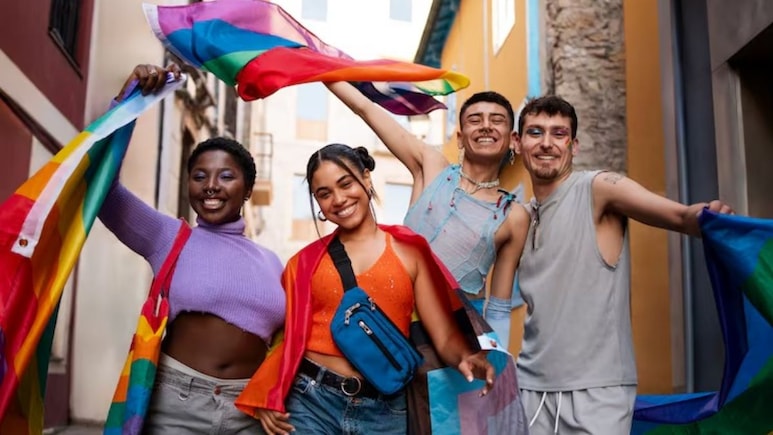
Curiosity, no commitment, and fluidity—these words describe modern relationships quite well. They also aptly describe heteroflexibility, one of the most talked-about sexual identities today.
The concept of sexual orientation emerged in the late 19th century. Karl Heinrich Ulrichs, a German lawyer, jurist, writer, and journalist, argued for homosexual rights in 1867. Before that, the world largely recognised only heterosexuality (men attracted to women, women attracted to men) as the sole sexual orientation. Hence, the concept of a man/woman gender binary was widely accepted.
As times changed and LGBTQ+ people began uniting as a community, the world not only learned but also acknowledged other genders and sexual orientations. One term that has moved from dating apps to dining table conversations is heteroflexible.
The simplest definition of heteroflexible is: people who identify as heterosexual but are open to romantic or sexual experiences with partners of the same sex.
What Is Heteroflexibility?
According to Verywell Mind, heteroflexibility refers to someone who is straight but open to exploring a romantic or sexual bond with another person of the same gender.
Feeld's 2025 Raw Report found that heteroflexibility is the fastest-growing sexuality in the UK. The dating app, which caters to people interested in non-traditional relationships, also noted that at least 15% of people in the US identify as heteroflexible.
This roughly adds up to millions of people who previously felt uncomfortable identifying with other sexualities.
Why More People Are Identifying as Heteroflexible
Dina Mohammad-Laity, Feeld's Vice President of Data, noted in the report: "We're seeing a surge in people exploring connection and playfulness in authentic, fluid ways, redefining what it means to be seen and to connect in 2025."
The data skews toward Millennials, followed by Gen Z and Gen X. Berlin emerged as the most heteroflexible city, while New York saw growth in people identifying as bisexual.
In the late 19th century, when terms like homosexuality and heterosexuality were introduced, they were not immediately accepted by society. For the longest time, intimacy among gay and lesbian partners was not only frowned upon but also illegal (a law that still exists in more than 65 nations worldwide).
However, social scientists have observed that fluidity extends beyond homosexuality and cisgender identities. Heteroflexibility does not require a lifelong commitment or a declaration of sexuality.
Many critics, including members of bisexual and pansexual communities, argue that heteroflexibility might dilute their identities and struggles. They have fought hard for years to get recognised and continue to battle the stigma around their sexual orientations.
However, others view the emergence of heteroflexibility positively, as the rigidity around sexuality is loosening, paving the way for a more inclusive and less judgmental world.
Heteroflexibility is all about curiosity, evolution, and expanding the binary construct. For people who find it difficult to express attraction or curiosity within rigid norms, heteroflexibility opens up a world of possibilities and ever-evolving skies.
Track Latest News Live on NDTV.com and get news updates from India and around the world
