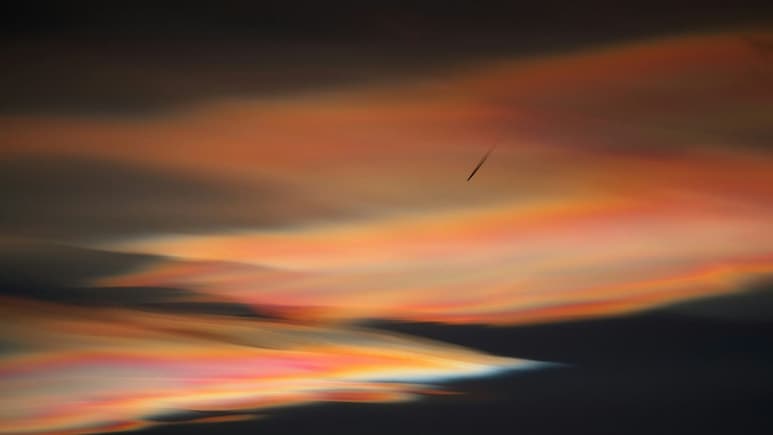
There is something about winter travel in the Arctic that feels almost otherworldly. The air is sharp and clean. The sun barely rises above the horizon, painting the sky in soft pastels for hours. In places such as Finland, days blur into long blue twilights and golden dawns. Most travellers go there hoping to tick one major experience off their bucket list - the Northern Lights.
But sometimes, the Arctic has other plans. Recently, a travel content creator, Celine Nadolny, shared a video that left the internet stunned. Instead of the usual green aurora ribbons, her clip showed a sky glowing in dreamy shades of yellow, pink, orange, and electric blue. The clouds looked almost painted on - soft, shiny, and unreal.
The text overlay on the video read: "POV: Finland surprises you with something even rarer than the Northern Lights: polar stratospheric clouds."
Her caption added: "Peak life experience!!! These clouds only appear near the Arctic in winter and are even rarer than the Northern Lights."
Watch the video below:
So what exactly are these clouds that can outshine even the aurora?
What Are Polar Stratospheric Clouds?
Polar stratospheric clouds (PSCs) are rare, high-altitude clouds that form in extremely cold conditions near the poles. According to NASA, these clouds have long been known for their role in ozone destruction, especially over Antarctica. Scientists have also observed them forming more frequently in the Arctic in colder years.
A specific type of these clouds, often called nacreous clouds, is what most people notice because of their stunning colours. As explained by Space.com, nacreous clouds are sometimes called “mother-of-pearl clouds.” The name comes from “nacre,” another word for mother-of-pearl, because of their shiny, iridescent look. The World Meteorological Organisation (WMO) also describes them as ice clouds that glow in bright, shifting colours.
These clouds are classified as Type II polar stratospheric clouds. They are made almost entirely of ice crystals. There is also another category, Type I PSCs, which form in slightly warmer conditions and contain supercooled droplets of water mixed with nitric and sulfuric acids. The Australian Antarctic Program notes that Type I clouds are less colourful but still important in atmospheric chemistry.
Why Do They Appear Only in Winter?
Polar stratospheric clouds form in the stratosphere, which is the second layer of Earth's atmosphere. Most clouds we see, like fluffy cumulus clouds or thin cirrus clouds, form much lower. PSCs form much higher up, where conditions are extreme.
For these clouds to appear, temperatures must drop below about minus 121 degrees Fahrenheit (minus 85 degrees Celsius) below, according to the WMO, as cited by Space.com. That kind of cold happens only in polar regions during winter.
At such freezing temperatures, moisture in the air turns into supercooled liquid and tiny ice crystals. These crystals are extremely small – about 10 micrometres in diameter, thinner than a human hair.
Because the Arctic and Antarctic stratosphere get cold enough only in winter, that is when these clouds show up. And even then, they do not appear every year in every place. That is what makes them so rare.
Why Are They So Colourful?
During the day, nacreous clouds do not look very special. The UK Met Office notes that they can appear similar to thin, wispy cirrus clouds. The magic begins close to sunrise or sunset.
Their shifting colours are caused by a process called diffraction, according to Atmospheric Optics. When sunlight hits the tiny ice crystals in the clouds, the light bends and scatters in different directions. This creates bright shades of pink, orange, green, blue and purple.
The best time to see them is during “civil twilight,” which is just before sunrise or after sunset. At that time, the sun sits slightly below the horizon. Because these clouds are so high up and because of Earth's curve, sunlight can still reach them from below. The WMO explains that they shine most brightly when the sun is between 1 and 6 degrees below the horizon.
That's why, in videos like Celine Nadolny's, the sky looks like a soft rainbow melting into the snow.
Are They Dangerous?
While they look peaceful, polar stratospheric clouds play a serious role in atmospheric chemistry.
NASA explains that PSCs help destroy ozone in two ways. First, they provide a surface that converts harmless chlorine compounds into reactive forms that can break down ozone. Second, they remove nitrogen compounds that would otherwise slow down ozone destruction.
This is one reason why scientists closely monitor them, especially over Antarctica and the Arctic.
Space.com also reports, citing The Conversation and Atmospheric Optics, that chemicals like chlorine and bromine react on the surface of these ice crystals. This speeds up ozone breakdown. Type I PSCs may pose a greater threat in this process, though both types are involved.
Track Latest News Live on NDTV.com and get news updates from India and around the world
