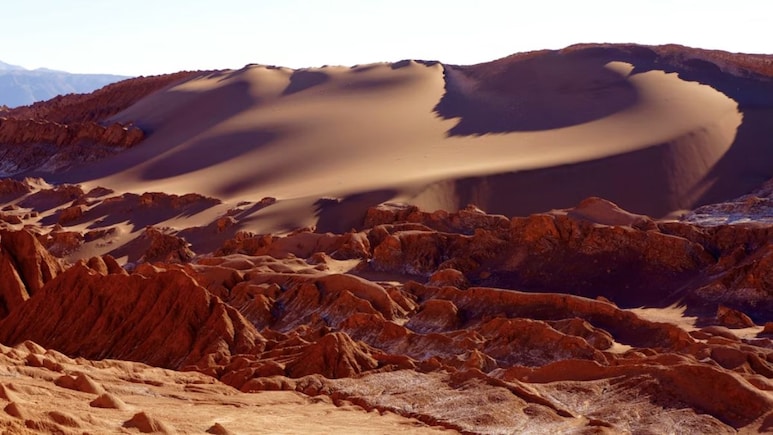
NASA describes Mars as a dusty, cold, and red desert world with a thin atmosphere. Now search for the Atacama Desert, Chile, on Google or social media, and you will be amazed to see how it almost looks like the fourth planet from the sun.
Known as the driest place on Earth, the desert has a rugged terrain, comprising volcanic peaks, salt flats, canyons, vibrant dunes, and stony plains. You can call it a slightly picturesque painting of Mars.
Why Is The Atacama Desert In Chile The Driest Place On Earth
The desert spans over 4,800 square kilometres and contains hardly any traces of water, courtesy of the mountains surrounding the region. The Atacama Desert has been arid for 10-15 million years. Some of its areas did not even see a drop of rain for more than 400 years, from 1570 to 1971.
The other regions only receive rainfall between 0.04 to 0.01 inches, according to NASA. In fact, a team of scientists have studied the region to understand how much water is required for life to survive. Interestingly, researchers undertook this study only to understand the possibility of life on Mars.
The NASA report, published in April 2022, quoted a researcher, "The soils in the extreme arid core region of the Atacama appear to be the most lifeless and Mars-like on Earth."
Since a trip to Mars and conducting a study on it costs millions, the NASA scientists studied the Atacama Desert in Chile. They spotted succulents, like cacti, in the region along the coast, but the rest of the region is without a trace of vegetation.
If you explore any other desert, you will still find cyanobacteria (green photosynthetic microorganisms) that live in rocks or under stones. But even they are missing in the Atacama Desert, making it the driest place on Earth.
Is The Atacama Desert Lifeless
Contrary to popular beliefs, the Atacama Desert region is not entirely lifeless. It might be the driest non-polar place on Earth, but there are a few communities of microorganisms that survive in some parts of its arid terrain.
In 2018, scientists from Washington State University (WSU) visited Chile's Atacama Desert, according to a Times of India report. They found specialised bacteria that could survive in the dry region. Their quality? They can remain dormant for decades, without water, and get reactivated when the region is hit by the monsoon. Once the soil gets moist, they can reproduce.
This even led them to believe that if life can exist in the Atacama region, there is a possibility that Mars might be habitable, too.
How Tourists Can Explore The Atacama Desert, The Driest Place On Earth
The Atacama Desert in Chile is not just a place where scientists can go. It is also frequented by globetrotters who wish to experience the Mars-like ecosystem on Earth. Not only do people explore the destination, but it is also where they find some of the most picturesque spots.
You can camp at the Nevado Tres Cruces National Park, but you will have to carry water bottles. Travellers can hike to Santa Rosa and Negro Francisco lagoons, from where they can witness Nevado Ojos del Salado volcano and towering peaks.
Travel ahead, and you will reach San Pedro de Atacama, the green lung of the desert - a small town located on the banks of the Loa River and surrounded by green carob trees. El Tatio Geysers lie a little further down the road, and it is the biggest geyser field you can witness in South America. People also add Salar de Atacama, the largest salt deposit in Chile, to their itinerary. It is a 90 km stretch of lithium and salt.
The Atacama Desert might be the driest place on Earth, but undoubtedly, it is among the most picturesque destinations that you should add to your 2026 travel bucket list.
Also Read | Lake Natron, The Red Lake In Tanzania That Turns Living Things Into Stone
Track Latest News Live on NDTV.com and get news updates from India and around the world
