





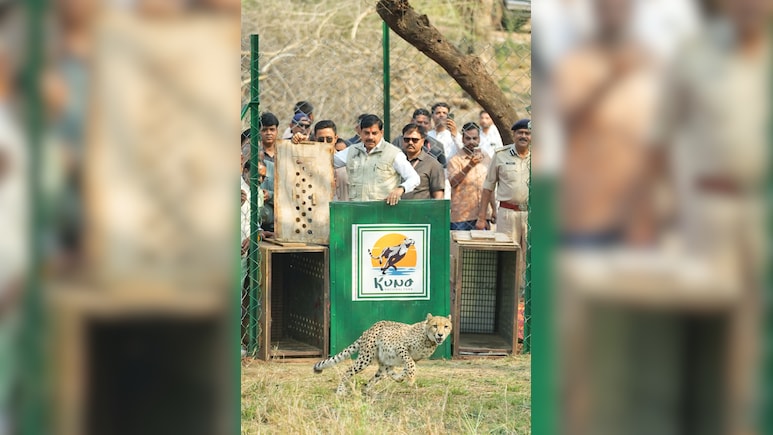
- Two female cheetahs from Botswana were released into Kuno National Park on May 11
- Madhya Pradesh now hosts 57 cheetahs, making it India's leading state in cheetah revival
- Botswana cheetahs add critical genetic diversity to India's growing population
In the sunlit wilderness of Kuno National Park on May 11, history did not roar it sprinted. Two female cheetahs from Botswana, once confined to protective enclosures, finally burst into the open forests of Madhya Pradesh, their first powerful strides symbolising not just freedom, but India's boldest wildlife resurrection gaining fresh momentum.
As their enclosure gates opened, the big cats leapt, bounded and vanished into Kuno's vast landscape - an electrifying moment that transformed Sheopur's forests into the stage for one of modern India's most ambitious ecological comebacks.
For Madhya Pradesh, this was not merely another wildlife event. It was a declaration. The cheetah, once extinct in India, is no longer a visitor. It is reclaiming citizenship.
Chief Minister Mohan Yadav, who released the two cheetahs during his visit to Kuno, described the occasion as a defining chapter in the state's environmental history. Declaring that Madhya Pradesh had embraced the cheetahs as family, he said the state was no longer just participating in conservation it was becoming the heartland of cheetah revival.
From Namibia to South Africa, and now Botswana, the global journey of these cheetahs is steadily converging in the forests of Madhya Pradesh, where Project Cheetah is rewriting the future of species restoration.
With these latest releases, India's cheetah population has now climbed to 57, including 54 in Kuno National Park and three in Gandhi Sagar Sanctuary, turning Madhya Pradesh into what officials proudly call the nation's "Cheetah State".
The Botswana cheetahs are particularly significant because they bring critical genetic diversity, a key factor in ensuring a healthier, more sustainable future population. Wildlife experts believe this broader gene pool could prove crucial in establishing a robust and self-sustaining cheetah landscape not only in Kuno but eventually across multiple sanctuaries, including Gandhi Sagar and Nauradehi.
The rewilding effort is also expanding geographically. According to officials, Kuno's effective cheetah habitat now spans nearly 5,000 square kilometres, with movement patterns already extending toward Rajasthan and across the broader Chambal belt, including Shivpuri, Gwalior and Rajgarh.
The journey to this moment began on September 17, 2022, when Prime Minister Narendra Modi reintroduced cheetahs to Indian soil with the arrival of eight cheetahs from Namibia. South Africa followed with 12 more in 2023. Earlier this year, Botswana added nine additional cheetahs, six females and three males, who underwent quarantine and acclimatisation before entering Kuno's ecosystem.
Now, as the latest two sprints are free, Project Cheetah appears to be moving from cautious experimentation toward tangible ecological establishment.
Track Latest News Live on NDTV.com and get news updates from India and around the world

