





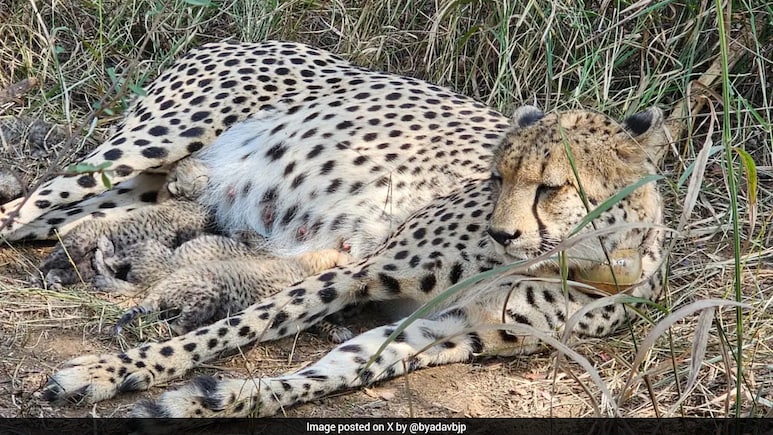
A 25-month-old Indian-born female cheetah, KGP-2, has given birth to four cubs in the Kuno National Park, marking yet another milestone in India's ambitious Cheetah Conservation Project and taking the country's total cheetah population to 57.
This is not just another birth in the wild. It is a moment that reflects continuity, adaptation, and hope. KGP-2 herself represents the second generation of cheetahs born on Indian soil. She is the offspring of Gamini, one of the cheetahs translocated from South Africa as part of the reintroduction programme. Today, as she becomes a mother in the wild, her journey comes full circle, symbolising the project's shift from reintroduction to natural reproduction.
The forest of Kuno, once silent of the fastest land animal, is now witnessing a steady rise in its cheetah family. Just days ago, Mukhi, the cub of Jwala and among the first cheetahs born in India, gave birth to five cubs after learning to survive independently in the wild. Now, with KGP-2 adding four more cubs, the cheetah population is not only growing but also stabilising.
At present, Kuno National Park is home to 54 cheetahs, including adults and cubs, while three others are roaming freely in the Gandhi Sagar Sanctuary in Mandsaur. Officials confirm that both the newborn cubs and their mother are healthy, with veterinary teams closely monitoring their well-being.
Chief Conservator of Forests (CCF) Uttam Kumar Sharma described the development as a "significant step forward," emphasising that the core objective of the project is not just relocation but successful breeding in a natural habitat. "KGP-2 was once a cub here. Today, she is reproducing in the wild. This is a strong indicator that the ecosystem is supporting long-term sustainability," he said.
Chief Minister Dr Mohan Yadav echoed this sentiment, stating that Madhya Pradesh is steadily emerging as a key hub in the global effort to revive cheetahs. "The birth of these cubs in open wilderness proves that our land is conducive for their growth. Our commitment to wildlife conservation is delivering results," he said.
The return of the cheetah to India was once seen as an ambitious, even uncertain experiment. But moments like these quiet births in the wild, unseen by crowds but deeply significant, are turning that vision into reality.
Track Latest News Live on NDTV.com and get news updates from India and around the world

