





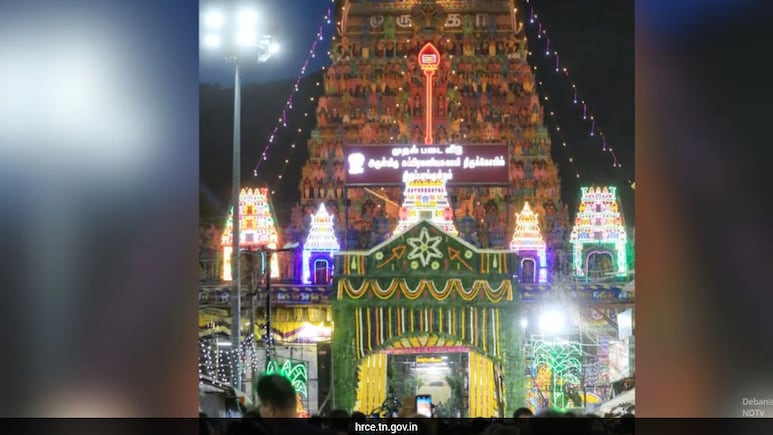
Lawmakers from Tamil Nadu's ruling Dravida Munnetra Kazhagam will table a motion to impeach Justice GR Swaminathan, the Madras High Court judge who ruled on the Thirupparankundram Subramaniaswamy temple case, sources told NDTV Monday afternoon.
The case revolves around the lighting of a festival lamp on one of two ancient pillars, called 'deepathon', on a hill that is home to the sixth-century temple and a 14th-century dargah.
On Monday, after a contentious hearing, Justice Swaminathan overruled protests by the state government and temple officials, and ordered the lamp to be lit on the pillar built halfway up the hill instead of the one at the foot of it, which has been the tradition for over a 100 years.
But the judge reasoned that the upper pillar is also temple property and must, therefore, be included in the ritual. The court emphasised the necessity of the temple asserting possession.
The DMK argued, and continues to argue, that such an order could inflame communal tensions, particularly with an Assembly election less than six months away. It has also pointed that Justice Swaminathan's order reverses a 2017 judgement by a Madras High Court division bench.
The temple did not comply with the court's original order; on Wednesday, December 3, the day of the festival, the lamp was lit at the traditional spot on the lower pillar.
An irked judge, citing non-compliance, then ordered it lit on the upper pillar also, leading to unruly scenes as hundreds tried to march up the hill to light the lamp – backed by armed central security forces – prompting district officials to issue orders banning large gatherings.
Events continued to move at breakneck pace.
On Thursday appeals by the Tamil Nadu government were heard by a two-judge bench of the Madras High Court. Among other points made, the state argued it (and the dargah, the administration of which also objected to the lamp being lit on the upper pillar) should have had 30 days to appeal the original order, i.e., the one on Monday, before the enforcement order.
The state also argued deploying CISF amounted to judicial overreach, noting the force is meant to secure court premises and not enforce the law. It also alleged the petitioner mobilised crowds, disturbed public harmony, and triggering imposition of prohibitory orders.
The petitioners countered by saying police refused security despite a court order and that the state's non-compliance had forced a second court order allowing them to light the lamp.
The court decided against the Tamil Nadu government and on Friday state filed a plea with the Supreme Court, which agreed to hear the matter but has not yet fixed a date.
Politically, the developments have been seen as a setback for the DMK, which already faces accusations of an 'anti-Hindu' stance to appease Muslim voters - a charge it has denied.
Chief Minister MK Stalin hit back on Sunday to accuse the Bharatiya Janata Party, which has re-allied with the DMK's arch-rivals, the AIADMK, for this election, of politicising religious issues.
He said that ritual at the Thiruparukundram temple was conducted – i.e., the lamp was lit on the lower pillar, in line with a long-standing tradition and that his government had never opposed spiritual practices. "… . but some parties have a riot mindset. They are attempting to derail our growth by raising needless issues," he declared.
Track Latest News Live on NDTV.com and get news updates from India and around the world

