





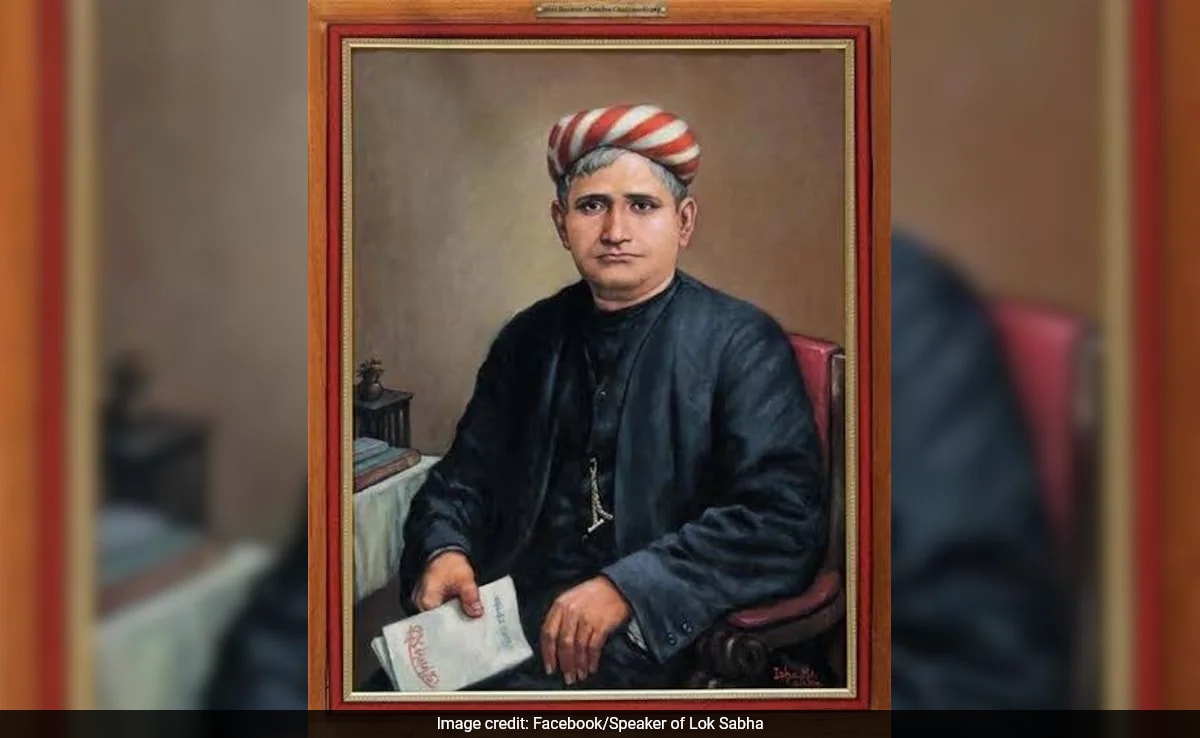
In the vibrant tapestry of India's cultural and political landscape, few figures loom as large as Bankim Chandra Chattopadhyaya. In his seminal work, Anand Math, the genius novelist and poet not only penned the iconic anthem "Vande Mataram" but also crafted a complex narrative that intertwines Mother and Motherland, nationalism, patriotism, spirituality, and identity.
Vande Mataram is a Sanskrit phrase meaning "I bow to you, Mother."
"Mother" referring to the Motherland, Bharat, is the most powerful metaphor ever evoked in the history of modern global literature. Bankim, who was a wordsmith par excellence, creates a poem and a song which renders itself to mellifluous music.
Before we delve into the story and history of Vande Mataram, its revolutionary and electrifying role during the national movement against the colonial British empire, let us briefly consider the debate over Vande Mataram in parliament.
Vande Mataram: A National Resonance In Times Of Elections
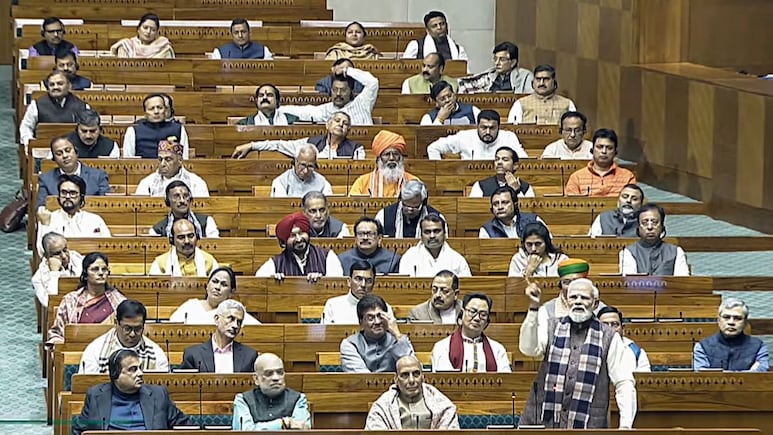
On December 8, parliament buzzed with an energy that seemed almost palpable, as Prime Minister Narendra Modi took centerstage, invoking the spirit of "Vande Mataram." PM Modi's symbolic speech drew from Mahatma Gandhi's admiration for the poem. Recalling Gandhi's gem of an input in the periodical 'Indian Opinion' published from South Africa in 1905, that "Vande Mataram" should be the "national anthem of Bharat," PM Modi evoked a moral imperative.
This historical lineage carved a narrative that sought to connect PM Modi's NDA government with the ideals of freedom struggle, enunciated by the Father of the Nation, Mahatma Gandhi, thus portraying the NDA administration as continuators of a significant nationalist legacy.
In a scathing attack on the Congress, PM Modi said the party broke the national song into parts and thereby weakened its original spirit. The Congress had always rejected the allegation. The Congress party said the 1937 decision to use simply the first two stanzas of Vande Mataram was based on the recommendations of the Congress working committee, which included Mahatma Gandhi, Jawaharlal Nehru, Sardar Patel, Subhas Chandra Bose, Rajendra Prasad, Sarojini Naidu and Maulana Abul Kalam Azad.
Vande Mataram became part of the Congress's formal political culture. In 1896, Rabindranath Tagore sang it at the Calcutta session of the Congress. In 1905, during the Varanasi session, the Congress formally adopted the song for national occasions. In 1907, Bhikaji Cama unfurled the first national flag abroad in the Black Forest area of Sttuttgart in Germany, with the words "Vande Mataram" written across it.
As PM Modi stood in his uniquely dramatic style before parliament, the importance of "Vande Mataram" transcended its historical context, finding new relevance amidst the political landscape of the impending Bengal assembly election scheduled in early 2026.
The juxtaposition of such an iconic verse with the urgency of election strategy was not lost on those observing the national debate on TV all across the country. PM Modi's invocation of the poem was deeply layered, a purposeful melding of culture and politics, nationalism and patriotism, Mother and Motherland, rooted in the very identity of Bharat.
The Story And Historical Context Of The Novel Anand Math
The novel Anand Math is about militant sannyasis (Sanatans) rebelling against British and Muslim forces during the Great Bengal famine in 1770. The magnumopus of Bankim is as replete with dramatic scenes as it is about the delicate nature of renunciation for a justice. But its story of recovering the Motherland's lost glory and standing up and fighting against invaders clearly has a political message of nationalism and anti-colonialism. It struck an immediate chord with people in the late 19th century.
As a poem and later song sung by millions, ironically, the Vande Mataram, was written purportedly as a 'page-filler' for the magazine Bangadarshan in 1875, six years before Anand Math was serialised in the same magazine (1881) and seven years before the novel was first published as a book (1882). Particularly electrifying was Vande Mataram, a war cry straight out of the poet-cum-novelist's heart. Vande Mataram gained in strength independently of the novel. It reconceptualised nationalism as Motherhood in the form of a powerful metaphor.

The time when Vande Mataram really gained currency was during the agitations against the 1905 Partition of Bengal. This was when the expression was first used as a political slogan.
"The chanting [during the August 7, 1905, protest procession against the impending decision in Calcutta] was not confined to Hindus; people of all communities were reported to have been involved," Julius Lipner, in his introduction to the English translation of Anand Math, wrote. A violent police assault in Barisal (now a district in Bangladesh) against protesters chanting Vande Mataram in April 14, 1906, cemented the anti-British, Hindu-Muslim anti-Partition movement.
How Aurobindo Ghose Coopted Vande Mataram?
The overt 'Hinduisation' of the anti-Partition movement came about later with the appearance of the English language revolutionary paper, Bande Mataram, on August 6, 1906. The philosopher Aurobindo Ghose (1892 to 1950), co-opted Bankim's nationalistic poem into a dominant Hindu credo. By 1921, some 10 years after the Bengal Partition was reversed and when many bhadraloks (Bengal elite gentry) started to perceive a Bengali Muslim resentment against the decision, Vande Mataram was being used as a slogan by Hindu rioters against Muslims.
Any Effect On Bengal Election?
This symbolism becomes particularly potent as Bengal debates its Bangla identity in the wake of rapid challenges posed by 15 years of Trinamool Congress's rule in Kolkata under Chief Minister Mamata Banerjee. With state assembly elections looming, PM Modi's evocation of "Vande Mataram" could serve as a rallying cry, a powerful rhetoric for the BJP, reviving a sense of pride and belonging that has, at times, been overshadowed by divisive politics.
By entwining concepts of spirituality and nationalism, PM Modi sought to shape a narrative that elevated the political discourse into a realm of almost sacrosanct commitment. "Vande Mataram," in this discourse, has become not just a poem but a symbol of dedication -- a reminder that true patriotism stems from love for one's cultural roots and heritage.
BJP Adopts Vande Mataram As Steward Of Cultural Renaissance
"Vande Mataram," with its evocative imagery of the motherland, provides a framework for exploring Indian nationalism. In a nation as diverse as India, where identities often splinter along lines of caste, creed, and region, the poem emerges as a unifying force. By reaffirming it in parliament, PM Modi sought to rekindle a sense of collective identity, positioning himself and his party, the BJP, as stewards of a cultural renaissance. This was not merely about reverence for a legacy; it was about forging a path that could galvanize support and rally the masses under a single banner.
Parmar's Vicious Attack On Raja Ram Mohan Roy
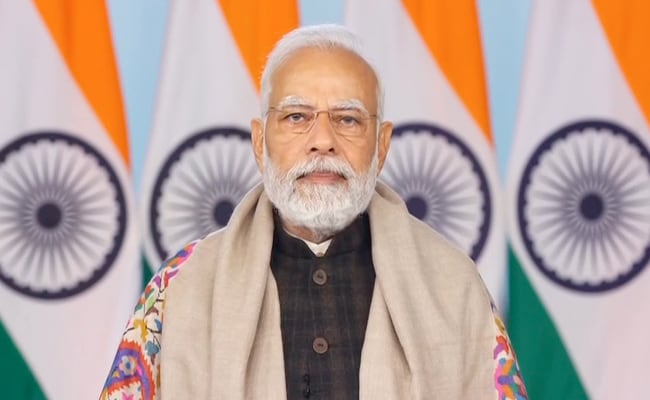
While PM Modi sought to shape a narrative via Vande Mataram that elevated the political discourse into a realm of sacrosanct commitment, some motormouths in the BJP have been busy digging holes into the exalted narrative. In November, during an event to mark the 150th birth anniversary of tribal icon Birsa Munda, Inder Singh Parmar, a minister in the Madhya Pradesh BJP government called Raja Ram Mohan Roy an "angrezon ke dalal" (British agent). Parmar alleged that Roy was involved in a "vicious cycle of religious conversion" through the promotion of English education. The remarks sparked significant controversy and protests, particularly in West Bengal, with the Trinamool and other parties strongly condemning the statements and accusing the BJP of being "anti-Bengali". Later, Parmar offered an apology but not before the damage was done.
The appropriation of Vande Mataram does not occur in a vacuum; it has involved a concurrent denigration of other towering intellectuals like Ram Mohan Roy and Rabindranath Tagore. Roy, heralded as the father of modern India, advocated for rationality, social reform, and gender equality. Tagore, with his nuanced philosophy and artistic brilliance, emphasized universality and humanism. In stark contrast, Bankim's nationalism is often depicted through a lens of exclusivity -- one that resonates more closely with the BJP's vision of a Hindu-centric narrative of India.
This selective interpretation of history raises profound questions about the nature of nationalism evoked by the BJP. The figures who once stood as champions of progressive thought are now overshadowed by an oversimplified narrative that frames Bankim as the singular voice of Indian identity. The BJP's foregrounding of Bankim serves both to consolidate power and to forge an identity that becomes palatable within the framework of Hindutva. It is a narrative rooted in a historical rewriting that seeks to create a monolithic sense of belonging aligned with the party's agenda.

Yet, in this quest for cultural domination, there is an irony that cannot be overlooked. Bankim, who envisioned a unified India, spoke of a composite culture -- a notion that transcends singular narratives of identity. His verses urged a collective awakening, a call to arms that resonated with a diverse populace. The BJP's efforts to truncate this vision into a purely Hindu identity risks fracturing the very essence of his ideals.
In its campaign to elevate Bankim, the BJP also uses symbols and rhetoric that echo the sentiments of a bygone era, tapping into the emotional reservoirs of the populace. The invocation of "Vande Mataram" in contemporary political settings evokes a sense of nostalgia that resonates with the cultural consciousness of the nation. It's an emotional appeal that seeks to bind citizens into a singular narrative of nationalism that, ironically, Bankim himself might have found limiting.
The BJP must steer clear of such denigration of other Bengal nationalist icons. The Bengali bhadralok as well as the common man is too steeped into Bengali nationalist heroes to welcome such divisions between heroes and villains. Such a narrow strategy could backfire in a culturally and historically rich Bengal during the state assembly polls next year.
Conclusion: Convergence Of Past And Present
As the debate unfolded in parliament, the historical weight of "Vande Mataram" intertwined with the currents of modern India. PM Modi's articulation was not merely a nostalgic hark back to a freedom song but a vivid attempt to project an image of unity and strength. By linking the poem to nationalism, spirituality, and motherhood, he carved out a multi-faceted identity for the nation, one that could resonate across diverse demographics.
Ultimately, December 8 marked a significant moment -- a reminder that in the complex tapestry of Indian identity, cultural symbols like "Vande Mataram" are capable of wielding immense power. In the hands of a charismatic leader keen on unifying and mobilizing, these symbols become instruments, drawing upon the past to shape a vision for the future. The echoes of "Vande Mataram" thus surged through parliament, reminding all that in the age of politics, the heart still beats to the rhythm of poetry.
Ajit Kumar Jha is Editor Research with NDTV.
Track Latest News Live on NDTV.com and get news updates from India and around the world

