





The ongoing war involving Iran, the United States, and Israel have rattled financial markets across the world. Oil prices have surged, currencies have swung sharply and equity markets have turned volatile as investors react to the evolving conflict, which has not yet shown any signs of de-esclataion. FOLLOW LIVE UPDATES
For investors, such moments often trigger a familiar question: should portfolios be repositioned during a geopolitical crisis? Most financial advisers believe that the focus should remain on disciplined asset allocation and diversification, instead of making sweeping changes based on daily headlines.
Markets & Wars: What History Suggests
History shows that wars and geopolitical shocks often lead to short-term volatility, but markets have generally recovered over time. A look at the past conflicts suggests that equities frequently rebound once the initial uncertainty subsides.
The key risk in the ongoing Iran War lies in energy markets. A prolonged disruption to oil supplies from the Persian Gulf -- particularly shipping through the Strait of Hormuz -- could push crude prices higher and trigger inflationary pressures globally. Such shocks tend to affect equities, currencies and interest rates simultaneously.
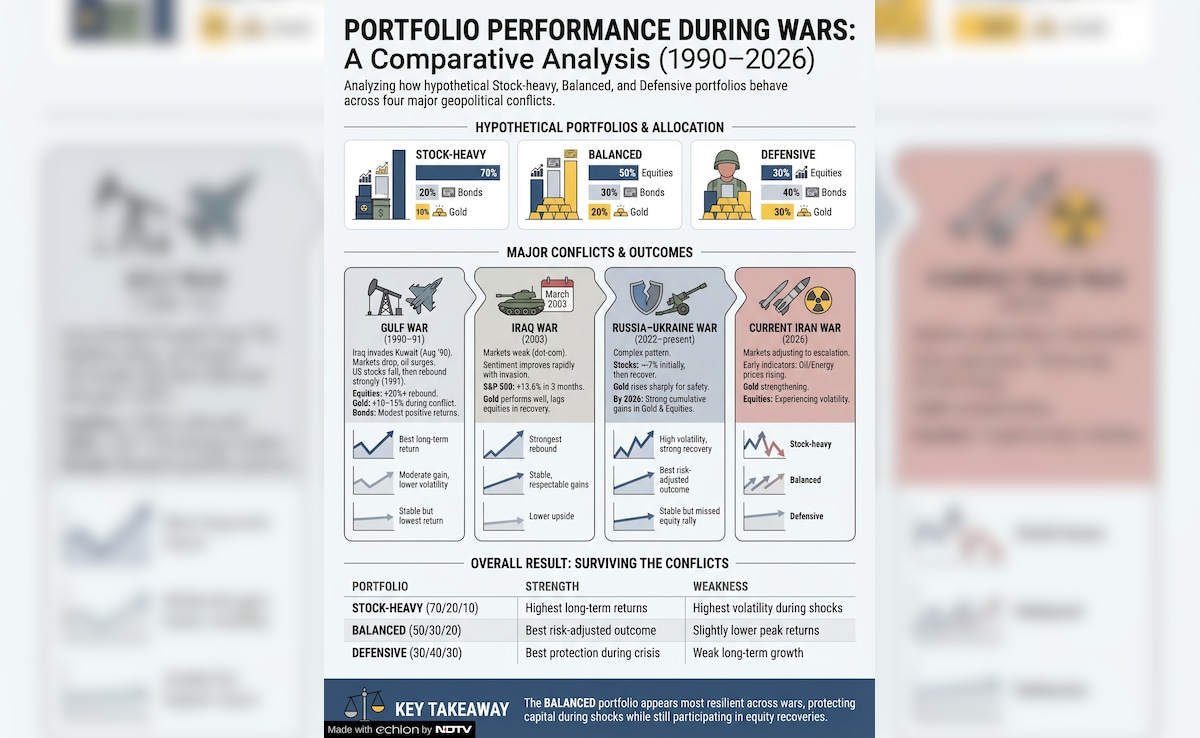
Due to this uncertainty, advisers are recommending balanced portfolios rather than aggressive sector bets. Pearl Agarwal, founder and managing partner at Eximius Ventures, says certain sectors historically tend to perform better during periods of conflict. “Historically, periods of war tend to reward a few specific sectors, particularly defence and the materials ecosystem that supports it, such as metals and industrial inputs. Rather than dramatically reshuffling portfolios, investors should focus on resilience. Long-term private market investments generally remain less sensitive to short-term geopolitical volatility and can benefit meaningfully once economic activity rebounds post-conflict.”
She adds that some sectors could face temporary pressure. “In public markets, exposure to sectors like retail commerce, travel, and global trade may face near-term pressure due to supply chain and airspace disruptions, whereas defence, AI-driven defence technologies, and certain metals could see stronger tailwinds.”
Equities Remain The Core
Despite the volatility, equities continue to form the backbone of most long-term portfolios. Large caps typically offer greater earnings visibility and lower volatility compared with smaller companies during uncertain market phases.
Some wealth managers recommend limited exposure to mid- and small-cap stocks for investors with longer investment horizons, though these segments tend to experience sharper swings during periods of global uncertainty.
Precious metals
Gold has traditionally acted as a hedge during geopolitical stress, currency weakness and inflation. Precious metals often move differently from equities, which helps stabilise portfolio returns during market drawdowns.
Silver, while more volatile than gold, also benefits from strong industrial demand in sectors such as solar power, electronics and electric vehicles. Nikhil Aggarwal, founder and group CEO of Grip Invest, says investors should prioritise stability when geopolitical risks rise. “In wartime scenarios, investors should prioritise capital preservation through diversification, focusing on defensive assets that hedge inflation and volatility from oil spikes and supply disruptions. Investors can allocate a meaningful portion of the portfolio to relatively stable assets like government bonds, corporate bonds, and structured debt products that offer predictable returns with lower risk.”
He adds that precious metals remain an important hedge during such periods. “Investors can also choose to invest in gold & precious metals. These act as a natural hedge against both inflation and currency depreciation, both of which tend to accelerate during prolonged conflicts.”
Role Of Debt & Liquidity
Periods of uncertainty often increase the appeal of fixed-income investments, particularly when interest rates remain elevated. Aggarwal notes that investors should ensure adequate liquidity and maintain exposure to fixed-return instruments.
“Maintaining adequate liquidity is critical. War situations can be unpredictable in duration and outcome. Having 10-15% in liquid assets ensures you can capitalise on opportunities when the market dips sharply.” Aggarwal also recommends shifting towards shorter-duration debt instruments. “Redirect new investments and rebalance existing holdings towards short-duration funds (1-3 years) or money market funds. These categories minimise interest rate risk during market volatility.”
'Core & Satellite' Model
Another approach gaining traction among advisers is the "core-and-satellite" model. Under this framework, around 70–75% of the portfolio forms the core, consisting of diversified large-cap or flexi-cap funds along with a modest allocation to high-quality debt funds.
The remaining 25–30% can be deployed tactically in themes that may hold up better during geopolitical stress, such as domestic consumption, infrastructure, pharmaceuticals or gold-linked instruments. This structure keeps the bulk of the portfolio tied to long-term growth while allowing flexibility to respond to changing market conditions.
Avoid Sudden Moves
One consistent message from market history is that reacting impulsively to geopolitical events rarely works. Investors who attempt to trade around wars -- buying energy stocks, defence companies or commodities after prices have already surged -- often struggle to time their exits.
Instead, advisers recommend staggered investing and periodic rebalancing. Aggarwal notes that spreading investments over time can help manage volatility. “Rather than deploying a large lump sum, use Systematic Investment Plans (SIPs) or staggered investments to war resistant sectors in equities. This averages out the cost basis and reduces the impact of any single rate event.”
The Bottom Line
There is no universal formula for investing during geopolitical crises. However, most advisers converge on the importance of diversification and liquidity. Aggarwal suggests a broadly balanced allocation during uncertain global conditions.
“While asset allocation depends on individual risk appetite, a balanced approach during uncertain global conditions could mean maintaining 30-35% in equities for long-term growth, 35-40% in fixed-return assets such as bonds or debt funds for stability and capital preservation, 10-20% in gold or silver as a hedge against geopolitical and inflation risks, and 5-10% should be cash or liquid assets as war markets are volatile and create sharp, short-lived dips that reward investors with cash to deploy,” said Aggarwal.
Above all, investors are urged not to let geopolitical headlines dictate their financial decisions. Markets have endured wars, political crises and economic shocks before. While volatility may persist in the near term, disciplined asset allocation -- rather than frequent portfolio shifts -- remains the strategy most advisers recommend.
(Disclaimer: Investors should assess their financial goals, risk tolerance and investment horizon, and consult a qualified financial adviser before making any investment decisions.)
Track Latest News Live on NDTV.com and get news updates from India and around the world

