




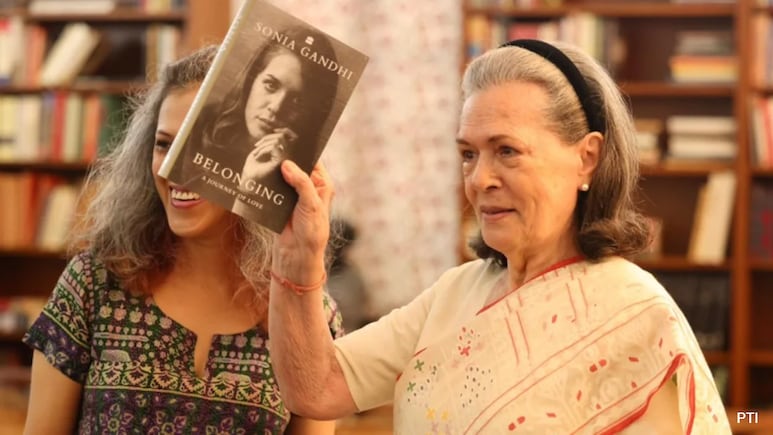
Sonia Gandhi's long-awaited memoir, 'Belonging: A Journey of Love', has offered readers an account of her personal journey into the Nehru-Gandhi family, but the book, which hit the stands on Tuesday, has also come under scrutiny for some factual errors.
At least three historical details in the passages provided from the memoir appear to be incorrect. The errors appear in different chapters of the book, which traces Sonia Gandhi's transition from a young Italian woman who married Rajiv Gandhi to one of the most influential political figures in independent India.
Anna Hazare's Anti-Corruption Movement: 2011, not 2012
One of the apparent errors appears in Chapter 33, on page 461, where Sonia Gandhi discusses the anti-corruption movement led by Anna Hazare, which became one of the biggest political challenges faced by the Congress-led United Progressive Alliance (UPA) government.
READ | "Take A Good Look": Sonia Gandhi's Most Harrowing 2002 Gujarat Riots Memory
In the memoir, Gandhi traces the emergence of Hazare and the India Against Corruption movement to 2012.

"In 2012 a well-known activist from Maharashtra, Baburao 'Anna' (Marathi for 'father' or 'elder brother') Hazare, emerged as the figurehead of a movement that titled itself 'India Against Corruption'," the book reads.
READ | "We Fell In Love With Him": Sonia Gandhi On 1st Son Who Died Just After Birth
However, the movement that brought Hazare to national prominence began in 2011, not 2012. Its defining moment came on April 5, 2011, when the activist began an indefinite hunger strike at Jantar Mantar in New Delhi, demanding the introduction of a stronger anti-corruption law through the Jan Lokpal Bill.
The India Against Corruption campaign also brought together several prominent activists and public figures, including Arvind Kejriwal, Kiran Bedi and Baba Ramdev, although their roles and demands were not identical.
READ | Sonia Gandhi's Interview With NDTV In 2004, Now Seen From Her Memoir's Lens
RSS Was Founded In 1925, Not 1921
Another factual discrepancy appears in Chapter 24, on page 338, where Sonia Gandhi discusses the ideological foundations of the RSS and its political relationship with the BJP.
"The RSS, founded in 1921, dreamed of a 'Hindu nation' that would replace constitutional ideals of equality, pluralism, and secularism with second-class citizenship for Muslims, Christians, and other religious minorities in India," she writes.
READ | Why Sonia Gandhi Begged Husband Not To Enter Politics But Didn't Stop Son
The founding year mentioned in the memoir is incorrect. The RSS was established on September 27, 1925, in Nagpur, then part of British India, by Keshav Baliram Hedgewar.
A doctor by profession, Hedgewar founded the organisation with the objective of building unity and discipline within the Hindu community. The RSS subsequently developed into one of India's most influential ideological and organisational movements.
Ahmed Patel Died In 2020, Not 2022
Perhaps the most significant error was made in connection to one of the most influential figures in the Congress organisation during Sonia Gandhi's years as party president. In Chapter 29, on page 401, Sonia Gandhi recalls veteran Congress leader Ahmed Patel, who served as her political secretary and was widely regarded as one of her closest and most trusted political aides.
READ | In Memoir, Sonia Gandhi Describes Fallout With "Choti Bahu" Maneka
"He came to wield considerable influence across the political spectrum but could be unforgiving towards those who crossed him. He remained my political secretary till sadly he fell norim to the Covid epidemic in 2022, leaving a vacuum in the party and an absence I felt personally," she writes.

The year of Patel's death mentioned in the passage is incorrect. He died on November 25, 2020, after suffering multiple organ failure following complications related to Covid-19.
Patel had tested positive for Covid-19 and was admitted to Medanta Hospital, where his condition deteriorated. He was subsequently placed in the intensive care unit before his death.
His body was taken to his ancestral village in Gujarat, where he was buried.
Gujarat's Capital Is Gandhinagar, Not Ahmedabad
In one chapter where Sonia Gandhi writes about the 2002 Gujarat riots, she incorrectly names Ahmedabad as the capital of Gujarat.
Sonia Gandhi, who was then the Leader of the Opposition in the Lok Sabha, described travelling to Ahmedabad as part of an all-party parliamentary delegation, visiting relief camps housing survivors and witnessing the physical and emotional devastation inflicted on families caught in the violence.
"When I was leader of the opposition in Parliament, I met the victims of many tragedies, and each time I was haunted by the misery I had witnessed. In 2002, the state of Gujarat was ravaged by communal riots; much of the carnage was televised live with the advent of cable TV and shook the country with its fearsome images. The riots were triggered when four coaches of the Sabarmati Express were set on fire and fifty-nine pilgrims dead [sic]. The train was returning to the state capital Ahmedabad [sic] from Ayodhya carrying Hindu kar sevaks-volunteers for the Ram temple," Sonia Gandhi writes in her book.
Gandhinagar has been the capital of Gujarat since 1970.
Track Latest News Live on NDTV.com and get news updates from India and around the world

