





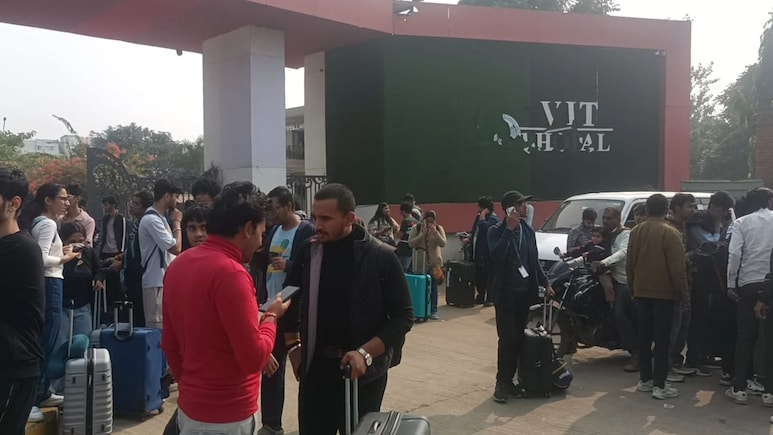
Five days after violent unrest shook VIT University in Sehore district, the Madhya Pradesh Higher Education Department has finally issued a show-cause notice to the university management, giving it seven days to explain serious violations. If the reply is unsatisfactory, the department has warned of disciplinary action under Section 41(2).
The notice is based on a damning report submitted by a three-member inquiry committee of the MP Private University Regulatory Commission. NDTV has accessed the report, which reveals disturbing conditions, administrative failure, and shocking mismanagement at one of the state's biggest private universities.
The panel found the university hostel mess in an "extremely unsatisfactory" state. Students complained about the poor quality of food and beverages, contaminated water, and foul smell in the drinking water. The management admitted that between November 14 and 24, 23 male students and 12 female students contracted jaundice, strongly suggesting water contamination.
The report paints a picture of a university running like a fortress of fear. Students told the committee they were threatened with harassment for complaining, warned their I-cards would be confiscated, threatened with being barred from exams, told they would receive poor marks in practicals, and, in a shocking incident, even the District Chief Medical and Health Officer (CMHO) was made to wait for two hours at the campus gate.
The committee stated that student dissatisfaction grew steadily, but the management ignored warnings. As tensions escalated, the administration called the police at 2 am, further inflaming the situation.
Under Secretary Viran Singh Bhalavi, in the notice, warned that the government would take unilateral action if the university fails to provide a proper explanation.
The crisis began when a student was allegedly assaulted by hostel staff after complaining about contaminated water and food. What followed was unprecedented chaos.
On November 25, around 4,000 students gathered in protest.
Within minutes, buses and vehicles were torched, an ambulance was vandalised, windscreens were shattered and fire spread across the parking lot.
Police forces from five stations had to be deployed to bring the situation under control. The university has since been shut until December 8, and most students have returned home.
Earlier, the PHE Department collected 18 water samples. Four tested positive for harmful bacteria, including E coli. PHE official Pradeep Saxena confirmed contamination in water taken from tube wells, ground-level tanks and RO systems
The Food and Drug Administration collected 25 food samples from the hostel mess - pulses, rice, oil, flour, semolina, and more.
Among the most alarming revelations, 11 campus blocks were operating without fire NOCs, putting thousands of students at severe risk. Gross negligence by management directly contributed to the crisis.
The investigation team, Hamidia College Principal Dr Anil Shivani, MVM College Professor Sanjay Dixit, and GMC Professor Dr Lokendra Dave, concluded that the entire chain of events was a result of deep-rooted administrative failure.
Track Latest News Live on NDTV.com and get news updates from India and around the world

