



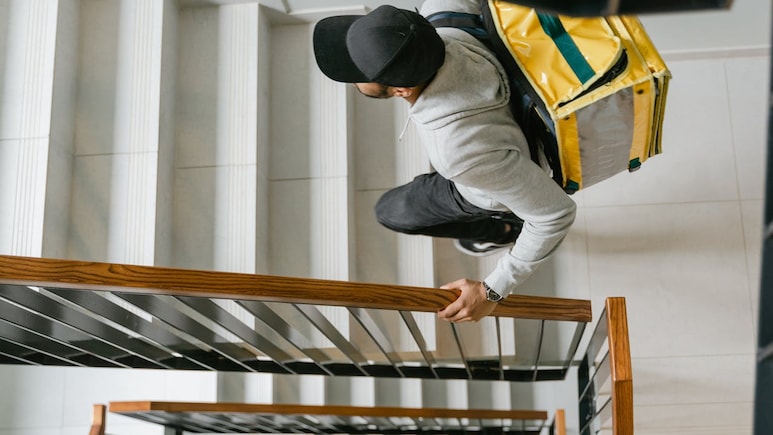
- Blinkit drops 10-minute delivery claim after Labour Ministry raises gig worker safety concerns
- Delivery times now consider traffic, dark store proximity, and order volume
- Shoppers accept longer delivery times, gig workers say it benefits them
In the fast-paced world of India's quick commerce boom, the "10-minute delivery" tagline was more than just marketing. It symbolised a revolution in convenience, powered by hyper-local dark stores and optimised logistics. But, as Blinkit bows to pressure from the Labour Ministry and drops this claim, the landscape is shifting in view of widespread concerns over gig workers' safety.
A rider on conditions of anonymity said, "I was part of the nationwide strike. There have been umpteen times I was humiliated by customers just for a five-minute delay in delivery. I even had a minor accident because I was caught up and kept getting calls from the customer while I was driving. I was too scared they would complain. It's a big thing that the government has acknowledged our concerns, intervened, and brought relief for the gig workers who are serving the public but remain so invisibilised."
'Don't Feel Bad If Deliveries Take Longer'
As Blinkit revises its branding to emphasize "30,000+ products delivered at your doorstep" instead of rigid timelines, deliveries will increasingly reflect real-world factors like dark store proximity, traffic, and order volume rather than enforced targets.
"At times, the 10-minute thing was just for show; many times it took 20-25 minutes during high-demand hours. Now that it's officially gone, it's actually better. Customers who are habituated to these apps will learn patience. No more pressure on the delivery boys. If my children need milk or veggies urgently, I will still order from these apps. I don't feel bad if it takes longer to deliver," said Luna Ghosh, 42, a homemaker.
Read: No More 10-Minute Delivery Promise: Labour Ministry To Blinkit, Swiggy
This change in the delivery model means no more blanket 10-minute guarantees that could indirectly pressure riders through customer expectations or incentive structures. Operations remain efficient—picking and packing still happen swiftly, often in under three minutes, with most rides covering short distances at moderate speeds—but the absence of prominent time branding reduces the implicit urgency.
Denser Dark Store Networks
Riders face less algorithmic or perceptual push to rush, potentially lowering accident risks and stress levels. As other platforms like Zepto, Swiggy Instamart, and Zomato are expected to follow suit, the industry is moving toward sustainable logistics: denser dark store networks for naturally faster service in high-density areas, while accepting longer waits in outskirts or during peaks, all backed by stronger social security measures under the Code on Social Security.
Ramesh Chandra, a retired government officer, 78, shared: "I've always enjoyed buying vegetables and meat from the market. But now my legs don't work properly anymore, so going to the local shop has become very difficult. Blinkit is a big help. Now that the 10-minute promise is removed, it doesn't matter to me. As long as the delivery boy stays safe and the order arrives properly, that's what counts. I've seen how these delivery boys overspeed to deliver on time, but that's no good. The government did the right thing."
Read: "We Have Won": Raghav Chadha On Centre's Direction To Halt 10-Minute Deliveries
For Manasvi, 20, a college student who lives in the hostel, late-night Maggi, cold drinks, or pads are a necessity, and apps like Blinkit and Zepto mean everything. "It's a good thing that the 10-minute rule has been removed. We will still order all the time, especially if there are good offers. Time-bound deliveries impose undue pressure on riders. I have seen my friends become extremely rude when delivery boys arrive late," she said.
'Good News For Gig Workers'
Delivery partners, or gig workers, voice profound relief at the shift, having long highlighted the toll of time-bound pressures.
Union leaders celebrated the win, with Shaik Salauddin of the Telangana Gig and Platform Workers' Union (TGPWU) and the Indian Federation of App-Based Transport Workers (IFAT) calling it "a victory for all gig and platform workers who protested on New Year's Eve, demanding better pay, safety protection and social security," noting how the model had forced "dangerous road behaviour, extreme stress, and unsafe working conditions."
Pritam, a Blinkit rider, told NDTV, "We haven't been informed about this change in branding, but it's surely good news for all of us. I deliver in Noida, where dark stores are close by, so I'm anyway delivering items in under 10 minutes."
The Q-Commerce Reality
Though the government directive mandates dropping the "10-minute delivery" claims, this would impact only the marketing language and not operations. A rigid 10-minute guarantee was never a functioning factor for quick commerce platforms, unlike Domino's deliveries that promised free pizza if it took longer than 30 minutes to deliver.
Rather, the delivery times were always dynamic, determined by distance, store density, rider availability, and batching logic. Thus, the directive does not change the dark store operations, routing algorithms, rider workflows, or fulfilment speed on the ground. The only change is in the branding: from time-bound delivery promises to softer claims around faster delivery.
Consumer behaviour is unlikely to change since demand is driven by convenience and not time-bound promises. Speed will remain a competitive advantage for firms, but it will be pursued through network density and efficiency, rather than promises.
Zomato Boss's Explanation
Zomato founder Deepinder Goyal had earlier explained that the 10-minute delivery promise was enabled by store density and planning, and not by forcing delivery partners to ride faster.
He had highlighted how dark stores (compact warehouses stocked with essentials) are strategically placed near residential areas, allowing items to be picked and packed in just two-and-a-half minutes. Delivery partners then typically cover less than two kilometers at an average speed of 15 km/h.
Crucially, Goyal noted, "Delivery partners are not shown the promised delivery time on their app," emphasizing that the system relies on logistics efficiency, rather than individual pressure.
Track Latest News Live on NDTV.com and get news updates from India and around the world

