





The 2027 Punjab assembly election campaigns will not only discuss 'Udta Punjab' [Drug-hit Punjab], 'Darta Punjab' [Fear-stricken Punjab], or 'Berozgar Punjab' [Unemployed Punjab], but also 'Kangal Punjab' [Bankrupt Punjab]."
The state continues to witness a new wave of socio-economic, governance and fiscal stress, which has been heavily debated from past two decades. The people of Punjab gave a historic mandate in 2022 to the Aam Aadmi Party (AAP) which promised a 'Rangla Punjab' (vibrant Punjab). As the AAP government is about to complete its tenure the same issues with renewed challenges have cropped up and will fuel the future debates.
Politically, the doles like Mukh Mantri Mawan Dhiyan Satkar Yojana, free power and Mukh Mantri Sehat Yojana (MMSY) have worked for the ruling AAP to some extent but have severely stressed Punjab's finances.
Critics and analysts point out that funding a universal cashless health scheme for roughly 65 lakh families, free 300 units of power to nearly 62 lakh households, and financial assistance between Rs 1000 to Rs 1500 per month to 68.5 lac women have increased Punjab's already heavy debt.
These doles cost roughly Rs 17,071 crore annually, and consume over 15 percent of the state's total projected revenue receipts. This spending will fail to generate compounding economic returns because it is purely consumption expenditure.
The economists have cautioned that prioritising non-asset-creating consumption payouts limits the state's ability to expand its long-term tax base, leaving Punjab dependent on continuous borrowing to meet recurring commitments.
Punjab's dole basket has more to be counted. In addition to above schemes the state is also spending another 22 per cent of its budget i.e. over Rs 18,211 cr on Agriculture power subsidy, industrial power subsidy, free bus travel scheme for women, social security pensions ,subsidised food grains and doorstep ration, Aam Aadmi Clinics and urban water and sewerage charge exemptions.
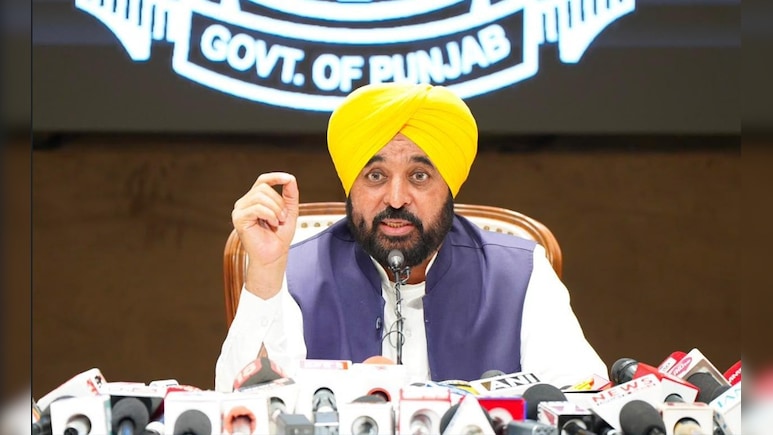
Chief Minister Bhagwant Mann's public stance on Punjab's debt is consistent and largely defensive. He places the primary responsibility on previous governments and projects confidence that Punjab will clear all debt.
"The previous government left behind Rs 3.5 lakh crore in debt. But where did they spend that money? I am building roads, fixing government schools, giving money to universities, clearing the debt of the electricity board, building hospitals, and giving jobs," he says.
The liquidity stress in Punjab
The Aam Aadmi Party had promised to create a 'Rangla Punjab' but the financial data presents a different reality.
Punjab 2026-27 State Budget says AAP government's total accumulated loan since taking office in March 2022 is projected to exceed Rs 1.65 lakh crore by the end of the current fiscal year. State's debt is nearing Rs 4.50 lakh crore. This shows that instead of financial restructuring and taking austerity measures the state government continued the past practice of running on loans.
The political parties eager to dethrone AAP and form the next government in Punjab will inherit a financial crisis so severe that 70 to 80 per cent of the budget will be devoured by loan repayment and interest payments, leaving the remainder for the freebies and other committed liabilities.
With meagre or low budgetary provisions funding the doles, the present and successive Punjab governments are notorious for diverting development funds to areas where sufficient money is not available. The Punjab and Haryana High Court recently stayed the diversion of construction workers' welfare corpus to fund the cash dole scheme Mukh Mantri Mawan Dheeyan Satkar Yojana.
Another embarrassment also came from the High Court when it slammed the AAP government for not releasing the arrears of Dearness Allowance to the six lakh government employees and pensioners and dismissed the state government's claim that the employees were already getting fat salaries. The state had also requested that the DA arrears be paid in instalments over five years which the court rejected. The fund starved AAP government was struggling to arrange Rs 14,000 crore as the court had set a 16-day deadline.
The court also slammed the AAP government for ruthless spending on advertisements which has been banned till the DA arrear payment is released to the employees.
Previously, the opposition parties had also accused the state government of utilizing State Disaster Response Fund allocations for publicity and general state expenditures instead of providing relief to the flood affected people. The central grants under the 15th Finance Commission, intended for rural infrastructure development were also allegedly diverted to a reverse pooling account to pay rural power and water bills.
Another example pointing to a clear liquidity stress in Punjab is the delayed disbursement of monthly salaries in many departments.
The Union Government has also slashed Punjab's borrowing limits, citing fiscal mismanagement after the state's revenue deficit breached statutory limits, by over Rs 16,600 cr.
Punjab Finance Minister Harpal Cheema blames previous governments for the financial mess they created.
"Our state finances suffered significantly due to the stoppage of the Central GST Compensation regime and the reduction in Revenue Deficit Grants compared to past tenures. Regarding the pending employee arrears-such as the Rs 14,191 crore Sixth Pay Commission arrears-this liability was entirely created between 2016 and 2022 by previous governments. While the previous SAD-BJP and Congress administrations raised loans at exorbitant interest rates of 11% to 12%, our AAP government has managed to secure loans at much lower rates of around 7%. Despite the heavy burden of servicing old debt, we have demonstrated strict fiscal discipline by successfully bringing down the state's debt-to-GSDP ratio from 48.25% in 2022 to 44.47%," Cheema says.
What should have been done to stop Punjab turning into a pauper state?
Experts say that completely eliminating both schemes - the free 300 units and the Mawan Dheeyan Satkar Yojana schemes -may be politically unrealistic and socially undesirable as these were part of the AAP's poll manifesto and guarantees.
Prof Varinder Sharma, Director, Institute of Development and Communication says the state government could have saved public funds by not extending the benefits of these schemes to all domestic , income tax payers in particular and the women who belong to high income groups.
"Offering freebies has become a compulsion for political parties who will go to any extent to attract votes. Women are not only being paid Rs 1000 to Rs 1500 per month but also receive free bus travel. The free 300-unit electricity scheme and monthly payments to women will consume 15 per cent of the budget. Rationalising these two programmes would not solve every fiscal problem but would, however, restore a meaningful margin of manoeuvre," he says.
Prof Sharma also adds that restricting free power strictly to small and marginal farmers and genuinely low-income domestic consumers, while introducing graded tariffs for higher consumption and larger holdings, could realistically cut the subsidy bill by 40-60 per cent.
" Even a conservative 50 per cent reduction would free Rs 7,750-9,000 crore annually. Converting the universal monthly transfer into an income- or asset-based safety net-excluding higher-income households-could reduce outlays by a similar proportion, releasing another Rs 4,000-5,000 crore a year," he adds.
Track Latest News Live on NDTV.com and get news updates from India and around the world

