





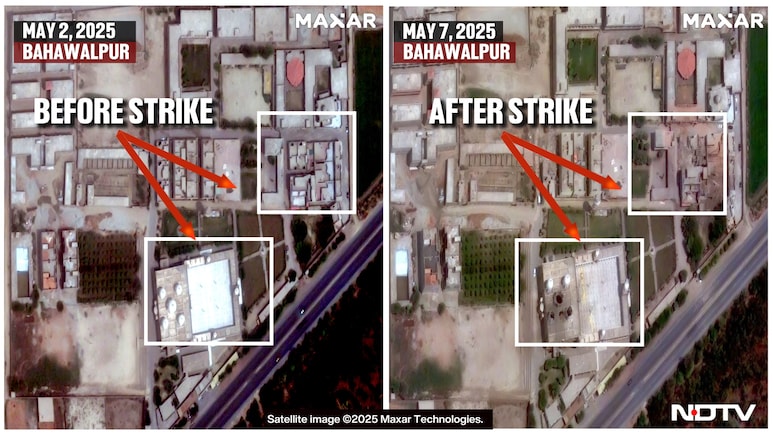
Exclusive visuals and intelligence inputs accessed by NDTV point to a striking revival of the Pakistan Sponsored Terror Group Jaish-e-Mohammed headquarters in Bahawalpur, raising fresh questions over Islamabad's continued protection and patronage of a terror organisation designated by the United Nations and the United States.
The sprawling Markaz Subhanallah complex, badly damaged in India's precision strikes during Operation Sindoor last year, has now been extensively rebuilt. What was left scarred by missile impacts has been transformed with new construction, plaster, paint and polished marble, according to visuals accessed exclusively by NDTV.
The reconstruction appears to have erased much of the physical evidence of the damage inflicted during the operation. Sections of the central hall that had suffered deep impact damage have been repaired, with craters filled and structural portions restored. The facility, once visibly battered, now appears ready to resume its role as a major centre associated with JeM's activities.
The scale and speed of the restoration are significant because the complex is not an ordinary religious or residential site. It has long been identified with JeM, an organisation designated as a terrorist group by the UN and the US. The rebuilding therefore raises the larger question of whether Pakistan's security establishment is merely tolerating the group or actively enabling the infrastructure that sustains its operations.
According to intelligence inputs cited in the NDTV report, the Pakistani establishment provided PKR 25 crore to JeM through cash instalments. Of that amount, approximately PKR 11 crore was reportedly allocated for rebuilding the central hall. If borne out, the funding would represent a significant indication of state support flowing towards the restoration of a facility linked to a globally designated terrorist organisation.
The rebuilding has extended beyond the main complex. Structures damaged during Operation Sindoor, including the Madrasa Al-Sabir, described as an indoctrination centre, and residential facilities associated with JeM commanders, have reportedly been demolished or cleared. New construction has subsequently taken place at the site.
The revival also highlights the continued importance of the JeM leadership network.
With founder and chief Masood Azhar reportedly incapacitated by illness, operational responsibilities at the headquarters are said to have shifted towards his brothers, including Talha Al-Saif and Mohinuddin Aurangzeb, alias Ammar Alvi.
Intelligence inputs indicate that Masood Azhar and his brother Rauf Asghar continue to remain beyond the reach of Indian agencies while allegedly enjoying protection within Pakistan. Their reported presence in the Nawabshah area of Sindh reinforces longstanding Indian allegations that Pakistan provides safe haven to wanted terrorist leaders.
The reconstruction of Markaz Subhanallah consequently carries a significance far beyond bricks, marble and fresh paint.
It suggests that the destruction caused by Operation Sindoor may have disrupted JeM's infrastructure, but has not eliminated the ecosystem that sustains it.
For India, the development adds to concerns that Pakistan's counter-terrorism commitments remain fundamentally at odds with the continued survival, financing and rebuilding of infrastructure associated with groups targeting Indian interests. The renovated Bahawalpur complex could therefore emerge as yet another symbol of what New Delhi has repeatedly described as Pakistan's enduring state-backed support for cross-border terrorism.
Track Latest News Live on NDTV.com and get news updates from India and around the world

