





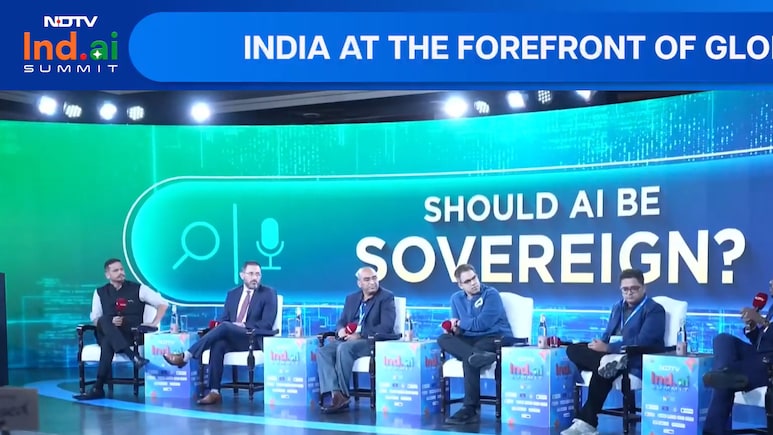
At NDTV's Ind.ai Summit Wednesday, four prominent business leaders and investors from the world of Artificial Intelligence dissected sovereignty for an AI-driven world, urging India to rethink control beyond borders to encompass data, culture, and individual agency.
Sovereignty operates on multiple levels, Raffi Krikorian, Chief Technology Officer of mozilla.org, argued - from national governments navigating diverse global value chains to corporations and even citizens protecting their digital footprints. In an era where AI algorithms shape personal choices and national strategies, relinquishing control at any layer erodes autonomy.
"I think sovereignty is important at every single level. So, I think one question is sovereignty at the government level... value chains are different across every level in the world and it is different for India. The difference matters but I think it also matters down to the individual level," he said.
Arun Subramaniyan, Founder and CEO of Articul8, framed it as one side of a coin, balanced by cultural heritage akin to diplomatic soft power. Nations fiercely guard strategic assets while selectively sharing knowledge to build global influence. Corporations, however, remain woefully unprepared, their security mindset softened by breakneck innovation that outpaces traditional defences.
"I feel it is only one side of a coin which I equate to defence of a nation. It is the same thing for defence of corporations. The other side is heritage which I would equate to diplomacy. One is something you want to share in terms of soft power and the other is something to use, to secure, and also deter. We need to be careful about both."
"Countries are grappling with this as we speak but companies are far from even thinking about it because security landscapes went from 'I want to secure everything' to 'I cannot because things are moving so fast'. Talking about sovereignty without heritage is as dangerous as security without diplomacy."
The conversation spotlighted data "neo-colonization," echoing warnings from former NITI Aayog CEO Amitabh Kant - that global AI firms offer free tools to extract local data, then sell back premium models trained on it. Building sovereign AI requires not just indigenous models but distribution networks and feedback loops to recycle value domestically.
Siddharth Bhatia, Co-founder and CEO, Puch AI, made that point and spoke about sovereign distribution, saying, "Everyone is focused on India doing great work on the models aspect and building sovereign models. But at the same time we feel this is incomplete without sovereign distribution as well."
Linguistic diversity intensified the stakes. India's over 19,000 dialects-per census data-represent thousands of subcultures demanding AI that works in local tongues and contexts, not just dominant languages. Failing here marginalizes communities, deepening internal divides.
Manu Chopra, CEO, Karya, said, "India has over 19,000 unique dialects, based on the last census. Language is like a dialect with an army, so at least 19,000 unique subcultures... we need to make sure our models work for. So I define sovereignty not just as making world class AI models but also making sure they work in all of these languages and contexts."
Looking ahead, experts called for structural ambition over catch-up tactics. While infrastructure gaps persist, India's timing is ideal to pioneer unsolved AI challenges over the next two decades. Sovereignty isn't about arriving late; it's about redefining the game on its own terms-from data provider to global innovator.
Anagh Prasad, Vice President, Accel, said, "What we're talking about right now is mostly LLM. i.e., large language models, and research around that. Yes, it is very important. Okay we need to catch up and build infrastructure and so on... but if we want to enable a long-term shift then India needs to be ambitious and we have to shed the mindset we are late. Don't think we are."
NDTV Ind.AI highlights India as a country that is not catching up in AI, but leaping ahead. As the global AI landscape evolves, the world is increasingly looking to India not just for scale, but for leadership and direction.
The NDTV Ind.AI Summit brings together policymakers, industry leaders, innovators, and thinkers to shape an AI future that is rooted in human values and ethical responsibility.
Built on two core pillars - India's human-centric AI agenda for the world and safe, responsible and impact-driven AI - the summit champions a people-first approach. It envisions AI as a force that elevates humanity, drives inclusive growth, and safeguards societal well-being while accelerating innovation.
Track Latest News Live on NDTV.com and get news updates from India and around the world

