





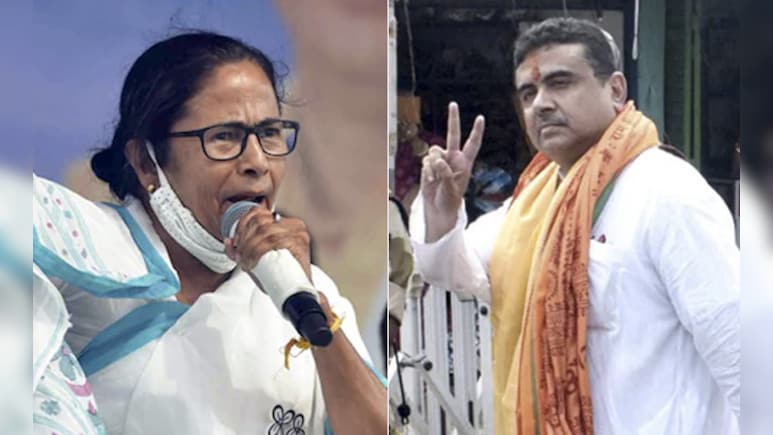
Nandigram has turned into one of the most closely watched political battlegrounds in West Bengal ahead of the assembly election in the state. The high stakes contest is between Suvendu Adhikari, the BJP's Leader of Opposition, and Pabitra Kar, a former aide of Adhikari who is now contesting as a candidate of the ruling Trinamool Congress. People view the election as a continuation of the dramatic 2021 battle, when Adhikari defeated Chief Minister Mamata Banerjee in Nandigram with a narrow margin.
Adhikari is trying not just to keep Nandigram, but has raised the stakes by challenging Mamata Banerjee from Bhabanipur, her stronghold in south Kolkata, turning the move into a direct political showdown between the two leaders.
The BJP sees Adhikari - Mamata Banerjee's former aide who switched sides ahead of the 2021 election -- as a strong figure capable of challenging her dominance in Bengal. The Trinamool remains confident about the strength of its leadership and organisational base.
The election schedule has also added to the intensity of the contest. Polling in Nandigram is scheduled for April 23, while Bhabanipur will go to polls on April 29. The results will be announced on May 4.
Yesterday, Suvendu Adhikari went to Nandigram to file his nomination, turning the occasion into a major political event. His intention was to generate maximum hype and gain attention.
The other noteworthy development during the nomination was the presence of Dilip Ghosh, the former BJP state president and one of Suvendu Adhikari's long-time political rivals.
There has been considerable tension between Adhikari and Dilip Ghosh.
Ghosh, who is a leader from Medinipur and often described as a "son of the soil," had been denied a ticket from his home turf and was instead sent to contest from another constituency. He eventually lost the election.
The move had generated much internal resentment.
Ghosh had previously served as the BJP's state president and had played a key role in the party's strong performance in the 2019 Lok Sabha elections in West Bengal. Removing him from Medinipur and giving the ticket to another candidate had become a major point of conflict.
BJP leader Amit Shah later intervened in the matter, reportedly calling Dilip Ghosh for a meeting. After the meeting, Ghosh publicly said that he was a "party soldier" and would follow whatever the party leadership decided.
Following this episode, the BJP appeared to adopt a more inclusive approach, bringing Dilip Ghosh back into the political fold and involving him in the campaign process.
Interestingly, Suvendu Adhikari had also hoped to turn his nomination filing into a major political event --- , the presence of a senior national leader such as Amit Shah would have made the occasion even more significant.
Read: The Protege Paradox: Can Suvendu Adhikari's Ex-Loyalist Reclaim Nandigram?
Adhikari had defeated Mamata Banerjee by 1,956 votes in Nandigram. After the results were announced, Banerjee alleged irregularities during the counting process and claimed that there had been suspicious interruptions.
The BJP, however, strongly rejected these allegations and insisted that the victory was legitimate. The controversy created a tense political backdrop, with accusations and counter-accusations flying between the BJP and the Trinamool Congress.
Within the Trinamool, the leadership eventually decided that Mamata Banerjee will not contest from Nandigram again. Instead, she will fight from Bhabanipur, her established constituency. The decision was reportedly taken after internal discussions involving senior leaders such as Abhishek Banerjee.
For Nandigram, the party chose Pabitra Kar, broadcasting a loud tit-for-tat message.
The decision also reflected a different campaign strategy. Rather than field a nationally prominent figure, the party opted for a relatively low-profile local candidate who could focus on grassroots mobilisation in the constituency. Political observers believe that the Trinamool's approach is to emphasise local political networks and ground-level campaigning rather than relying solely on big personalities. The idea is to quietly build support through organisational strength and direct engagement with voters.
Read: A Tale Of Two Constituencies: Bhabanipur And Nandigram
Pavitra Kar has been maintaining a relatively silent but steady grassroots campaign. While he may not be a widely known charismatic figure, the Trinamool appears to be focusing on strengthening his local connections and organisational support in the constituency.
With multiple layers of rivalries, past controversies, and competing campaign strategies, the constituency is expected to remain at the centre of attention throughout the election season. The outcome remains uncertain.
Track Latest News Live on NDTV.com and get news updates from India and around the world

