





Madhya Pradesh Police training is no longer confined to drills, law, and weapons. It now begins with the recitation of the Shri Dakshinamurthy Stotra, a hymn to Lord Shiva. The order - which mandates that every recruit starts the day with this chant -- comes after Bhagavad Gita and Ramcharitmanas were introduced in the training modules.
Article 28(1) of the Indian Constitution is unambiguous: no religious instruction shall be provided in any educational institution wholly maintained out of state funds. Police training schools, funded and run by the state, fall squarely within this framework.
The contradiction is sharp and unavoidable. If the Constitution bars religious instruction in state institutions, where does this directive stand? At the heart of this controversy lies a larger question: Can a force that embodies the authority of a secular republic be trained through religious texts, even in the name of ethics?
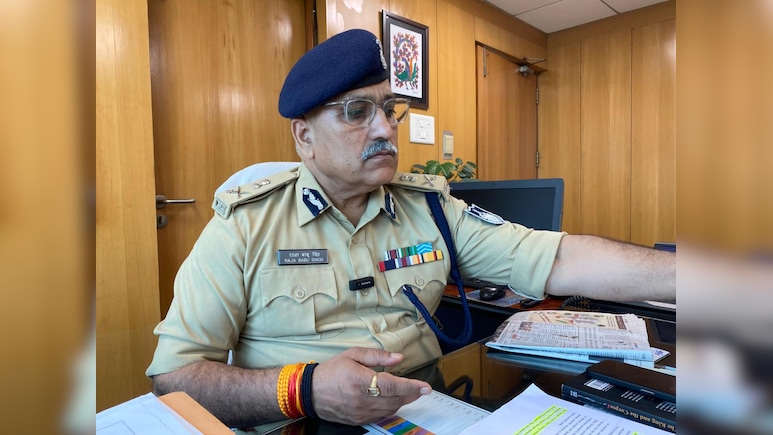
Caught between the Constitution, secularism, and the idea of police reform, NDTV spoke to the head of police training in Madhya Pradesh, ADG Raja Babu Singh.
Q: What innovations have you introduced in police training?
A: The Prime Minister's Vision 2047 requires us to prepare for the future. If you look at how society is evolving, technology is at the center -- IT, AI, even tools like ChatGPT. Nearly 60 per cent of crime today is in the digital space. That is why I felt a fundamental overhaul of police training was necessary.
Earlier, computer knowledge was a small paper. I have expanded it into a full-fledged two-volume syllabus covering cybersecurity, the dark web, and cyber fraud.
On the physical side, we have moved from a 5 km standard to preparing recruits for a full 42 km marathon. This is the first time in Madhya Pradesh Police history that recruits are being trained to this level during basic training.
Q: What other reforms or proposals are in the pipeline?
A: I have proposed AI-enabled training. Currently, everything is manual. With AI, recruits can learn faster and better. We are also proposing augmented reality and virtual reality for weapon simulation. Additionally, 1,086 cyber warriors have been trained and will be deployed in cybersecurity roles.
Q: Is your priority to make the police spiritual, or professionally and constitutionally capable?
A: After Independence, we inherited a colonial policing model -- the Irish constabulary system, which was designed for control, not service. You saw what happened during the Dandi March. We have tried to humanize and constitutionalize policing over time, but incidents still occur whether in Seoni or Guna. So I believe training must go beyond law and forensics. It must include the overall personality development of a police officer.
Q: You are introducing the Gita, Ramcharitmanas, and now the Dakshinamurthy Stotra. Will you also introduce the Quran, Bible, or Guru Granth Sahib? Or is this selection one-sided?
A: I do not have a sectarian mindset. There is no hidden agenda. But if we seek moral values, we will naturally draw from our own civilizational heritage our Vedic and cultural legacy. Every nation draws from its own traditions.
Q: But India is a secular country...
A: I do not want to enter that debate. I am a police officer bound by civil service conduct rules. I have taken an oath to the Constitution. My only objective is to create a committed, professional, smart, and sensitive police force.
Q: Article 28(1) prohibits religious instruction in state-run institutions. Does this not violate that?
A: This is not religious education. This is about becoming a better human being. The Bhagavad Gita transcends religion and has guided humanity for centuries. It helps bring out the best in one's personality.
Q: Did you seek legal advice before issuing this order?
A: There was no need for legal consultation. This is an administrative decision aimed at improving training.
Q: Should the police be guided by the Constitution or by scriptures?
A: When you take young people from diverse backgrounds and train them in nine months, you must teach them drill, law, weapon handling, forensics, and behavior. Initially, you need regimented conditioning. This is part of that conditioning to refine their personality.
Q: In Advaita philosophy, the idea is that there is no distinction between the creator and the creation. You have suggested reading the Gita in madrasas. Would you similarly recommend reading the Quran or the Bible in other institutions?
A: When a Maulana friend of mine said that students studying the Quran those becoming Aalims should be addressed, I suggested that they should also read the Shrimad Bhagavad Gita. The Maulana appreciated the idea, saying it would help people become more tolerant and lead an ethical life. I specifically referred to the verse "Karmanye vadhikaraste, ma phaleshu kadachana" and encouraged that the Bhagavata should also be read.
Q: But is this moral policing or police reform?
A: This is about building a sensitive, public-friendly police force. Moral values are part of that. Along with the stotra and Gita, recruits also engage with Panchatantra and Neeti Shatak. Training schools have adopted nearby villages where recruits interact with communities and understand their problems.
Q: If this order is challenged in court?
A: I will not comment on that. I am a committed police officer doing my duty.
Q: Has your personal faith influenced this decision?
A: I am a practicing Hindu and a student of philosophy. I have studied multiple religious texts. But I work under the Constitution. My goal is only to build a better police force.
Q: After retirement spiritual life or politics?
A: My life has always followed the path laid out by God. It will continue that way. My nature is to serve society. Whether you call it selfless action or something else, my only intention is to do good for people.
Track Latest News Live on NDTV.com and get news updates from India and around the world

