





Union home minister Amit Shah, speaking during the debate in parliament on the women's reservation bill, said the southern states are spinning a false narrative on delimitation and presented data, which, he said, proves that even the south will gain after delimitation. The Opposition is standing firmly against the Constitution amendment bills tabled today, clarifying that while they are not against reservation for women, the government's move to club delimitation with quota is an opportunistic plan to "gerrymander" Lok Sabha seats to its advantage for the 2029 elections.
The Opposition's biggest grouse is that a population-based delimitation using the 2011 census data will push southern states to the fringes of parliament, leaving the Hindi heartland in the driver's seat. This, they have contended, goes against the principles of federalism, where every state should be given equal importance and representation in parliament. The Opposition has contended that they will remove their roadblock if the women's bill is delinked from delimitation.
The government has said the planned 50 per cent increase in seats will give more seats to every state in south India. Giving examples today, Shah said Tamil Nadu will get 20 more seats, Kerala 10, Telangana 9 and Andhra Pradesh 13 seats. Maharashtra, which after Uttar Pradesh, has the second highest number of MPs in the Lok Sabha, will gain 24 more seats.
The overall outlook:
* Karnataka: Seats to rise from 28 to 42, share remains broadly stable at about 5.1 per cent
* Andhra Pradesh: A rise from 25 to 38 seats, seat share rises slightly from about 4.6 per cent to 4.65 per cent
* Telangana: 17 to 26 seats -- seat share increases from 3.13 per cent to 3.18 per cent
* Tamil Nadu: 39 to 59 seats -- share moves from 7.18 per cent to about 7.23 per cent
* Kerala: 20 to 30 seats -- share remains nearly unchanged at about 3.67 per cent
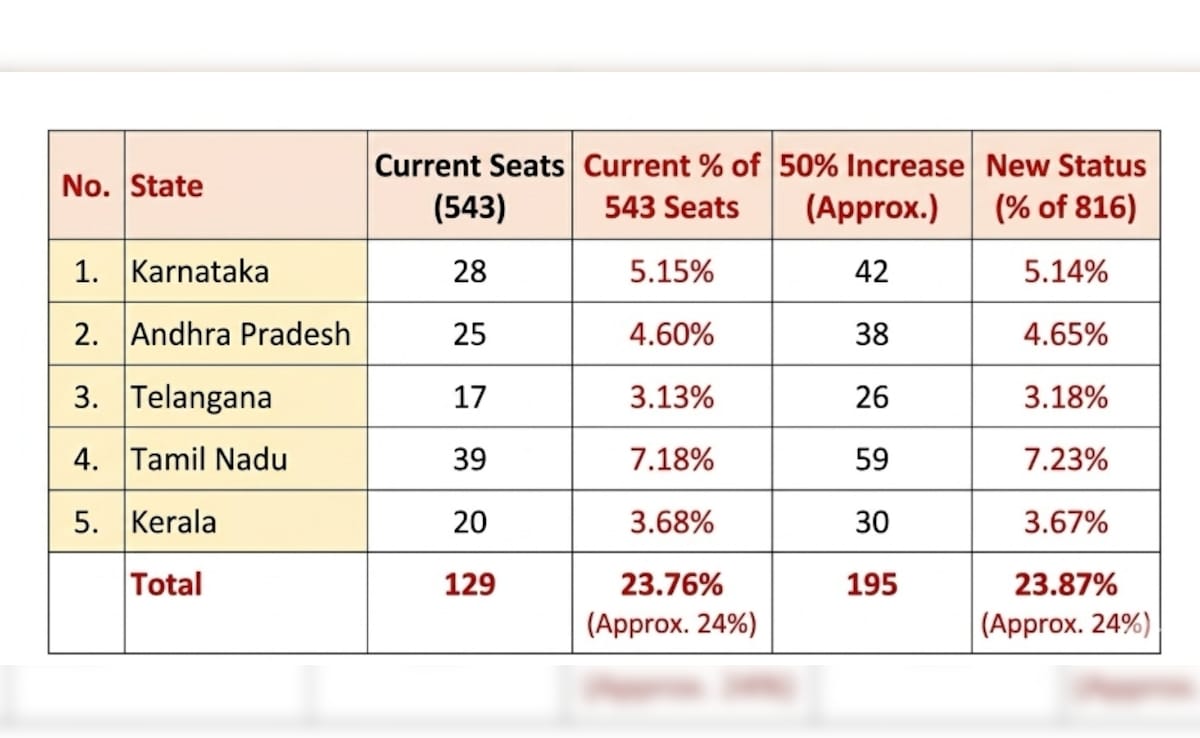
Shah said the total number of Lok Sabha seats in the five southern states will go up from the current 129 seats to 195 while the percentage of power will increase from 23.76 per cent to 23.87 per cent.
"They asked where the figure of 850 came from. I will explain it. This figure of 850 is derived in the following way: Hypothetically, if there are 100 seats and 33 per cent reservation is to be given to women, then increasing the total seats by 50 per cent makes it 150. And when the reservation is applied as 33 per cent of 150, it automatically comes back to 100 seats," he said.
"So, with 543 members currently sitting, there will be a 50 per cent increase, and when 33 per cent is reserved for mothers, then all 543 seats will be open where women can also contest. So this 50 per cent has come about in this way. And 850 is a round figure -- 816 will be the exact number. They will ask again why this was done -- even now -- the round figure is not 543, it is more than 543," Shah added.
To implement women's quota, the government has planned to conduct delimitation on basis of the 2011 data and then increase the figure by 50 per cent so the numbers in the Lok Sabha add up to 816.
The Delimitation Bill states that the total number of seats will be increased. The boundaries of the electoral constituencies will be redrawn on the basis of 2011 Census data.
Seven articles of the constitution will be amended through the bills -- Articles 55, 81, 82, 170, 330, 332, and 334(a).
Shah also said the Delimitation Commission law is "strictly in accordance with the existing law". "There is no change. It will not impact the ongoing elections," he added.
The numbers in parliament indicate that the government could be in a tight spot if the Opposition stands together. A constitution amendment bill requires a two-thirds majority in terms of the members present and voting in each house of parliament.
Given the effective strength of 541 in the Lok Sabha, the two-thirds mark stands at 360. The ruling NDA which has 293 members, falls short by 67 seats. The magic number for the Rajya Sabha is 163 and the NDA's strength of 142-plus members leaves it 21 seats short of majority mark.
Track Latest News Live on NDTV.com and get news updates from India and around the world

