





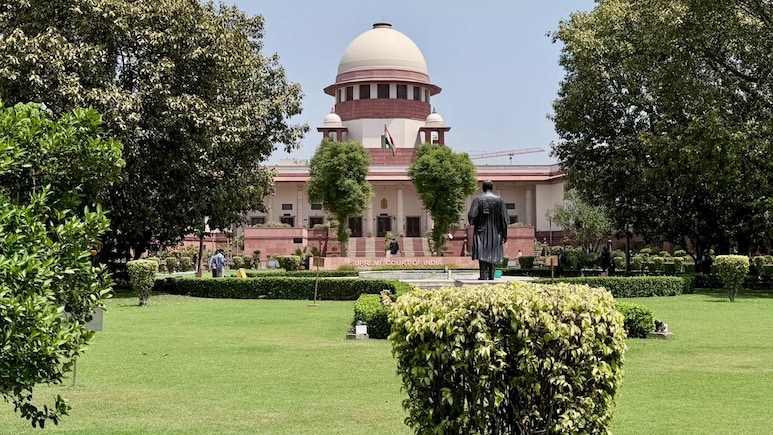
The Supreme Court has dismissed several petitions flagging instances of hate speeches over the past few years, observing that the existing criminal law adequately deals with such offences.
The notion that the offence of hate speech is not covered under the legal framework is misconceived, the court observed.
Closing contempt cases against state authorities over inaction against hate speeches, the top court emphasised that there is no legislative vacuum in this regard and individuals can approach appropriate forums for legal remedies.
It added that it was beyond the remit of the judiciary to create an offence, as it remains exclusive to the domain of the legislature.
A Changed Approach
For years, the Supreme Court has found itself at the center of a difficult question: how far can the judiciary go in confronting hate speech?
From the early wave of petitions during the pandemic, which flagged slurs like "corona jihad," to challenges against the controversial "UPSC jihad" broadcast by Sudarshan TV, and later pleas arising from speeches at Dharam Sansad gatherings, the court has repeatedly been asked to step in.
At moments, it has acted decisively, even halting the telecast of contentious programming in 2020, and later, in 2023, directing police across States and Union Territories to register FIRs on its own in cases of communal hate speech.
But its latest stance signals a shift in tone.
Dismissing a batch of long-pending petitions, the court underscored the constitutional limits of judicial intervention, invoking the doctrine of separation of powers.
With the enactment of new criminal law frameworks -- the Bharatiya Nyaya Sanhita (BNS) and Bharatiya Nagarik Suraksha Sanhita (BNSS) -- the bench noted that the legislature has now occupied the field, leaving no "vacuum" in law when it comes to addressing hate speech.
While acknowledging that hate speech remains "detrimental to fraternity," the court declined to issue fresh directions, instead leaving it to lawmakers to decide whether a more elaborate legal framework is needed.
Petitioners, it said, are free to pursue remedies under existing law or approach appropriate authorities.
The restraint shown by the top court today reflects the evolving approach of the court in dealing with cases of hate speech.
Here's a look at earlier directions and interventions by the top court with hate speech cases:
1. The initial intervention: In 2020, the Supreme Court intervened to restrain the telecast of the "UPSC Jihad" programme. The top court first started dealing with hate speech cases in this form back then. The immediate triggers were the "corona jihad" narrative during the COVID-19 induced pandemic, which communalised the spread of virus in the country. A similar trigger was Sudarshan TV's "UPSC Jihad" programme, which alleged a conspiracy by Muslim candidates to infiltrate the civil services.
Petitioners argued that these narratives violated fundamental rights to equality, dignity, and fraternity, and that state authorities had either failed to act or were complicit through inaction.
2. Hate speech cases pile up: The Supreme Court's hate speech docket grew bulkier between 2021-22 after Dharam Sansad event and similar religious gatherings featured open calls for violence against Muslims, economic boycotts, armed mobilisation, and even genocide. Several intervention applications were filed from across the country in the top court flagging instances of hate speech.
Petitions by Qurban Ali, Major General SG Vombatkere, journalists, civil liberty groups, and religious bodies pointed to a troubling pattern of such events being publicly announced, police often granting permission or staying passive, and FIRs rarely leading to arrests or prosecutions.
Confronted with what appeared to be a systemic enforcement failure rather than isolated incidents, the Supreme Court intervened in October 2022, directing police of states in front of it to register FIRs on their own in cases promoting communal hatred or offending religious sentiments, without waiting for formal complaints.
Warning that inaction would invite contempt proceedings, the Supreme Court underscored that hate speech undermines fraternity, secularism, and constitutional morality.
3. A decisive order: In a major intervention, the Supreme Court on April 28, 2023 directed states to suo motu register FIRs on hate speech incidents and proceed against offenders without waiting for someone to lodge a complaint.
A bench of Justices KM Joseph and BV Nagarathna said the court's order would apply to all hate-speech makers irrespective of their religion. The secular nature of the nation must be protected, the court had stressed. This April 28, 2023 order was an extension to its 2022 order, which was then passed for only three states.
4. A Step Back: By late 2024-2025, the Supreme Court signalled a clear recalibration in its hate-speech jurisprudence. Benches led by Justices Vikram Nath and Sandeep Mehta emphasised that the court could not function as a permanent national monitoring authority, substitute for police, magistrates, or high courts, or legislate in the absence of parliamentary action. While maintaining that its earlier directions prevail, the Supreme Court acknowledged institutional limits, noting that judicial intervention had reached its ceiling without corresponding executive will. What began as an expansive constitutional effort to frame hate speech as a threat to fraternity, secularism, and constitutional morality gradually narrowed into institutional restraint, with greater emphasis on statutory remedies, executive responsibility, and case-specific adjudication.
5. Closure: Six years after the initial intervention, on January 20, 2026, the Supreme Court today dismissed a batch of pending petitions flagging hate speech or inaction by state authorities on it. This closure reflects a shift in the top court's approach to deal with cases of what may be the end of a prolonged phase of judicial intervention with hate speech cases.
A bench of Justices Vikram Nath and Sandeep Mehta, while reserving orders in January this year, had indicated that all matters in the batch would be closed, while explicitly preserving the liberty of parties to pursue other remedies under law. It said that only one case of Kazeem Ahmad Sherwani v. State of Uttar Pradesh and Ors will be kept pending, limited to monitoring the progress of trial and allied proceedings arising out of a 2021 alleged hate crime against a Muslim cleric in Noida.
Today, the top court passed a judgment to that effect, ending its six-year-long tryst with hate speech cases.
Track Latest News Live on NDTV.com and get news updates from India and around the world

