





The world today is chasing one thing with an urgency usually reserved for oil, rare earths, or strategic minerals. That thing is an NVIDIA chip. Or more accurately, an NVIDIA GPU, the Graphics Processing Unit, that has become the engine of artificial intelligence. Governments want them, technology companies cannot get enough of them, and nations that hope to shape the future of AI know that without access to these chips, ambition will remain just that, ambition.
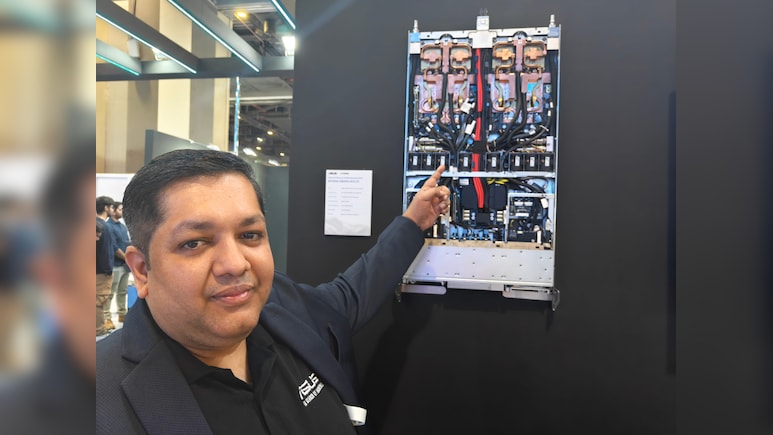
NDTV brings a rare touch-and-feel of this much sought-after technology. What stands on display is not a small chip or a plug-in card, but an imposing rack of machines, the kind that now defines computing power in the AI era.
India currently has about 38,000 such NVIDIA Graphics Processing Unit (GPUs), a number publicly cited by Union Minister Ashwini Vaishnav, who has also said that the government has approved orders for another 10,000. Even so, in a world where artificial intelligence is becoming central to economic growth, defence, healthcare, climate science, and governance, that number barely scratches the surface.
To understand what exactly this NVIDIA system is and why it has become so critical, NDTV speaks to Mr Ketan Sharmakaloni, Product Manager for Servers at ASUS Technology Pvt Ltd, one of NVIDIA's key global hardware partners. Standing beside the rack, Sharmakaloni makes it clear that what we are looking at is not a conventional computer. "These are not normal chips, not traditional Central Processing Unit or CPUs," he explains. "These are ARM-based CPUs designed by NVIDIA itself, and they work with the Blackwell GPUs the B200 series."
Sharmakaloni says these are so advanced that none of this fifth generation are still available in India and each comes with GPS tracking unit to ensure that they are not sold or surreptitiously shipped to China and Russia. They support trillion parameter large language inferencing and training.
That distinction matters. Traditional CPUs process tasks sequentially and are designed for general computing. NVIDIA's GPUs, by contrast, are designed for massive parallel processing, making them ideal for artificial intelligence, where billions and trillions of calculations need to be performed simultaneously. This is what allows modern AI systems to generate text, images, videos, and predictions at astonishing speed.
What is striking is how much computing power has been packed into such a small physical space. Sharmakaloni points to the compact form factor. "This entire system is compressed into a 1U or one unit size," he says. But with that density comes a problem, heat. Enormous amounts of it. So much so that conventional cooling methods simply do not work.
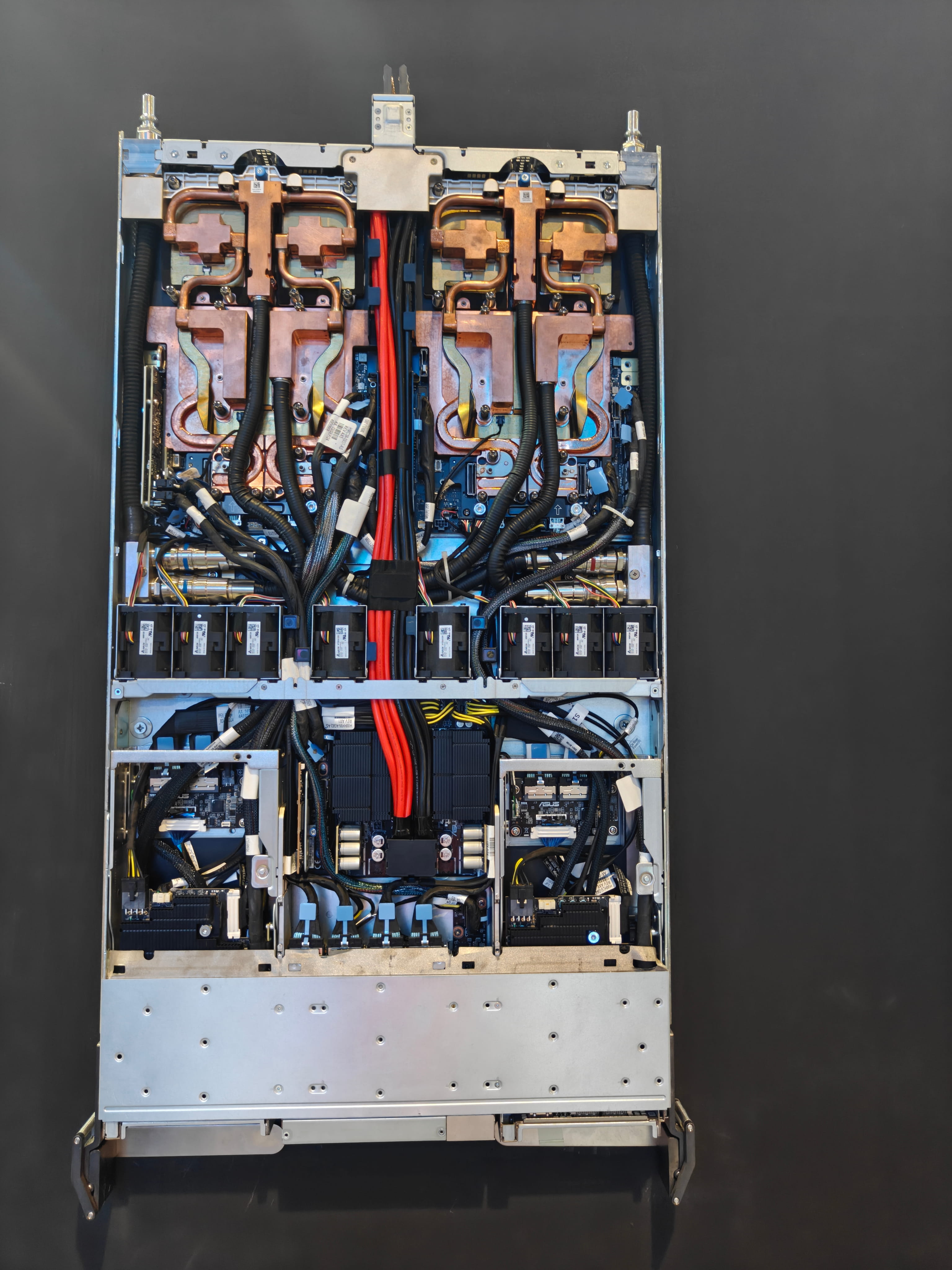
"To cool this, you don't have fans," Sharmakaloni explains. "You need liquid cooling."
The idea immediately raises a red flag. Water and electronics are a famously dangerous combination. Anyone who has dropped a phone into water knows the outcome. When this concern is raised, Sharmakaloni smiles. "You are absolutely right," he says. "That is why this does not use water." Instead, the system uses a dielectric liquid, a special coolant that does not conduct electricity. "Even if it leaks, it does not damage your electronics," he explains. In the age of AI, liquid cooling is no longer exotic. It is essential.
Then comes the question that puts the entire system into perspective: cost. How much does something like this actually cost? Sharmakaloni's answer is blunt. A full rack system costs between $5 to 5.5 million. It is a staggering figure, and it explains much of what is happening globally. "Yes, it's very expensive," Sharmakaloni acknowledges. "And that is why there is a shortage." But cost alone is not the reason. Demand for NVIDIA's AI systems has exploded across the world, while production remains limited. "There is too much demand, and the production is very low," he says. "It does not sustain the demand that exists."
This is why countries and companies are competing fiercely for access to NVIDIA hardware. Even those with money cannot simply buy these systems off the shelf. Waiting lists are long, allocations are tightly managed, and supply chains are stretched. NVIDIA's chips have, in effect, become strategic assets.
What NDTV is shown at Bharat Mandapam is not just one computer, but a complete AI rack system. "There are 18 servers that go inside one rack," Sharmakaloni explains. "This is the GB300 system." Ten servers on one side, eight on the other, connected through high-speed internal networking. And this is only a building block. "Multiple such racks are connected together," he says, "and it becomes one whole cluster. It becomes a supercomputer for your generative AI."
This is how modern artificial intelligence works, not on single machines, but on vast clusters of GPUs working together like factories of computation. But this power comes at a cost beyond money. Electricity consumption is enormous. Sharmakaloni puts it simply: one rack consumes electricity equivalent to 50 to 60 households. Every AI-generated image, every chatbot response, every personalised recommendation draws on real power from the grid. As AI scales up, energy efficiency becomes one of the biggest challenges facing the industry and governments alike.
At the centre of this transformation sits NVIDIA, a company that has reinvented itself. Once best known for gaming graphics, NVIDIA spent decades building an ecosystem of hardware, software, and developer tools that positioned it perfectly for the AI revolution. Today, its GPUs power data centres, scientific research, climate models, drug discovery, autonomous vehicles, and national AI programmes. Its dominance is such that when people talk about AI infrastructure, they are often really talking about NVIDIA.
NVIDIA's founder and CEO Jensen Huang has been candid about what is unfolding. "The whole world is racing to adopt AI," he has said, describing the current phase as the beginning of a new industrial revolution. Huang has also pointed out that demand for computing has risen dramatically because AI systems are now good enough that everyone wants to use them. As he puts it, artificial intelligence is no longer a niche technology, it is becoming foundational.
For India, the implications are profound. Union Minister Ashwini Vaishnav has said that the country needs thousands of these NVIDIA GPUs. That represents a serious commitment, but in a global context, it also highlights how far India still has to go. Countries leading the AI race are building massive GPU clusters backed by dedicated data centres and power infrastructure. Without comparable investments, AI ambitions risk remaining limited in scale.
The reason NVIDIA's chips are so much in demand is simple. They scale better than alternatives, they deliver unmatched performance for AI workloads, and they are supported by a mature software ecosystem that developers trust. This combination has created a virtuous cycle: more users attract more developers, which further strengthens NVIDIA's position.
Everyone today is talking about NVIDIA chips. NDTV brings you a close-up look at what that conversation is really about: the machines, the money, the power they consume, and the future they are shaping.
At the AI Impact Summit in New Delhi, this is not just a display of hardware. It is a glimpse into the infrastructure that will define the next phase of India's technological journey.
Track Latest News Live on NDTV.com and get news updates from India and around the world

