





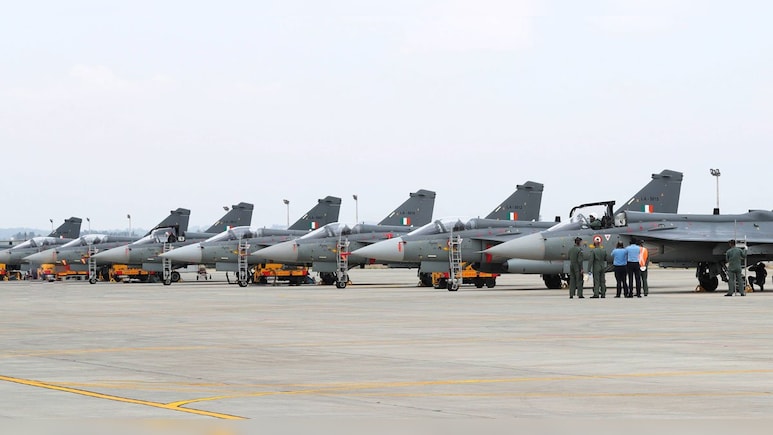
- Air Marshal Kapoor said Tejas Mk-2 may be outdated by mid-2030s frontline use
- China aims for 6th gen jets; India lacks 5th or 6th generation fighter platforms
- HAL delayed Tejas Mk-1A deliveries; integration and engine supply issues persist
In some of the hardest-hitting public comments made on the indigenous Tejas jet-fighter project, Air Marshal Nagesh Kapoor, who retired as the Indian Air Force's Vice Chief less than two months ago, has said the made-in-India fighter Tejas Mk-2 may not be operationally relevant in a frontline role when it starts entering service in significant numbers in the mid 2030s.
Asked if it makes sense for India to have a fourth generation aircraft in 2035 when China has moved onto 6th generation platforms and Pakistan is considering 5th generation [jets], the Air Marshal was categorical - ''No, operationally, definitely No.''
Fifth-generation fighters such as the US F-22 or the Chinese J-20 combine stealth, which makes them difficult to track on radar with sensor fusion, and the internal carriage of weapons. Sixth-generation fighters, such as China's J-36 and J-50 build on that stealth foundation by adding AI-driven autonomy with drone wingmen, and a "system of systems" approach where the jet acts as a networked node rather than a standalone platform.
India presently has neither Fifth nor Sixth generation platforms. Some estimates say China is on its way to deploying 500 fifth-generation J-20 fighters by 2030.
At the same time, the Air Marshal said fourth generation fighters of the class of the Tejas Mk-2 could still play a non-cutting-edge role.
''You can have a certain number of those 5th generation & 6th generation fighters, but given the size of the country, you won't be able to deploy them everywhere. So those gaps which continue to remain to be filled will have to be filled by this class of aircraft.''
Significantly, the Air Marshal slammed the attitude of Hindustan Aeronautics Limited (HAL) which builds the Tejas fighters. He said the present lack of availability of the Tejas Mk1A variant of the fighter in significant numbers was a ''huge'' concern.
''Why must it be that a machine that was promised to us so many years back with a certain set of capabilities continues to be denied to us on one pretext or the other?"
He then added: ''Why must we be hamstrung because someone somewhere has not been able to keep their promises?''
Read | The Hangar At Bholari: How A White Lie Sealed A Mission
While strongly backing the need for made in India fighters, the Air Marshal Kapoor added, ''Indigenous is the way to go without a doubt but how long do we keep waiting?''
The Tejas prototype first flew in 2001, and the Indian Air Force went on to order 40 Tejas Mk.1 jets. In 2021, it ordered 83 of the more advanced Tejas Mk-1A variant in a roughly Rs 46,000-crore deal. At the moment, not a single Tejas Mk-1A has been delivered to the IAF, with engine deliveries of the US-built General Electric F404-IN20 having failed to keep up with the pace of manufacture. In the interim period, HAL reportedly continues to address integration problems involving its radar, avionics and weapons systems.
A secondary order for 97 more Tejas Mk-1A jets was announced on 25 September 2025, in a Rs 62,370-crore deal. HAL, meanwhile, has been developing a genuinely more advanced successor, the Tejas Mk-2, and originally promised to roll out its prototype in 2022 - a promise it has failed to deliver on, with the timeline having slipped repeatedly since through 2023, 2024, 2025 and into 2026. As of HAL's most recent update, at the Farnborough Airshow in July 2026, the Mk-2's first flight is now expected sometime between March and July 2027.
''Their (HAL's) sense of urgency is not equal to the sense of urgency of the Indian Air Force,'' said Air Marshal Kapoor. ''The kind of urgency that they show for the job that they do is way far lesser than what we would like to have in the Indian Air Force.''
It's not just the Tejas programme that the IAF is concerned about. India's first home-grown stealth fighter, the AMCA (Advanced Medium Combat Aircraft), which could take a decade in development and trials, may also miss initial technology benchmarks in its first variants when they are available for induction.
India, the Air Marshal feels, must partner with a European consortium working on state-of-the-art sixth generation platforms. ''There are other things that are happening - why not FCAS? Why not GCAP? Why not join in on any one of those programmes?''
''You are probably going with a consortium which has got a good record of delivery, of development. Why go through this Gen 4, Gen 4.5 steps when you know the next best thing is already being thought of and why not just join up there?''
FCAS, or the Future Combat Air System, is a joint project between France, Germany, and Spain to develop a next-generation fighter jet along with supporting drones and a "combat cloud" network, targeted for around 2040. GCAP, the Global Combat Air Programme, is a joint project between the United Kingdom, Italy, and Japan. This aims for a next-generation fighter around 2035.
Hindustan Aeronautics Limited was excluded from India's AMCA stealth programme in early February 2026 after failing to qualify in an Expression of Interest (EoI) - an early screening step, before any formal contract, where the government checks which companies are financially and industrially capable of taking on a project - that had been opened to private industry in mid-2025. HAL's order backlog was nearly eight times its turnover, far over the allowed limit. Three private-led groups passed instead and received the formal Request for Proposal: Tata Advanced Systems Limited solo, an L&T-BEL consortium, and a Bharat Forge-BEML consortium.
Track Latest News Live on NDTV.com and get news updates from India and around the world

