





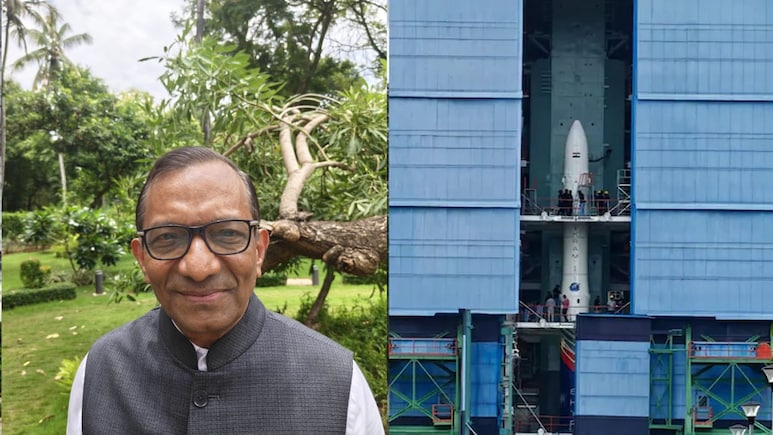
As Vikram-1 stands ready on the launch pad at Sriharikota, India is witnessing one of the most significant moments in the history of its private space sector. What makes the occasion extraordinary is not merely the debut of a new rocket but the remarkable story behind it. In just eight years, two former ISRO engineers transformed a startup into a company capable of building and launching an orbital rocket. For India's space regulator, IN-SPACe, that journey can be summed up in three simple words: Zero to Hero.
Speaking to NDTV, IN-SPACe Chairman Dr Pawan Goenka described Vikram-1 as a milestone not just for Skyroot Aerospace but also for India and the global space industry.
-

-
 World-Class Chefs, Food And Music: The Fun Side Of NDTV World Summit 2026
 -
 AI, Consciousness And Dharma: Why Ancient Indian Wisdom Matters Now
 -
 NDTV World Summit: What To Expect From PM Modi's Keynote Address
 -
 NDTV World Summit 2026: What To Watch Out For | PM Modi, Jaishankar, AI And Global Power Shifts
 -
 A World Between Orders: What To Expect At NDTV World Summit 2026
 -
 Who Is Rajiv Mehta? Lilavati Hospital Trustee To Speak At NDTV World Summit 2026
 -
 Alain Ebobisse, Africa50 CEO, To Attend NDTV World Summit 2026. All About Him
 -
 Kriti Sanon At NDTV World Summit: A Look At Her Career And Business Ventures
 -
 Ex-CIA Director To Decode 'War In Times Of AI' At NDTV World Summit
 -
 Who Is Vikram Rai, CEO, South Asia GE Aerospace, Set To Attend The NDTV World Summit 2026
"I think it is a big milestone for all three. For Skyroot, for India, and perhaps even for the world," Dr Goenka said.
Skyroot was founded in 2018 by former ISRO scientists Pawan Kumar Chandana and Naga Bharath Daka with an ambitious dream of building private launch vehicles in India. Today, that dream sits on the launch pad waiting to fly.
According to Dr Goenka, very few companies around the world have achieved what Skyroot has accomplished in such a short period.
"They started in 2018 with two engineers leaving ISRO and setting up this company. In eight short years they have come to a point where they have the rocket ready to be launched on the launch pad. I do not think too many companies can claim to have achieved this in eight years. I am told it is one of the fastest in the world."
The success has not come easily. The company has had to navigate an exhaustive evaluation process involving technical reviews, safety assessments, and repeated scrutiny from experts. Dr Goenka said the standards applied to Vikram-1 were as rigorous as those used for ISRO missions.
"We have put them through the rigor of reviews that is as difficult and as rigorous as ISRO does. They have passed all the tests. It took them many iterations, and they showed very high perseverance in responding to every question and every ask that the review committee had," he said.
His assessment of the rocket's readiness was unequivocal. "They have done a really good job. I am really happy with what I see in front of me."
Even so, Dr Goenka stressed that spaceflight is inherently challenging and no regulator or engineer can promise absolute success. "It is as safe as a rocket can be before launch. There is no such thing as a guaranteed 100 per cent success when you launch a rocket. It is rocket science. Every agency in the world and every large company in the world have gone through failures. But the rigor that it has passed through is really very high, and therefore the confidence level is as high as it can be."
Then came the phrase that perhaps best captures Skyroot's rise. "Zero to hero story. Absolutely. Zero to hero" asserted Dr Goenka.
For India, the significance of Vikram-1 goes beyond a single launch mission. The rocket represents the outcome of a national effort to create a thriving commercial space ecosystem. When the Government of India opened the space sector to private participation and created IN-SPACe, many questioned whether the model would work. Today, Vikram-1 provides one of the strongest answers yet.
Dr Goenka said India is pursuing a much larger ambition. "One of the things that we are wanting to do is to become the global hub for launching small satellites."
Achieving that goal requires much more than rockets. It requires launch infrastructure, satellite manufacturers, ground stations, investors and regulatory support. According to him, those pieces are now beginning to come together.
India is building a dedicated small satellite launch facility at Kulasekarapattinam in Tamil Nadu. In a significant disclosure, Dr Goenka said operations of the facility could eventually be handed over to private industry.
The private sector will do the rockets. The private sector will do the launches. ISRO will have its facilitation, mentoring, and guidance. It will be owned by ISRO but managed by the private sector," he said.
He described the move as another major step toward creating a complete commercial space ecosystem.
The chairman of INSPACE also highlighted the emergence of several Indian startups capable of building satellites weighing between 100 and 200 kilograms, creating a complementary industry alongside launch vehicle companies.
For some observers, the rapid growth of private space firms raises concerns over talent moving away from ISRO. Dr Goenka firmly rejected that view. "It is not an either-or situation. It is not a win-lose situation. It is a win-win situation."
Drawing from his decades of experience in the automobile sector, he argued that mature industries naturally create new entrepreneurs.
"ISRO is playing that role and should play that role. It is not a loss to ISRO. In fact, if you look at Pawan and Bharath, they came from ISRO. If they had not decided to jump into this eight years ago, this would not have happened."
He believes ISRO's talent base remains deep enough to support both national missions and commercial ventures. "I would very much encourage people to step out and do something different. It is not a loss to ISRO at all."
As Vikram-1 awaits launch, Dr Goenka reserved his warmest words for Skyroot's young team, whose average age is said to be around 28.
"We are proud of you. What you have achieved makes us feel very good about you, about us and about the whole ecosystem that we are trying to create."
But he also offered a note of caution.
"Remember this has just begun. There is a lot more that you have to do. To become commercially successful in this sector is going to take as much effort or maybe even more than it has taken to get to this first base."
Yet he believes Indian startups possess one major advantage that many competitors around the world do not. "Never undermine the presence of ISRO. The presence of ISRO gives you the strength that many other companies will not have in the world."
And he has a powerful assurance. "I can tell you with all confidence that IN-SPACe and ISRO are with you one hundred percent and will help you to succeed."
From two engineers with a dream to a rocket poised for liftoff, Vikram-1 represents more than a launch vehicle. It is proof that India's private space revolution has arrived. It is, in Dr Pawan Goenka's own words, a true "Zero to Hero" story.

