



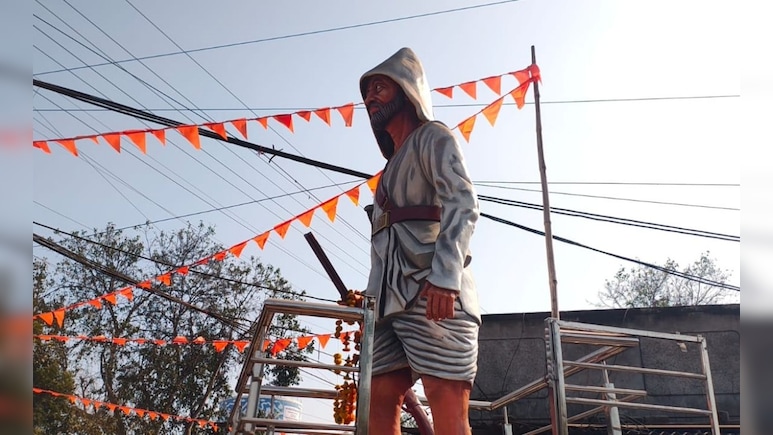
Tribals are once again at the centre of Madhya Pradesh politics. Speeches are being made, statues are being unveiled, leaders are paying tributes, and social media is full of references to tribal icons. At the heart of this politics stands Tantya Bhil, revered as "Tantya Mama", remembered as the Robin Hood of India, the revolutionary who defied the British for seven years before being captured and hanged in his youth. However, in Khargone, the celebration of Bhil's legacy has taken a disturbing turn, exposing how symbolism is being built on a foundation of neglect, manipulation and alleged corruption.
Four years ago, during the Congress' "Bharat Jodo Yatra", Rahul Gandhi walked into Tantya Bhil's birthplace, Baroda-Ahir village in Khandwa district, about 30-35 kilometres from the main road, accessible only by a broken, dusty stretch that tells its own story of neglect.
Then Madhya Pradesh Chief Minister Shivraj Singh Chouhan visited the same village just a day before Gandhi's visit. Baroda-Ahir has more than 200 families living below the poverty line (BPL), yet it has become a VIP destination during election cycles, proof that Tantya Mama's name carries political value, even if his people continue to live in poverty.
READ: Bhopal Literature Fest Cancels Session On Babur Amid Fear Of Protest
That contradiction is now most visible in the statue of Tantya Mama installed at the Bistan Naka intersection in Khargone. The municipality had floated a tender worth nearly Rs 10 lakh to install a statue in honour of the tribal hero. The press release and official records clearly stated that the statue would be made of marble or metal.
Khargone's collector also issued instructions to that effect. Yet what was ultimately installed was not marble, not metal, but a nine-foot fibreglass statue, a material whose market price is less than Rs 1 lakh.
The statue was unveiled with ceremony on November 15, on the 150th birth anniversary of Birsa Munda, by Khargone MLA Balkrishna Patidar and Municipal Council President Chhaya Joshi. The political optics were perfect. The material truth was not.
Municipal records show that a contract of Rs 9.90 lakh was awarded to Pinak Trading Company for the statue. Congress leaders alleged that this massive difference between tender value and actual material cost pointed to clear financial irregularity and misuse of public funds.
Khargone Congress President Ravi Nayak filed a formal complaint with documentary evidence, accusing the municipality of violating its own rules and insulting both public money and tribal sentiment. He has warned that if action is not taken, the party will protest in front of the statue on Friday.
Collector officials have assured that an inquiry will be completed within eight days. Meanwhile, the Chief Municipal Officer Kamala Kol admitted that the tender was issued for a marble or metal statue, but a fibreglass statue was installed instead. She said the contractor has admitted the mistake and apologised in writing, and that notices will be issued to employees concerned and a departmental inquiry will be initiated.
The controversy has hit deeper because of Tantya Bhil's significance. He was not just a freedom fighter; he was a symbol of resistance, dignity, and justice for tribal communities. He evaded the British for seven years, led armed uprisings, and was finally captured and executed in his youth. Today his name is used for schemes, memorials, political speeches and election outreach by both Congress and BJP because tribals are electorally powerful.
Tribals constitute 21 per cent of Madhya Pradesh's population, the highest in the country. Tantya Bhil belonged to the Bhil community, which alone accounts for about 40 per cent of the state's 1.53 crore tribal population, around 59.93 lakh people. Out of 230 Assembly seats, 47 are reserved for Scheduled Tribes, and tribals influence outcomes in at least 84 constituencies. In such a landscape, Tantya Mama is not just history; he is political capital.
A revolutionary who fought exploitation has become the face of a system now accused of exploiting his legacy. A man who resisted colonial loot is being remembered through a statue whose very procurement is under suspicion of loot. In the villages where he was born, poverty persists. In towns where his statue is raised, public money vanishes.
Track Latest News Live on NDTV.com and get news updates from India and around the world

