





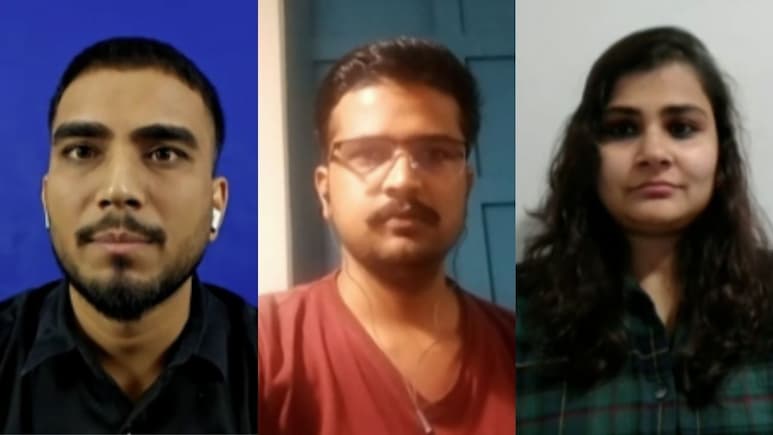
In an age when borders often amplify divides, three young people - Sandeep from Ludhiana, Faisal from Rawalpindi, and Ritika from Canada - have quietly built a bridge of shared humanity. Their collaboration, which began as a Facebook page called 'Bolti Khidki' (The Speaking Window) in 2017, has culminated in an Oxford University Press book - 'The Speaking Window: Tales from a Bloodied Timeline' - that preserves the living voices of Partition survivors.
Speaking exclusively to NDTV, the trio reflected on the emotional journey that brought them together and the deep sense of purpose it continues to give them.
It all started when Sandeep, then a 22-year-old student fond of poetry, joined an Urdu class and met retired principal Prem Singh Bajaj. Bajaj had migrated from Sargodha in 1947 and had been teaching the language of his childhood for 22 years. Inspired, Sandeep reached out through the Facebook group Aman Ki Asha and found Faisal Hayat, a 19-year-old journalism student in Rawalpindi.
"I shared the idea with him that you should find such people in Pakistan who migrated from India, and I would do the same here," Sandeep recalled.
Ritika, whose maternal grandparents hailed from Multan and areas near Lahore, joined soon after to help document the stories. "We grew up listening to their stories...that was the moving point for me," she said. Despite living in different time zones, the three held long late-night video calls, driven by a shared emotional connection to the land shaped by Partition.
What began as a simple Facebook page quickly resonated. The team located around 200 survivors and interviewed nearly 100 across 52 cities in India, Pakistan, Bangladesh and beyond. Of these, 47 carefully chosen accounts form the heart of the Oxford University Press book.
One story that stayed with Sandeep is that of Justice J C Verma. Orphaned as a toddler in Karachi and forced to sell peanuts on the streets of Ferozepur after Partition, Verma later studied privately, became a lawyer, and rose to become a High Court judge. "He was so humble. He approached me after reading an article, never once mentioning he was Justice J.C. Verma. When I finally reached his home and saw the nameplate, I was shocked." Sandeep said.
For Faisal, every conversation carried a quiet emotional thread. "Even after seeing all the brutality...they had this regret: We want to see our motherland one last time," he said.
He also spoke to members of minority communities in Pakistan, including a Hindu family in Sindh, and was moved by their shared human longing for belonging that transcended religion.
The project deepened the trio's understanding of empathy. "For every single thing that we have written in the book, I had to first feel it in my heart and then write it on paper," Ritika explained.
Sandeep added that the experience taught him the importance of simply listening: "You don't know what someone is carrying...if you have a chance to spend time with someone and listen to them, you should. You don't know how much solace it could provide."
Faisal, who once felt directionless, now speaks with quiet satisfaction. "Since the book is published, I am very much satisfied with my life...at least I won't have a regret in my heart that I haven't done anything for the community," he said.
The three acknowledge the emotional weight of the work; many of the survivors they interviewed have since died, yet what remains is a sense of fulfilment.
Their collaboration, conducted almost entirely across borders and screens, has turned personal memories into a shared emotional inheritance now reaching readers in homes across India, Pakistan and beyond.
As Sandeep, Faisal and Ritika continue their journey, 'Bolti Khidki' stands as a gentle reminder that even the most painful chapters of history can open a window of empathy, connection and hope.
Track Latest News Live on NDTV.com and get news updates from India and around the world

