





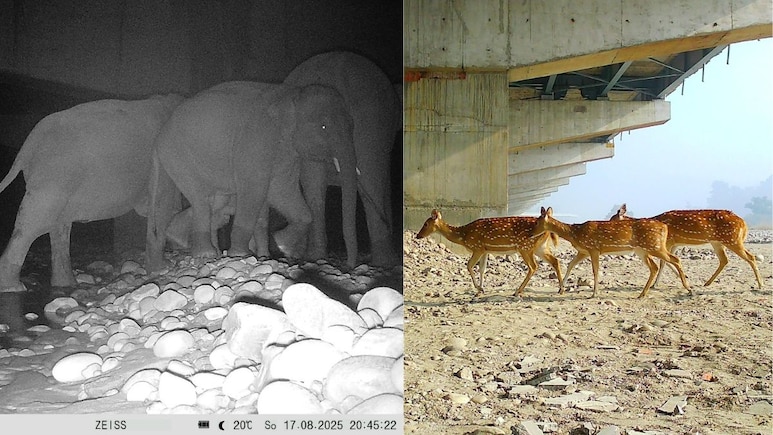
The Delhi-Dehradun Elevated Expressway is set to be inaugurated by Prime Minister Narendra Modi on Tuesday. A 12-kilometre "Green Elevated Corridor", Asia's longest, has been constructed on the expressway, allowing wildlife to cross the forest beneath the elevated structure with ease. The corridor has been built within the riverbed situated between the Rajaji Tiger National Park and the Uttar Pradesh Forest Department.
With the expressway, travel time between Delhi and Dehradun will be reduced to a mere 2 to 2.5 hours. This 210-kilometre expressway holds immense significance for Uttarakhand and is also being hailed as an "Economic Corridor." It will unlock vast potential for rapid development in the state, boost tourism significantly, and enable pilgrims, travellers, and tourists from across the country and the world to visit Uttarakhand with ease.
The corridor is not merely a road project but a transformative infrastructure initiative that establishes fast, safe, and highly reliable connectivity between Uttarakhand, Delhi, and Western Uttar Pradesh. This project is particularly significant because a sensitive section of it passes through the heart of the Rajaji Tiger Reserve, part of the Shivalik range, an area home to vital wildlife species such as elephants, leopards, sambar deer, chital, nilgai, hornbills, and king cobras. The corridor is not merely a marvel of engineering; it serves as a lifeline for maintaining ecological continuity.
The Wildlife Institute of India (WII) played a pivotal role in the construction of the elevated corridor. As part of the project, the WII deployed 150 camera traps and 29 audiomoth acoustic recorders over a 40-day monitoring period along an approximately 18-kilometre stretch beneath the elevated corridor-specifically covering the section between Ganeshpur (Saharanpur) and Asharodi (Dehradun). The research yielded a total of 40,444 photographs, capturing 18 distinct wildlife species utilising these underpasses and corridors. This serves as compelling evidence that this significant initiative has yielded dual benefits: while on one hand it has benefited the general public, on the other, it has created a safe passage for wildlife.
Research findings also indicate that 60 safe crossings by elephants were recorded. This fact is of particular significance, given that elephants are an extremely sensitive and large-bodied species. In other words, if a species like the elephant is utilising a structure, it implies that the design parameters, such as adequate height, width, openness, and minimal disturbance, have been largely successful.
Camera trap studies revealed that numerous wildlife species, including elephants, golden jackals, nilgai, sambar deer, chital, wild boars, peacocks, langurs, leopards, monitor lizards, and rabbits, were regularly observed traversing through the underpasses of this green elevated corridor.
According to official records, an animal-friendly underpass or elevated wildlife corridor spanning 10.97 km was developed within the approximately 20 km stretch between Ganeshpur and Asharodi. This structure was designed with an average clearance height of approximately 6-7 metres to ensure that even large mammals could pass underneath without obstruction. This facilitates the maintenance of ecological connectivity and mitigates the risk of wildlife populations becoming isolated. Other eco-friendly features of the project include a 12 km elevated wildlife corridor, a tunnel approximately 360 metres in length situated near the Datkali Temple, and the installation of sound and light barriers at various locations.
Along the Ganeshpur-Dehradun section, sound and light barriers have been installed across all structures-including the 11.6 km elevated corridor, four underpasses, and the tunnel.
In the construction of the expressway, efforts were made to minimise the felling of trees and to significantly reduce the extent of hill cutting. By aligning the entire elevated corridor along the central axis of the riverbed, the felling of trees was successfully kept to a bare minimum. Initially, it was estimated that 45,000 trees would be felled; however, following the implementation of the elevated corridor design, this figure was reduced to 11,160. Of these 11,160 trees, only 2,000 were cut within the Uttarakhand stretch of the project. Furthermore, 33,000 trees have been planted in Uttarakhand-part of a larger plantation drive involving 193,000 saplings-which will yield benefits for air quality, soil conservation, and biodiversity.
The construction of the Delhi-Dehradun Elevated Expressway is poised to serve a dual purpose: while on one hand it will boost the economy, on the other it will aid in environmental conservation. The construction of this elevated expressway will not only reduce travel time but also lead to significant fuel savings, estimated at 19 per cent, and, consequently, result in a reduction of 2.44 million tons of carbon dioxide emissions over the next 20 years.
Track Latest News Live on NDTV.com and get news updates from India and around the world

