





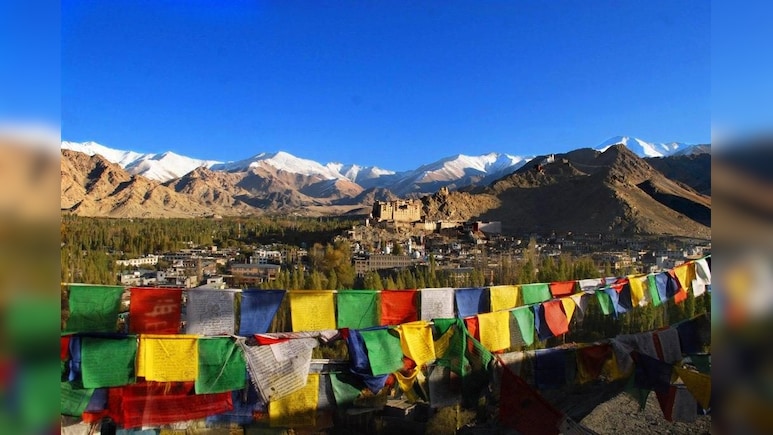
For decades, Ladakh's cold desert sat in the comfort of the shadow of the Himalayas. The vast mountain range acted as a natural barrier, taking away moisture from the monsoon winds long before they could reach the high-altitude plateau.
Recent rainfall data, however, paints a different image. Over the past five years, Ladakh, the cold desert has seen a dramatic shift in its summer precipitation. Marked by intense wet spells, less winter snowfall and record-breaking seasonal totals.
Five Consecutive Years of Excess Rain
Ladakh's rain has been in the spotlight for the past five years. In 2021, Ladakh received 21.9 mm of actual rainfall, which was 42 per cent below the then-normal level of 37.7 mm. In 2022, the IMD revised its long-period average for all-India rainfall, changing the reference period from 1961-2010 to 1971-2020. This brought Ladakh's normal monsoon rainfall down from 37.7 mm to 22.3 mm. The revision came alongside a period of increased monsoon rain in the region. In 2022, Ladakh received 37.6 mm of rainfall against the revised normal of 22.3 mm, an excess of 69 per cent. In 2023, the excess increased to 103 per cent with the region receiving 45.2 mm of rainfall.
2024 was the only year in this period when rainfall was not in the large-excess category with Ladakh receiving 17 per cent more rain than normal. The starkest difference came in 2025, when Ladakh recorded 98.6 mm of monsoon rainfall, 342 per cent above normal. August 2025 also saw the Union Territory's highest monthly rainfall on record since 1973, at 80.2 mm.
The Atmospheric Shift: Less Snow, Warmer Air
The question that the rainfall data triggers is: how are the moisture winds breaking through the walls of the world's highest mountain? A portion of the response lies in thermodynamics triggered by global warming: warmer air holds more moisture.
Dr Avijit Sahay, assistant professor, Department of Geography, Doon University, explains this phenomenon. “To understand the rainfall in Ladakh, we must first understand that the total precipitation in Ladakh (rain plus snow) has not changed drastically. Or at least there is no long-term study currently showing such a change.” However, in line with the rest of India, precipitation in Ladakh has become more erratic with occasional intense spells of rainfall and a long dry spell afterwards. In winter, because of the changing pattern of western disturbances, snowfall has become less frequent."
This shift in winter precipitation directly mirrors what is now happening during the summer months. Professor Sahay explains, "In summer, it is an entirely different story. Earlier, Himalayas used to act as an insurmountable barrier to monsoon winds and so all rainfall used to happen in the Himalayan belts of J&K, Himachal Pradesh, and Uttarakhand. However, because of increasing temperature during summers caused by global warming, the capacity of the air to hold moisture has increased. This means that while earlier rainfall used to be shed in the Himalayas, now the air is able to carry forward the moisture beyond Greater Himalayas and into Ladakh plateau. Therefore, we are now witnessing summer rain in Ladakh.”
He concludes that in recent years, we are seeing a decreasing trend of snowfall in winter and increasing trend of rainfall in summer.
Erratic Spells and Colliding Weather Systems
The heightened moisture capacity doesn't translate to gentle, spread across rain. Instead, it changes how and when precipitation hits the ground.
Dr Sahay explains, “People in the plains are feeling another aspect of the same phenomenon in their daily lives. While earlier the rainfall was distributed across the summer now it happens in a few intense spells only causing flash floods, waterlogging, etc. This also happens because air is holding onto moisture for a longer period of time and then shedding it in a few erratic spells.”
Professor Ankit Agarwal, Department of Hydrology, IIT Roorkee & Joint Faculty at the International Centre for Excellence in Dams elucidates. “Ladakh's repeated above-average monsoon rainfall should not automatically be interpreted as a uniformly stronger monsoon. The more important concern may be that a few intense wet spells are contributing disproportionately to the seasonal total.”
Professor Agarwal explains, “A plausible mechanism is the interaction of monsoon moisture with western disturbances or upper-level westerly troughs, combined with strong moisture convergence and Himalayan orographic lifting. Our research at HydroClimX lab shows that such interactions can organize extreme rainfall over northern India."
A Warning Signal
While five consecutive years of high summer rainfall feel like a fundamental shift, researchers emphasise the need for rigorous, event-by-event long-term tracking before declaring a new permanent climate baseline.
Professor Agarwal adds, “This remains a mechanism-based interpretation: event-wise analysis is required before attributing Ladakh's recent rainfall directly to western disturbances. Five consecutive above-average seasons are a warning signal, not yet proof of a permanent trend.”
Whether a permanent trend or an extended climate event, these erratic wet spells present immediate challenges. Ladakh's fragile environment, traditional housing, and valleys are prepped for cold dryness making adaptation to erratic rainfall an urgent priority in the region.
Track Latest News Live on NDTV.com and get news updates from India and around the world

