





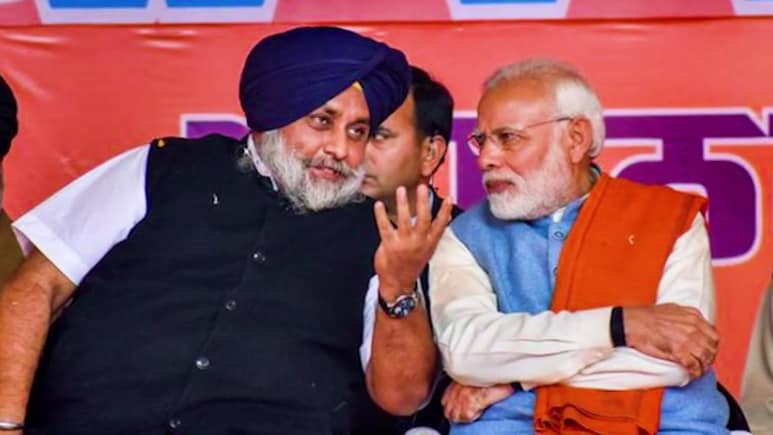
- Sukhbir Badal's meeting with PM Modi has sparked talk of a SAD-BJP alliance revival after six years
- BJP has sought more seats, ending the previous seat-sharing formula favoring SAD in rural Punjab
- Farmer resentment and anti-incumbency have remained strong obstacles for the renewal of the alliance
Shiromani Akali Dal chief Sukhbir Badal's recent meeting with Prime Minister Narendra Modi has created ripples in political circles, sparking speculation that a re-alliance is imminent after nearly six years.
The 23-year-old Akali-BJP alliance, once cited as the finest example of social engineering and communal harmony uniting rural Sikhs and urban Hindus, also became an example of pragmatic political opportunism on September 26, 2020, when SAD broke ties with BJP following resentment among the farming community due to the now-repealed three farm laws. SAD's opportunism did not help it its vote share, which slipped from 18 per cent in 2022 to 13 per cent in 2024 and 9.71 per cent in recently held municipal body elections.
Both BJP and Akali Dal tested the waters by contesting 2022 assembly and 2024 Lok Sabha elections solo but the results made them realise that had they fought together, the vote percentage might have gone up.
Both parties are now on the path to resolve their internal conflict. But psephologists say the transition from fearing losses and avoiding risks to making practical, deal-based alliances will not be as easy as both parties hope.
"We have noticed that the political landscape of the state has undergone a seismic shift after AAP forayed into Punjab politics besides the radical elements like SAD Waris Punjab De," said Professor Ashutosh Kumar, Head, Department of Politics, Panjab University. "Re-stitching the estranged alliance was far more complicated than simply picking up from the point where SAD parted ways," he added.
Below is an in-depth analysis detailing the five critical roadblocks that make a smooth reunion between these former allies exceptionally difficult.
BJP done playing 'Chhota Bhai'
While the previous SAD-BJP alliance was cited as an example of communal harmony between the urban Hindus and rural Sikhs, the less known is the fact that Badals never let the BJP contest elections in rural blocks and confined it to urban pockets only.
That's why SAD used to contest on 94 seats and only allowed 20 per cent seats to the BJP.
The structural arrangements followed by both the partners before 2022 no longer exist now.
The BJP has aggressively built an independent organisational footprint across all 117 assembly segments of the state. Its rural Punjab outreach was so aggressive that even the ruling Aam Aadmi Party feared the impact and disrupted BJP's registration desks set up for the beneficiaries of Central schemes.
The BJP will no longer be ready to settle for less and demand higher number of seats. This also became clear from Union Home Minister Amit Shah's statement that 'the BJP is done playing 'Chhota Bhai' in Punjab.
During his July 17 public address in Jalandhar, Prime Minister Narendra Modi had even pinched the Akalis harder by saying that "The Shiromani Akali Dai is caught up in its own internal matters and the net of selfishness at this point. It is not worried about the people of Punjab and development".
BJP insiders say a section of the party is not in favour of re-stitching the alliance.
Leaders like Sunil Jakhar and Captain Amarinder Singh, who came from the Congress, have favoured an alliance with SAD. Psephologists say the political ambition of BJP demanding more seats may become the roadblock. The Akali Dal may also not be ready to accept reduced seats, the issue which had also stalled speculated talks in 2024.
The legacy of rural agitation and anti-Incumbency
The Union government may have repealed the three farm laws on December 1, 2021, but the anti-incumbency still remains. Whenever there is a farmer protest for raising the unmet demands, the Union government is always at the receiving end.
The deep-seated resentment among farming communities, unions, and rural voter bases across Punjab's Malwa, Majha, and Doaba regions continues to linger. The farmer unions have kept the agrarian discontent alive by raising the issues like legal guarantees for Minimum Support Prices (MSP), farm debt waivers, and unresolved grievances.
The Shiromani Akali Dal also internally fears that the re-stitching the alliance will further fuel anger and annoy the rural Jat vote bank, which is SAD's core vote bank.
There is concern that the farmer unions will once again fear that the alliance will compromise farm-centric principles for electoral gains.
The state's farmer unions are already protesting against the proposed international Free Trade Agreements (FTAs), specifically objecting to the planned India-US Trade Deal.
Aligning the Jat-Sikh peasant base with the BJP will not be smooth as BJP faces deep-rooted scepticism in rural, farmer-dominated belts.
In order to keep its rural vote bank intact, the Akalis may also push for unrealistic or high-budget farmer union demands, which the Union government has avoided in the past.
Panthic Credibility & Identity Politics
Winning the panthic votes will also not be easy, as Sukhbir Singh Badal was declared Tankhaiya (guilty of religious misconduct) by the Akal Takht on August 30,2024, due to controversial decisions taken by his government and party between 2007 and 2011.
Although Badal resigned as SAD President in 2024 and performed rigorous religious penance (sewa) at the Golden Temple, this impacted the party's image as a Panthak Party.
SAD's loss was the radical element's gain. SAD's questioned credibility helped controversial, pro-Khalistani figures like Amritpal Singh and Sarabjeet Singh Khalsa win the 2024 Lok Sabha elections.
As radical groups paint the RSS as anti-Sikh, aligning with a centralist, Hindu-nationalist party will not only make it difficult but also provide ammunition to rival Akali factions, radical groups, and hardline Panthic organisations to question the alliance.
An Altered Multi-Cornered Electoral Landscape
The broader political environment in Punjab has moved permanently away from a two-way contest involving Congress, SAD and BJP.
A multi-corner contest is now at play after the AAP and radical elements entered the arena. The competition has become so fierce that the rival political parties, which once feared the SAD-BJP as a strong force, now know that both were re-stitching the alliance together based on mutual weakness rather than shared principles.
The SAD-BJP's prospects of winning elections in 66 rural constituencies are not as strong as those of AAP and Congress. AAP won 56 rural seats in 2022, followed by Congress, which won 7 and SAD just two seats. BJP could not win even a single seat.
As the Aam Aadmi Party is grappling with anti-incumbency, its loss will be the Congress's gain. Bhagwant Mann faces an Akal Takht edict, yet his party is still likely to draw significant rural support on the strength of populist schemes such as cash transfers for women and free power.
The Congress -- if successful in controlling factionalism -- can regain its rural stronghold.
Resistance from Ground Cadres & Vote Transferability
Amid the possibility of an alliance between SAD-BJP, the local cadres have already presented an operational challenge before the BJP leadership. The bonafide BJP leaders and the turncoats, mostly from the Congress, are divided over various issues.
Importing leaders from rival political parties is being opposed by the senior BJP leaders by silent protests.
They are also miffed with the party high command over showering plum organisational posts to the leaders who came from Congress, were rivals and have opposed BJP policies.
This will not be limited to the BJP; the alliance will further fuel dissidence among the grassroots workers of both parties. Both SAD and BJP spent nearly six years competing against each other in assembly and parliamentary elections, which hardened the local rivalries. This will further create local power centres in rural and semi-urban constituencies.
"The mutual vote transfer that once made the BJP-SAD alliance formidable has collapsed. While the urban Hindus will no longer readily back traditional Akali candidates, the rural Jat Sikhs will also distrust any BJP-linked ticket. What remains is fragmentation, booth-level apathy, and the risk of internal sabotage," said Prof Varinder Sharma, Director, Institute for Development and Communication, Panjab University, Chandigarh.
Other factors that may raise formidable barriers to any smooth reunion include the lingering wounds of rural agitation, the BJP's determination not to play second fiddle, the erosion of Panthic credentials, localised cadre rivalries, and a fiercely multi-cornered electorate.
Track Latest News Live on NDTV.com and get news updates from India and around the world

