





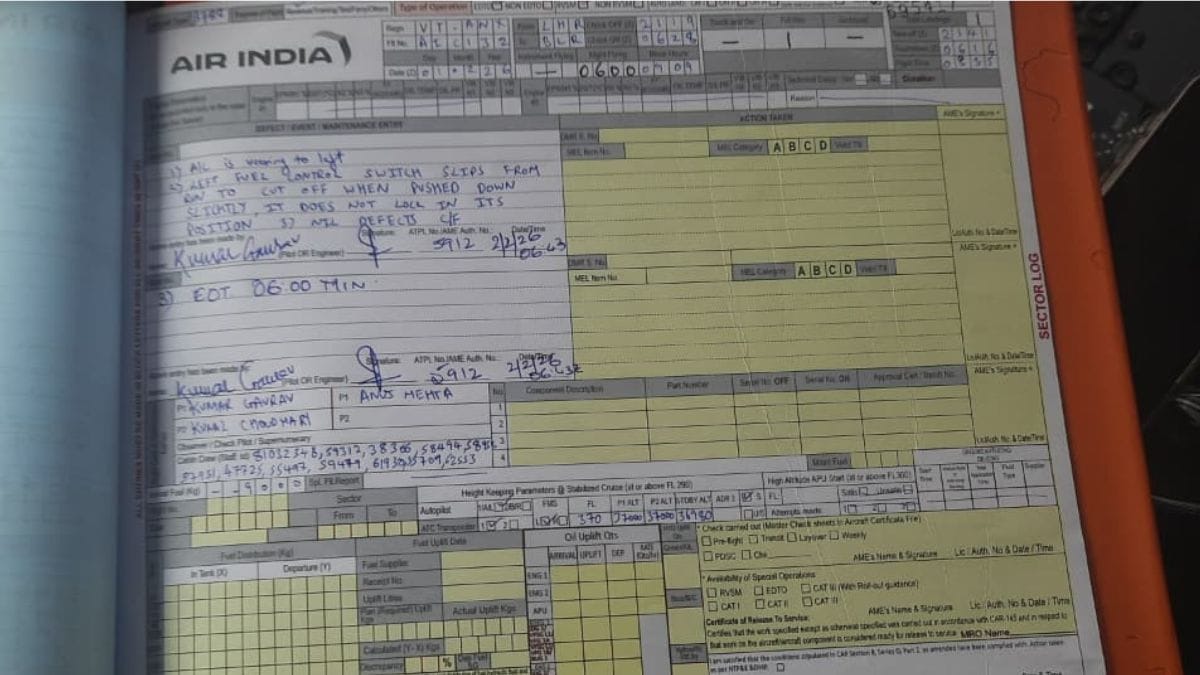
An Air India Boeing 787 Dreamliner was grounded after its left fuel control switch failed to stay in the 'run' position twice and moved to 'cutoff' during engine startup, an airline spokesperson said.
The flight AI 132 came from Heathrow to Bengaluru on Monday.
"We are aware that one of our pilots has reported a possible defect on the fuel control switch of a Boeing 787-8 aircraft," the Air India spokesperson said.
"After receiving this initial information, we have grounded the said aircraft and are involving the OEM to get the pilot's concerns checked on a priority basis," the spokesperson said, referring to the original equipment manufacturer i.e. Boeing.
Following the incident, a Boeing spokesperson confirmed they are in touch with Air India and are "supporting their review of this matter."
Air India said it has informed the civil aviation regulator DGCA about the matter concerning the fuel switch.
"At Air India, safety of our passengers and crew remains top priority," the spokesperson said.
After an Air India Dreamliner crashed in Ahmedabad in June 2025, killing 260 people, the Tata-owned airline had checked the fuel control switches on all Boeing 787 aircraft in its fleet. The airline had reported it found no issues.
In July 2025, a preliminary report from investigators who looked into the Ahmedabad Dreamliner crash showed that seconds after takeoff, the plane's engine fuel control switches were in the cutoff position briefly, starving them of fuel.
Fuel Switches
They are switches that regulate fuel flow into a plane's engines. They are used by pilots to start or shut down engines on the ground or to manually shut down or restart engines if an engine failure occurs during a flight.
Aviation experts say a pilot would not be able to accidentally move the fuel switches that feed the engines. But if moved, the effect would be immediate, cutting off engine power.
Where Are Fuel Switches Located
The two fuel control switches on a 787 are located below the thrust levers. The switches are spring-loaded to remain in position. To change one from run to cutoff, a pilot has to first pull the switch up and then move it from run to cutoff or vice versa.
There are two modes: 'cutoff' and 'run'.
In the Ahmedabad air accident, according to the flight recorder, a few seconds after takeoff, switches for both engines transitioned to 'cutoff' from 'run' one after another with a time gap of one second. As a result, the engines began to lose power.
One pilot was heard on the cockpit voice recorder asking the other why he cutoff the fuel. "The other pilot responded that he did not do so," the report said.
It did not identify which remarks were made by the flight's captain and which by the first officer.
Seconds later, the switches flipped back to 'run', according to the preliminary report. Both fuel control switches were found in the 'run' position at the crash site, it said.
When fuel control switches are moved from 'cutoff' to 'run' while the aircraft is in flight, each engine's control system automatically manages a relight and thrust recovery sequence of ignition and fuel introduction, the report said.
Track Latest News Live on NDTV.com and get news updates from India and around the world

