



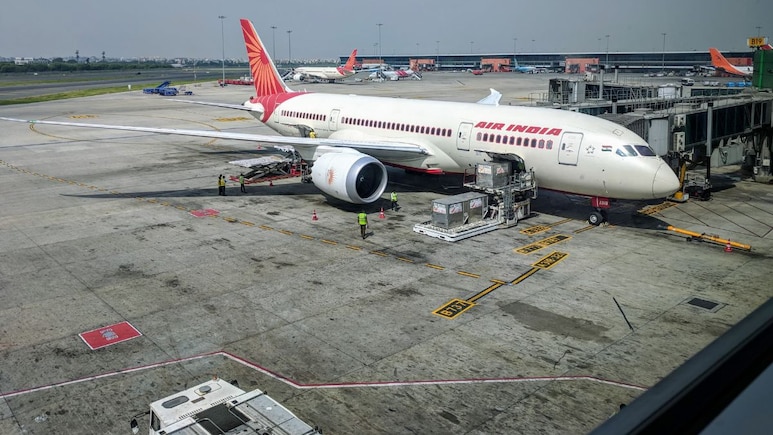
- The Aviation Ministry said Air India found both fuel control switches satisfactory after inspection
- Inspections were conducted by Air India engineers with DGCA officers following Boeing's recommended checks
- Improper handling can cause the fuel control switch to slip between RUN and CUTOFF positions, DGCA warned
The Aviation Ministry on Tuesday said that inspections of the fuel control switches on a grounded Air India Boeing 787 Dreamliner have found both switches "satisfactory", following a pilot's report that a switch did not remain properly latched in the 'RUN' position during engine start.
The Civil Aviation Ministry in a statement said that the findings came after detailed checks recommended by the aircraft manufacturer Boeing, carried out by Air India's engineering team in the presence of DGCA officers. The regulator also cautioned that improper handling of the fuel control switch can cause it to slip between the 'RUN' and 'CUTOFF' positions.
The issue has attracted scrutiny because of the June 2025 crash of an Air India Dreamliner in Ahmedabad that killed 260 people, an accident in which investigators found that the aircraft's engine fuel control switches had transitioned from 'RUN' to 'CUTOFF' shortly after take-off.
Engineering Checks And Regulator's Findings
Based on Boeing's recommended checks to establish the serviceability of the fuel control switch, Air India engineering inspected both the left and right switches, the Ministry said.
The airline reported that both switches were found satisfactory, with the locking tooth or pawl fully seated and not slipping from 'RUN' to 'CUTOFF'. When full force was applied parallel to the base plate, the switch remained secure.
However, engineers found that applying external force in an incorrect direction caused the switch to move easily from 'RUN' to 'CUTOFF'. This, they said, was due to the angular design of the base plate, which can allow the switch to slip if pressed improperly with a finger or thumb.
The Aviation Ministry, citing Air India, said in the statement: "Air India engineering observed that: 'Both left and right switches were checked and found satisfactory, with the locking tooth/pawl fully seated and not slipping from RUN to CUTOFF. When full force was applied parallel to the base plate, the switch remained secure. However, applying external force in an incorrect direction caused the switch to move easily from RUN to CUTOFF, due to the angular base plate allowing slip when pressed improperly with finger or thumb."
In addition, engineers checked the pull-to-unlock force on the fuel control switch using Boeing's recommended procedure. This was carried out on the involved fuel cut-off switch, on a fuel control unit to be installed, and on the fuel cut-off switch of another aircraft. In all cases, the pull-to-unlock force was found to be within prescribed limits. These inspections were conducted in the presence of DGCA officers, the Aviation Ministry said.
The regulator also examined a video circulating on social media that purported to show an issue with the fuel control switch. After analysing the video against Boeing's recommended procedures, the DGCA said the method demonstrated in the video was incorrect.
The airline has now been advised to circulate Boeing's recommended procedure for operating the fuel cut-off switch to all crew members.
In a statement, the DGCA said moving the fuel switch improperly can cause it to slip between the 'RUN' and 'CUTOFF' positions, reinforcing the need for correct handling.
The London-Bengaluru Flight
The incident involved an Air India Boeing 787-8 aircraft, registration VT-ANX, operating flight AI-132 from London to Bengaluru on February 1.
During engine start in London, the crew observed on two occasions that a fuel control switch did not remain positively latched in the 'RUN' position when light vertical pressure was applied. On the third attempt, the switch latched correctly and remained stable.
Before proceeding further, the crew carried out a physical verification to confirm that the switch was fully and positively latched in 'RUN'. No abnormal engine parameters, cautions, warnings or system messages were observed during engine start or at any time thereafter.
The crew briefed the operating pilot on the observation, avoided unnecessary contact with the switch, and closely monitored engine indications and alerting systems for the remainder of the flight. The flight was completed without incident and landed in Bengaluru.
After landing, the crew recorded the issue in the aircraft's post-flight defect report. Air India referred the matter to Boeing for guidance.
An Air India spokesperson said the airline was aware that one of its pilots had reported a possible defect on the fuel control switch of a Boeing 787-8 aircraft. "After receiving this initial information, we have grounded the said aircraft and are involving the OEM to get the pilot's concerns checked on a priority basis," the spokesperson said.
Air India said it informed the DGCA about the matter. Boeing, in a separate statement, said it was in touch with the airline and was supporting its review.
Track Latest News Live on NDTV.com and get news updates from India and around the world

