



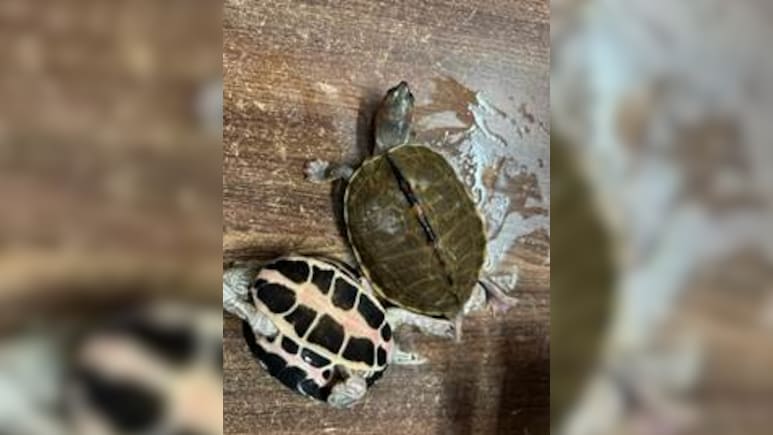
The plush privacy of AC First-Class coaches long considered the most secure and elite travel space on Indian Railways has now been exposed as an unlikely corridor for wildlife crime. An inter-state racket has been using these luxury compartments to smuggle rare and endangered turtles from Uttar Pradesh to Madhya Pradesh, before distributing them across western India.
In a major breakthrough, the Madhya Pradesh State Tiger Strike Force (STSF), in a joint operation with the Railway Protection Force (RPF) and the Bhopal Forest Division, seized 311 rare and endangered turtles from the AC First-Class coach of the 19322 Patna-Indore Express at Sant Hirdaram railway station in Bhopal.
Investigators revealed that the racket sourced turtles from the rivers of Uttar Pradesh, primarily the Ganga and Gomti and their tributaries and transported them concealed inside AC First-Class coaches to Madhya Pradesh. The smuggling operation allegedly used the services of coach attendants to stash the turtles during transit.
The 311 turtles were recovered from coach attendant Ajay Singh Rajput, who was allegedly working as a courier for the syndicate. Among the rescued species were endangered Crowned River Turtles, Indian Tent Turtles, and Indian Roofed Turtles, all protected under the Wildlife Protection Act, 1972.
Wildlife officials described the scene as disturbing. The turtles were packed in suffocating conditions, many dehydrated and stressed after long hours of concealment.
Further investigation led the STSF to Uttar Pradesh's capital, Lucknow, where a 17-and-a-half-year-old teenager was taken into custody and later sent to a detention home in Bhopal. Officials say the minor was part of a larger river-based poaching network operating in districts including Lucknow, Kanpur, Unnao, Sultanpur and Amethi.
According to investigators, local poachers extracted turtles from riverbanks and wetlands before routing them through railway channels into Madhya Pradesh. The consignment was allegedly controlled by a kingpin operating from Dewas district in western Madhya Pradesh.
That kingpin, identified as Asif Khan, managed to evade arrest for several days before being arrested from Dewas city on February 10. He has been remanded for interrogation, and officials believe his questioning could unravel deeper layers of the syndicate including financiers and interstate distributors supplying clients in Madhya Pradesh, Gujarat, and Maharashtra.
Sources in the STSF indicate that this racket has been operational for several years. The method exploiting train routes and insider access within premium compartments suggests meticulous planning and insider coordination.
This is not the first time railway routes have been used for wildlife smuggling.
In October 2023, during an all-India crackdown codenamed "Operation Kachchhap," the Directorate of Revenue Intelligence (DRI) rescued 955 live baby Gangetic turtles in simultaneous raids across Nagpur, Bhopal, and Chennai, leading to six arrests. At that time, turtles were recovered from trains passing through Itarsi and Nagpur.
Even earlier, the Madhya Pradesh Tiger Strike Force had arrested a gang smuggling rare turtles through the Yeshwantpur Express. Since then, suspicion had grown that a larger interstate syndicate was active, a suspicion that now appears confirmed.
Investigations into similar wildlife cases have previously revealed international links. Agencies have uncovered plans to traffic turtles to markets in China, Hong Kong, Myanmar, Thailand, Singapore, Malaysia, and Bangladesh, where demand for exotic pets, meat, and traditional medicine fuels illegal trade.
In a landmark 2021 judgment, a special court in Sagar, Madhya Pradesh, sentenced 13 poachers linked to an international syndicate to seven years' imprisonment for trafficking pangolins and turtles, sending a strong signal against wildlife crime.
Under the Wildlife Protection Act, 1972, capturing, smuggling or trading protected turtle species can attract imprisonment up to seven years and a minimum fine of Rs 25,000. Many of the species seized in the recent bust including the Indian Tent Turtle and Red Crown Roofed Turtle are native to the Ganges and Chambal ecosystems and are already under severe ecological stress due to illegal sand mining and riverbank destruction.
Wildlife experts warn that removal of turtles disrupts aquatic ecosystems. As natural scavengers, turtles play a vital role in maintaining river health.
Track Latest News Live on NDTV.com and get news updates from India and around the world

