





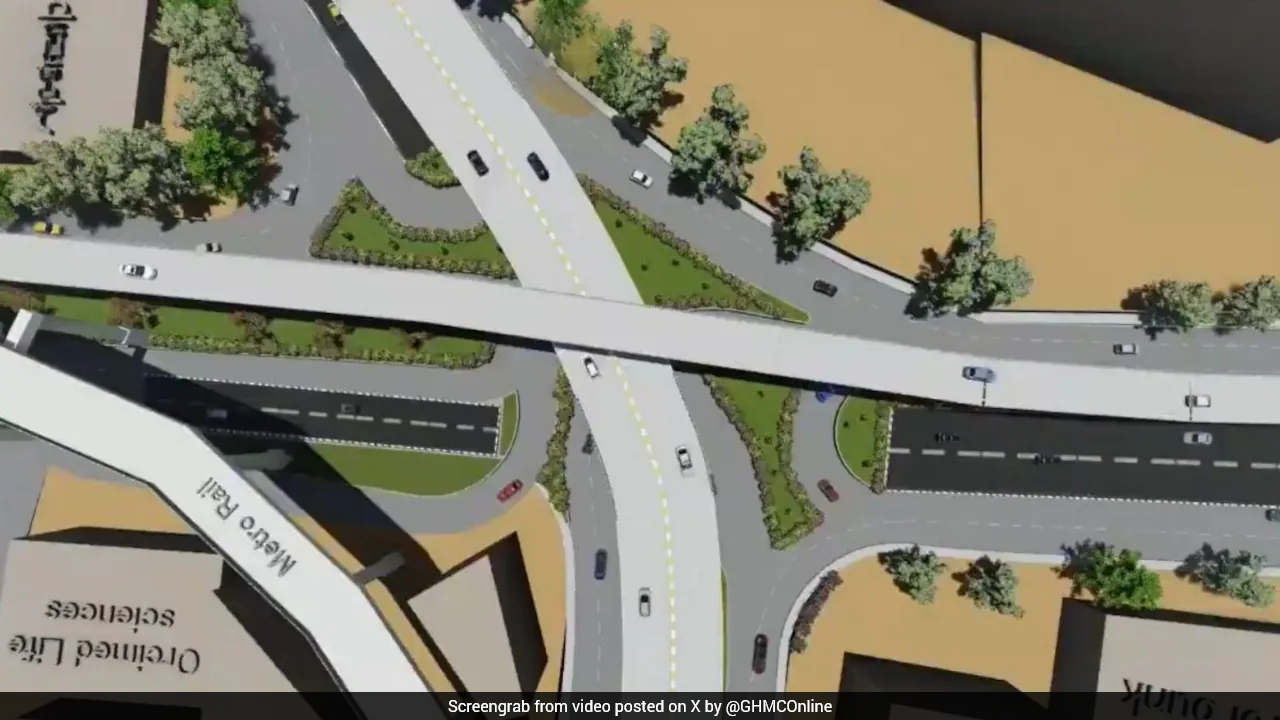
The Revanth Reddy government in Telangana has dropped its ambitious traffic decongestion plan around KBR National Park, replacing the earlier network of multiple flyovers and underpasses with now only a single 4.3-km elevated corridor connecting Jubilee Hills Check Post with NFCL Junction.
The revised proposal, approved by the Greater Hyderabad Municipal Corporation (GHMC) Standing Committee on October 3, gave a green signal to six-lane, bidirectional steel flyover designed to provide signal-free movement across five major junctions.
The earlier KBR Park plan had grown into a major infrastructure package involving 14 flyovers and underpasses, sanctioned in 2024 at an estimated Rs 826 crore and subsequently revised to Rs 1,090 crore.
The project was intended to tackle chronic congestion around the park and the Jubilee Hills-Banjara Hills-Punjagutta corridor.
But the project also became the centre of a prolonged environmental and legal battle.
Tree-felling linked to the road works triggered protests and litigation. In May this year, the Supreme Court ordered an interim halt to tree felling within the originally proposed 25-35 metre eco-sensitive zone around KBR Park while examining challenges to the environmental safeguards and ESZ notification.
Environmentalists claim that close to 2,000 trees had been felled in areas around the park for various flyover and underpass works attracting criticism from residents and civil society groups.
The latest redesign follows the introduction of a clockwise one-way traffic system around KBR Park, which officials say has improved traffic movement. GHMC now proposes retaining the one-way system while concentrating infrastructure investment into one continuous elevated corridor.
The revised corridor will be executed in two packages: Jubilee Hills Check Post to Mugdha Junction at Rs 580 crore, and Mugdha Junction to Muffakham Jah College, with a ramp towards Banjara Hills Road No 1 at Rs 510 crore.
The Hyderabad City Integrated Traffic Infrastructure - #HCITI project, with a budget of ₹826 crores, aims to transform traffic around #KBR Park using a series of underpasses and flyovers. Key features include a Y-shaped underpass from Road No. 45 to KBR and Yousufguda, a 4-lane flyover from KBR Park Entrance to Road No. 36, and a 2-lane flyover from Yousufguda to Road No. 45. These developments will ease congestion and enhance commute efficiency. The foundation stone for these projects will soon be laid by the Hon'ble CM. #JubileeHillsCheckPostJunction #KBRPark #GHMC
— GHMC (@GHMCOnline) September 29, 2024
The redesign has, however, attracted political criticism with the opposition BRS questioning why such a massive project was pursued, trees were removed and roads excavated before the original plan was substantially altered.
Party working president and former Municipal Administration and Urban Development (MA&UD) minister KT Rama Rao attacked the government over what he described as a costly policy reversal.
"Welcome to the new Tuglak era'' he posted on social media.
While BRS has made it a political agenda with questions thrown to the government over accountability and wastage of public money for Hyderabad daily commuters, the real test now is whether the new single-corridor strategy actually delivers the promised signal-free, congestion-free vehicular movement.
Track Latest News Live on NDTV.com and get news updates from India and around the world

