
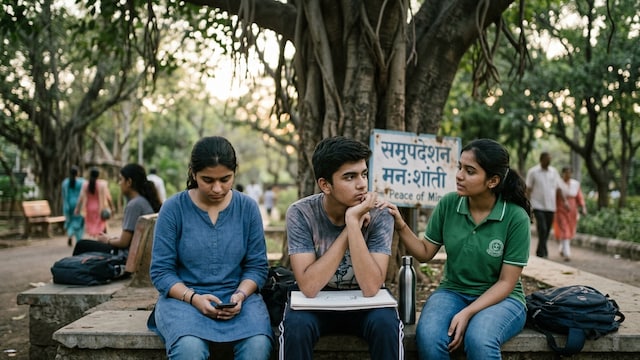
India has 436 million children and teens, which makes it one of the largest youth populations globally. Despite this, mental health services remain severely inadequate and not on the priority list, according to a UNICEF report. The main concern lies in the lack of pace with the size of the population that needs help in India's mental health system. Millions of Indian adolescents are struggling with anxiety, depression, and emotional distress, but are not getting help.
A new review by The George Institute for Global Health, published in the SSM - Mental Health journal, highlights why this is happening and what needs to be done to bridge this gap. The review covers 26 studies across major Indian cities, making it one of the most comprehensive analyses yet on teenage mental health in India in 2026. The review pinpoints that the real crisis is not just mental health, but access to care that is much needed.
What The Review On Mental Health Found
The review analysed adolescent mental health help-seeking behaviour across India, covering cities Delhi, Mumbai, Chennai, Hyderabad, Pune, Bengaluru, Goa, Odisha, Bihar, Assam, and Vijayawada.
The key finding from the review suggests that adolescents struggle with recognising symptoms, seeking help, and accessing care.
This review also indicates that mental health issues often begin during adolescence and keep on progressing until adulthood, and can even get worse if left unaddressed.
Stigma Remains The Biggest Barrier
The social stigma attached to mental health issues remains the biggest barrier that results in most teens delaying much-needed care. It has been identified as the most common obstacle as teenagers fear being judged, labelled, and treated differently, as they are in a phase of their lives where they are figuring out their place in the world.
The result of the social stigma is that most teenagers end up suffering in silence and delay help from their families, peer groups, and experienced medical professionals such as psychiatrists and psychologists.
Stigma is still the biggest enemy of adolescent mental health in India that needs to be broken.
Also Read: 1 In 7 Indians Affected By Mental Health Disorders And Face Treatment Gaps: Experts
Low Mental Health Literacy Is Costing Early Intervention
Mental health literacy remains low even in urban cities, as most parents and guardians fail to recognise symptoms, resulting in delayed care.
Most teens don't know when they should seek help for their mental health issues, which leads to missed early diagnosis opportunities that can help them recover faster.
System-Level Barriers Blocking Access To Care
The review highlights that there are systemic barriers to access to mental healthcare for teenagers in India, which can be as follows:
- A shortage of mental health professionals who can attend to every teenager in need of help.
- Lack of youth-friendly services that target the population that needs help.
- Financial barriers also lead to delayed care, as mental health issues aren't covered under health insurance policies.
- Long distance to facilities makes people hesitant to seek timely care.
- Poor past experiences with healthcare providers also drive them to delay care.
- Access is as big a problem as awareness when it comes to mental healthcare services for teenagers.
Why Teens Avoid Professional Help
- Teenagers tend to avoid seeking professional help, as their problems can be shared with their parents without their consent.
- Fear of breach of confidentiality can make them hesitant to seek professional advice for their mental health issues.
- Their innermost thoughts, feelings, and concerns revealed during the counselling sessions may be shared with their family.
- This is why most teenagers share their struggles with friends and peers over medical professionals.
Dr. Sudha Kallakuri, Senior Research Fellow, The George Institute for Global Health, India, explains, "Adolescence is a crucial phase where stigma, low mental health literacy, privacy concerns, and poor access prevent timely support." And Professor Pallab Maulik, Director of Research, The George Institute for Global Health India, says, " Improving adolescent mental health requires more than expanding services-young people need trusted, accessible, youth-friendly systems."
Role Of Schools In Bridging The Gap
Schools are where most teenagers spend their time during the day, and the review highlights that school-based programs could improve the mental healthcare gap. Programs that target the specific issues that may arise with teenagers can help with increasing:
- Mental health literacy
- Coping skills
- Help-seeking behaviour
These programs could also help with stigma among adolescents that builds up their hesitancy to seek help when needed.
Digital Mental Health Tools: Promise And Limitations
There are digital mental health tools, such as therapy apps, that have benefits but also limitations when it comes to accurate addressing of mental health issues.
Benefits of using it can include:
- Increase access to support.
- Scalable solutions
Challenges that are present with it:
- Trust and privacy concerns
- Lack of device access
- Parental acceptance issues
The Missing Piece - Vulnerable Teen Groups
The review lacks data on teenagers in urban slums and those in low-resource settings.
There are even higher social and economic risks attached to seeking mental healthcare for teens that restrict their help-seeking behaviour.
What Needs To Change
Systematic changes need to take place that can address this large gap in mental healthcare that is needed for the betterment of the next generation. Steps such as :
- Strengthening mental health systems that already exist and expanding their access is needed.
- Reduce stigma through awareness and build safe spaces for teenagers to safely open up about what they are feeling without judgment.
- Improve mental health literacy so that teenagers have the language to voice their concerns.
- Develop youth-friendly services that make it easier for teenagers to seek help.
- Specialised training programs need to take place for teachers, community workers, and counselors to make it a better environment for teenagers in schools.
India's adolescent mental health crisis is not just about rising stress but also systemic barriers that exist. India does not just need more mental health services, but it needs systems that young people trust, understand, and can access without fear of being judged.
Disclaimer: This content including advice provides generic information only. It is in no way a substitute for a qualified medical opinion. Always consult a specialist or your own doctor for more information. NDTV does not claim responsibility for this information.