

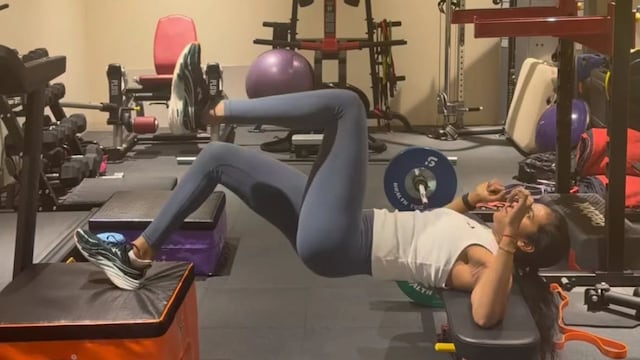
PV Sindhu has entered into the French Open 2026 final after a 73-minute semifinal against Japan's Hina Akechi, winning 21-10, 20-22, 21-16. As the two-time Olympic medallist prepares for her final against Olympic champion An Se-young, her demanding fitness routine offers a glimpse into the physical preparation required to compete at the highest level of badminton. Sindhu recently shared a glimpse of her workout on social media with the caption, 'Just me vs me'. The exercise highlighted the importance of single-leg strength training, balance and control, all of which are relevant to the rapid movements and explosive changes of direction required in badminton. From strength and conditioning to endurance, agility and recovery, here's a closer look at the fitness principles behind Sindhu's training routine.
1. Single-Leg Hip Thrusts For Strength And Stability
One of the exercises that brought Sindhu's 'Just me vs me' philosophy into focus was a single-leg hip thrust, also known as a single-leg glute bridge variation. In this exercise, the upper back is supported on a bench while one leg performs the movement, with the other leg elevated. The exercise targets the gluteal muscles and challenges the body to maintain stability while generating force through one side at a time. For badminton players, lower-body strength is essential for lunging towards the shuttle, pushing off the ground, changing direction and recovering quickly between shots. Single-leg exercises can also help identify differences in strength and control between the two sides of the body. However, they are only one part of a comprehensive training programme, and their benefits depend on correct technique, suitable resistance and individual training needs.
2. Strength Training To Support Explosive Movements
Badminton demands more than speed and quick reflexes. Players must repeatedly accelerate, jump, land, lunge and change direction while maintaining control of their bodies. In an earlier interview with Hindustan Times, Sindhu spoke about incorporating weight training, endurance and agility into her fitness programme. She also highlighted the importance of strengthening different parts of the body because of the sport's physical demands.
Strength training can help athletes develop the muscular capacity needed for powerful movements and repeated efforts on court. Exercises may target the legs, glutes, core, back and shoulders, depending on the athlete's requirements and training phase. For Sindhu, such conditioning is part of preparing her body for the repeated high-intensity efforts that competitive badminton demands.
3. Endurance Training For Long Rallies
A badminton match can involve repeated bursts of intense movement, interspersed with short recovery periods. As matches progress, players must maintain their footwork, reaction time and shot quality even when fatigue sets in.
Sindhu has previously spoken about the importance of endurance in her training. In an interview with Hindustan Times, she described working on endurance and agility alongside strength training, noting that the demands of longer rallies have made physical conditioning increasingly important.
Endurance training helps athletes sustain repeated efforts throughout a match. Depending on the training plan, conditioning may include running, court-based movement drills and other exercises designed to improve the ability to recover between intense efforts. The objective is not simply to build stamina but to maintain movement quality and decision-making as physical demands increase.
4. Agility And Footwork For Quick Changes Of Direction
Agility is central to badminton because players must move quickly in multiple directions to reach the shuttle. They also need to stop, stabilise themselves and return to a ready position before the next shot.
A comprehensive badminton conditioning programme may include footwork drills, controlled lunges, acceleration exercises and changes of direction. These movements help train the coordination and movement patterns required on court. Strength and agility also work together. Strong muscles can help generate force, while balance and coordination help players control their bodies as they move and land. For an elite player preparing for a final, maintaining these qualities is particularly important when facing an opponent capable of extending rallies and forcing repeated defensive movements.
5. Training Load And Recovery Matter
Training hard is only one part of an elite athlete's preparation. Managing fatigue and allowing the body to recover are equally important, particularly during tournaments when matches can take place on consecutive days. In an April 2026 interview with The Indian Express, Sindhu said she trained for approximately 20 to 25 hours a week at that stage of her preparation. She explained that her programme included on-court training, strength sessions, agility and movement drills, mobility work and recovery sessions, with training loads monitored by her performance team. Her comments underline an important principle: an athlete's training programme must be adjusted to match physical demands, competition schedules and recovery needs.
During a tournament, the objective is not necessarily to complete the hardest possible workout every day. It is to arrive at competition prepared to perform while managing fatigue and reducing the risk of injury.
6. A Protein-Focused Diet To Support Recovery
Nutrition is another important part of Sindhu's preparation. In the same interview with The Indian Express, she said she followed a gluten-free and lactose-free diet and consumed approximately 140 to 150 grams of protein daily to support muscle maintenance and recovery. Protein contributes to muscle repair and maintenance, while carbohydrates provide an important source of energy for demanding training sessions and competition. Adequate hydration and total energy intake are also essential for athletes undertaking intensive exercise.
However, dietary requirements vary according to body weight, training volume, health and individual nutritional needs. Sindhu's reported intake is specific to her preparation and should not be treated as a universal target for recreational exercisers.
7. The 'Just Me Vs Me' Philosophy
The idea behind 'Just me vs me' is a useful way to think about personal fitness progress. Rather than measuring every workout against another person's performance, individuals can focus on improving their own strength, technique, consistency and movement control. For most people, this could mean gradually improving exercise technique, building strength at an appropriate pace or becoming more consistent with physical activity.
Sindhu's single-leg workout also highlights why fitness is not simply about lifting heavier weights or building visible muscles. Balance, coordination and the ability to control movement are important components of physical performance.
However, professional athletes train under specialised supervision, and their routines are tailored to their sport, physical capabilities and competition schedules. Anyone looking to incorporate similar exercises should start with a suitable variation and prioritise proper technique.
Disclaimer: This content including advice provides generic information only. It is in no way a substitute for a qualified medical opinion. Always consult a specialist or your own doctor for more information. NDTV does not claim responsibility for this information.