

)
If you have been told your AMH (Anti-Mullerian Hormone) is low but your periods are regular, you are not alone, and this does not mean you cannot conceive. Low AMH can sound alarming and is often misunderstood as an immediate sign of infertility.
AMH is a marker of ovarian reserve, indicating how many eggs you have left, but it does not directly predict whether those eggs are healthy or whether you can conceive. Understanding this distinction can help reduce anxiety and guide you to take empowered decisions about your reproductive journey.
What Is AMH, and Why Does It Matter?
Low AMH with regular cycles is one of the most common and confusing fertility findings women encounter. When your doctor orders a fertility blood test, AMH is one of the first values they review. Anti-Mullerian Hormone is a hormone produced by small follicles in the ovaries, the tiny sacs that contain your eggs.
These follicles contain immature eggs, and the level of AMH in your blood gives an estimate of how many eggs are left in your ovarian reserve. The higher the number of follicles, the more AMH is released into the bloodstream. This is what fertility specialists call your ovarian reserve.
A higher AMH generally suggests a higher number of remaining eggs, while a lower AMH suggests fewer eggs. However, it is important to remember that AMH reflects quantity, not quality.
This is where much of the confusion begins. Many people assume that a low AMH automatically means poor fertility, but that is not always the case.
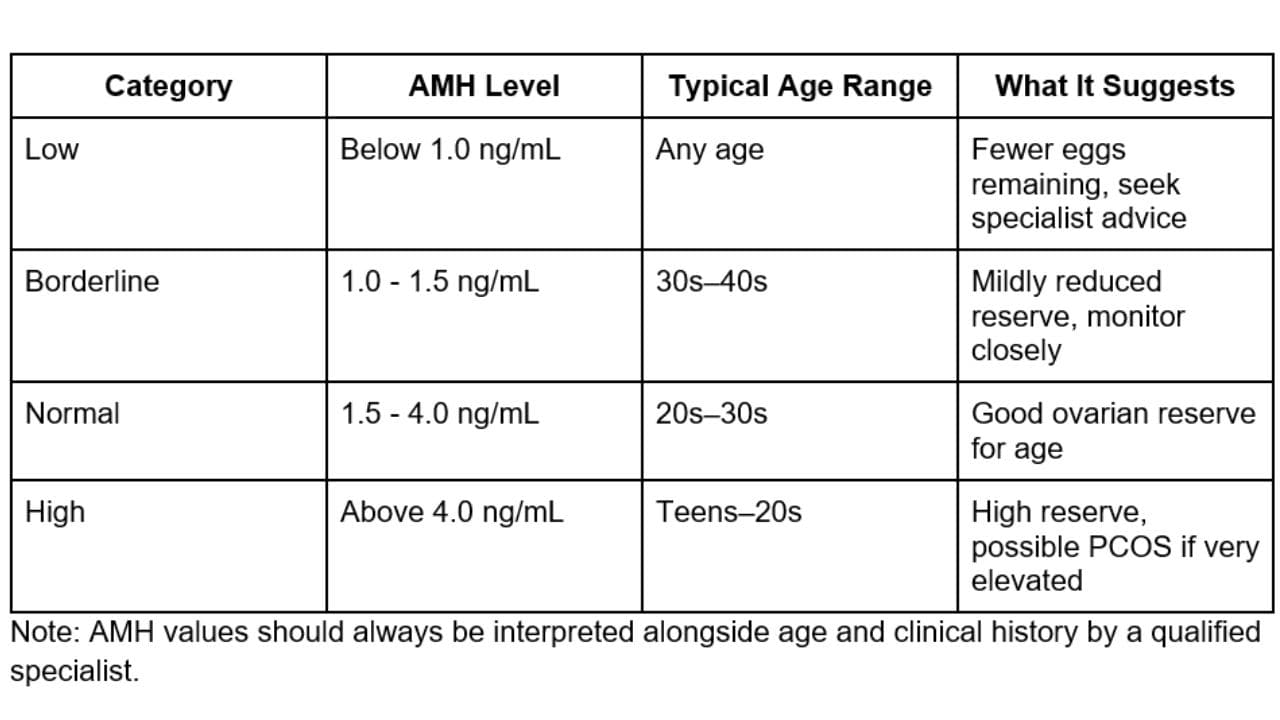
A "low" AMH is generally considered to be below 1.0 ng/mL, though some labs use slightly different cut-offs. If your result is below that range, it is natural to feel alarmed or confused, especially when everything else seems perfectly normal, including your monthly cycle. The table below shows AMH categories to help put your result in context:
AMH Reference Ranges by Category
Regular Periods: A Reassuring Sign
Here is something important that often gets lost in the numbers: if you are having regular periods, cycles that arrive roughly every 21 to 35 days, your body is almost certainly ovulating. If you are ovulating, you release an egg every month.
Ovulation is the cornerstone of natural conception, and regular cycles suggest that your hormonal system, the intricate communication network between your brain, pituitary gland, and ovaries (hormonal system), is functioning well.
Your FSH (follicle-stimulating hormone) and LH (luteinizing hormone) are doing their job. Your body is responding appropriately.
This is important because even if your ovarian reserve is lower than average for your age, you may still be ovulating normally, and that means pregnancy is still possible.
Ovarian Reserve vs Fertility Potential
One of the most important distinctions to understand is the difference between ovarian reserve and fertility potential.
- Ovarian reserve refers to the number of eggs remaining in your ovaries.
- Fertility potential refers to your ability to conceive, which depends on multiple factors, including egg quality, sperm health, fallopian tube function, uterine health, and timing of intercourse.
Low AMH only indicates the number of eggs. It does not tell us whether those eggs are capable of being fertilised or developing into a healthy pregnancy. In fact, many women with low AMH conceive naturally, especially if they are younger and have no other fertility issues.
A landmark study published in the JAMA (Journal of the American Medical Association) found that women with low AMH who were trying to conceive naturally had no significantly reduced chance of conception compared to those with normal AMH levels, particularly under the age of 35.
Age Matters More Than AMH Alone
Age plays a major role in fertility because it is closely linked to egg quality. With age, the likelihood of chromosomal abnormalities in eggs increases. According to the Human Fertilisation and Embryology Authority (HFEA), age is one of the most important factors affecting the success of fertility treatment.
Egg quality, which is primarily determined by age and genetic factors, is actually a stronger predictor of fertility than egg quantity. A woman in her late 20s or early 30s with low AMH may have fewer eggs. Still, the eggs she does have are statistically more likely to be chromosomally normal and capable of resulting in a healthy pregnancy. Compare this to a woman in her early 40s with a "normal" AMH, she may have more eggs, but age-related changes in egg quality may still make conception more challenging. This is why doctors often interpret AMH results in the context of age, rather than in isolation.
Why Can AMH Be Low?
There are several reasons why AMH levels might be lower than expected:
- Natural variation between individuals
- Increasing age
- Previous ovarian surgery
- Certain medical treatments, such as chemotherapy
- Genetic factors
Sometimes, there is no clear reason at all. A low AMH result can simply reflect your individual biology rather than a disease or problem.
Low AMH with regular cycles is a situation that calls for awareness, not alarm.
It may indicate that your reproductive timeline is shorter than average, but it does not rule out natural conception. And for natural conception, you only need one good egg per cycle. Many women in this situation go on to have successful pregnancies, sometimes without any medical intervention.
Women with low AMH have successful IVF cycles. Women with low AMH go on to have the families they dreamed of. Your ovarian reserve is one chapter in your fertility story, not the whole book.
If your cycles are regular and you are ovulating, your body is doing something remarkable and meaningful, regardless of your AMH level. Work with a specialist you trust, stay curious, and give yourself the grace to take this step by step.
(By Dr Apurva Satish Amarnath, Clinical Director & Fertility Specialist, Nova IVF Fertility, Kalyan Nagar)
Disclaimer: The opinions expressed within this article are the personal opinions of the author. NDTV is not responsible for the accuracy, completeness, suitability, or validity of any information on this article. All information is provided on an as-is basis. The information, facts or opinions appearing in the article do not reflect the views of NDTV and NDTV does not assume any responsibility or liability for the same.