

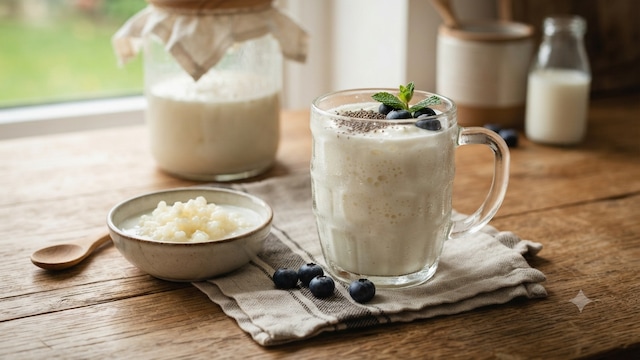
Fermented foods have long been a part of our everyday diet, with curd being one of the most common choices in Indian households. From pairing it with meals to making buttermilk and raita, curd is often included in our daily food habits. But have you heard of kefir? Often described as a probiotic-rich fermented drink, kefir is gaining attention for its potential gut health benefits. It is made by fermenting milk with kefir grains, which contain a mix of bacteria and yeasts. The fermentation process gives it a slightly different taste and texture from regular curd.
Kefir is known for containing a wider variety of microorganisms than traditional yoghurt or curd. These microorganisms may help support gut health by adding to the diversity of microbes in the digestive system. It is also a source of nutrients found in milk, including protein and calcium. However, its probiotic content and taste can vary depending on how it is prepared and fermented.
Now, if you are curious about making kefir at home, Dr Pal Manickam has shared a simple recipe. The doctor dropped a video on Instagram, explaining how to prepare probiotic-rich kefir curd using just two main ingredients: milk and kefir grains.
Dr Pal began by explaining what kefir grains are. He described them as a living community of microorganisms held together by a natural polysaccharide and protein matrix. In simpler words, these grains contain good bacteria and yeasts that help ferment milk.
Here's how he prepares it:
1. Get a clean glass jar: Start with a sterile and clean glass container. Make sure it is completely clean before adding the ingredients.
2. Add kefir grains: Put the kefir grains into the glass jar. Dr Pal mentioned that these grains are easily available online. He also shared that 25 grams cost around $18 in the US and approximately ₹800 in India.
3. Pour in the milk: Take full-fat milk, boil it and allow it to cool to room temperature. Pour the cooled milk into the jar containing the kefir grains.
4. Cover and ferment: Place a clean tissue paper over the jar. Do not close the lid tightly. Allow the mixture to ferment for around 12 to 24 hours.
5. Strain the mixture: Once fermentation is complete, use a bowl and a strainer with relatively larger holes to separate the kefir curd from the grains.
The kefir curd is now ready to eat.
Can kefir grains be reused?
Yes, Dr Pal highlighted that one of the best parts of making kefir at home is that the grains can be reused. Once separated from the fermented curd, transfer them to another clean glass jar and use them for the next batch.
Talking about its taste, the gastroenterologist said that kefir may not look as creamy as regular curd. However, he likes its slightly sweet taste and pointed out that it is not as sour or tangy as regular curd.
Disclaimer: This content including advice provides generic information only. It is in no way a substitute for a qualified medical opinion. Always consult a specialist or your own doctor for more information. NDTV does not claim responsibility for this information.