

)
If you want stronger shoulders, you probably already have a few familiar exercises in your routine, from overhead presses and lateral raises to the shoulder press machine. But there is another movement that can challenge your shoulders while also demanding control from your core and upper body: the Z press. Unlike a conventional overhead press, the Z press is performed while sitting on the floor with your legs extended straight in front of you. This seemingly simple change removes the support you normally get from a bench or your lower body, forcing you to maintain an upright posture and control the weight throughout the movement. For people looking to build shoulder strength while improving stability and pressing mechanics, the Z press can be a useful addition to a well-rounded strength-training routine.
What Is The Z Press?
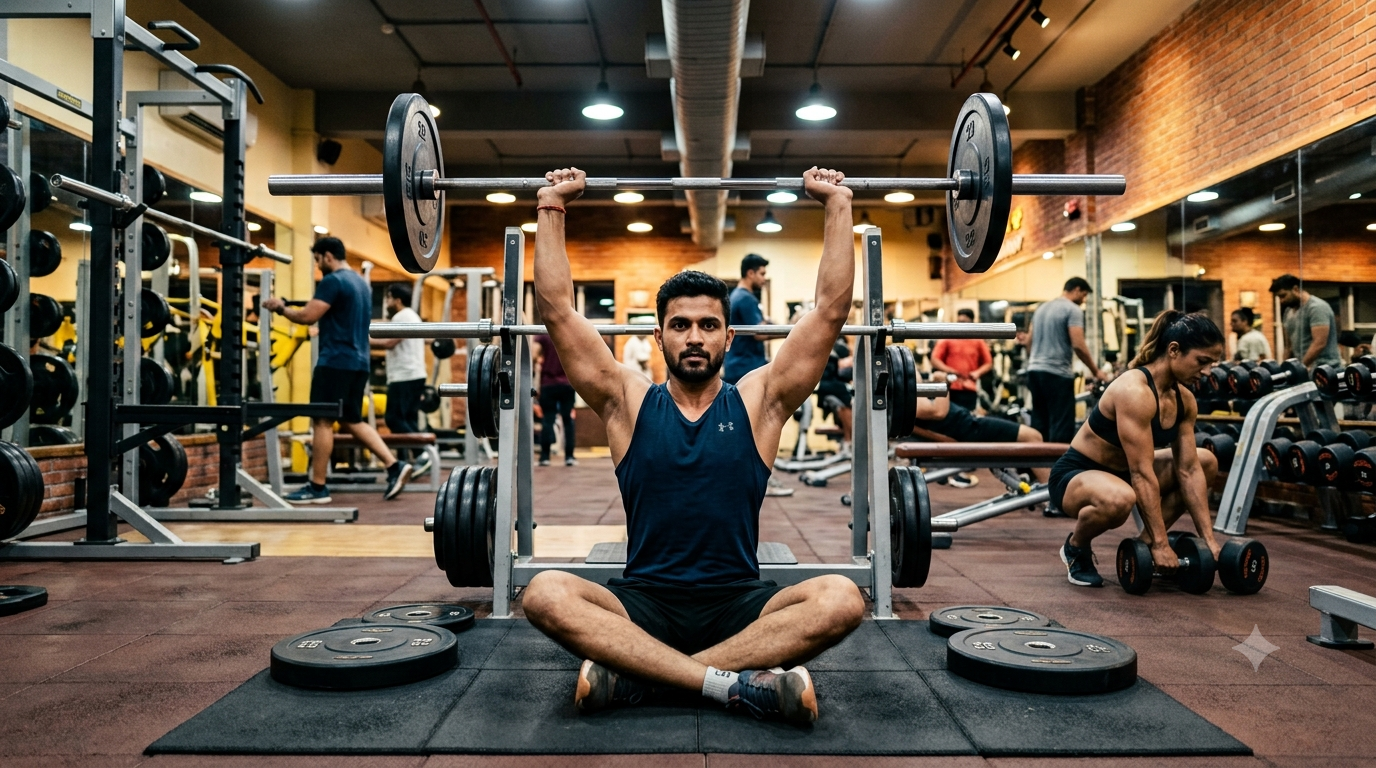
The Z press is a seated overhead pressing exercise generally performed with a barbell, dumbbells or kettlebells. To perform it, sit on the floor with your legs extended in front of you. Keep your torso upright, brace your core and hold the weights around shoulder height. From this position, press the weights overhead until your arms are extended, then lower them under control. Because your legs remain extended and you are not sitting on a bench, you cannot rely on your lower body to generate momentum. Your upper body and core have to remain stable as you press.
Why Does The Z Press Work Your Shoulders?
The primary muscles involved in the movement are the deltoids, particularly the front and side portions of the shoulder. The triceps also contribute significantly as you extend your elbows to press the weight overhead. However, the exercise is not limited to the shoulders. Your abdominal and lower-back muscles have to work to keep your torso upright. Muscles around the shoulder blades and upper back also contribute to maintaining a stable pressing position. This makes the Z press more than just another shoulder exercise. It combines pressing strength with postural control and stability.
1. It Challenges Shoulder Strength
The Z press puts your shoulders in charge of the movement because you cannot easily use your legs to create momentum. That can make even a relatively light weight feel challenging. The exercise may therefore help develop overhead pressing strength when performed with appropriate technique and progressive resistance.
2. It Trains Your Core At The Same Time
Sitting on the floor with your legs straight changes the stability demands of the exercise. Your core has to remain engaged to prevent your torso from collapsing backwards or excessively arching as you press. This means your abdominal muscles are working throughout the movement to help maintain your position. A stronger core can also contribute to better control during other compound exercises.
3. It Encourages Better Pressing Control
The lack of lower-body assistance makes it harder to turn the movement into a full-body push. This can encourage you to slow down, maintain a stable torso and pay closer attention to your pressing path. For experienced lifters, that can make the Z press useful as an accessory movement alongside conventional overhead pressing.
4. It Can Highlight Mobility Limitations
The starting position requires you to sit upright with your legs extended. If your hips or hamstrings are tight, maintaining this position can be difficult. You may find yourself rounding your lower back or struggling to keep your torso vertical. That does not necessarily mean the exercise is unsuitable, but it is a reminder that mobility and exercise technique can affect how comfortably you perform a movement.
How To Do The Z Press Correctly
Start with a light weight, particularly if you have never performed the exercise before.
- Sit on the floor with your legs extended straight in front of you.
- Keep your chest lifted and spine in a neutral position.
- Hold a barbell or a pair of dumbbells at shoulder height.
- Brace your abdominal muscles before initiating the press.
- Press the weight overhead in a controlled manner.
- Avoid leaning excessively backwards as the weight moves upward.
- Fully extend your arms without aggressively locking your elbows.
- Lower the weight slowly back to the starting position.
- Repeat for the desired number of repetitions.
The priority should be control and posture rather than lifting the heaviest possible weight.
Common Z Press Mistakes To Avoid
One of the most common mistakes is using too much weight. When the load becomes excessive, people may compensate by leaning backwards, losing their posture or using momentum. Another mistake is allowing the lower back to become excessively arched. The goal is to maintain a strong, controlled torso throughout the movement.
You should also avoid rushing through the repetitions. The Z press is particularly useful when performed with control, as this allows you to focus on the movement rather than simply moving the weight from one position to another.
How To Add The Z Press To Your Workout
The Z press does not necessarily need to replace your regular overhead press. Instead, it can be used as an accessory exercise after your primary strength movement. If you are new to the exercise, start with a manageable load and focus on learning the movement. Depending on your overall programme, you could perform it for around 2 to 4 sets of 6 to 12 controlled repetitions. Dumbbells can be a convenient starting option because they allow each arm to move independently. A barbell can be introduced if you are comfortable with the movement and can maintain good posture.
Who Should Be Careful With The Z Press?
The Z press can be demanding on the shoulders, hips, hamstrings and lower back. If you have an existing injury, pain during overhead movements or significant mobility restrictions, it is worth speaking with a qualified fitness professional or physiotherapist before adding it to your routine. And remember, feeling your muscles work is different from experiencing sharp or persistent pain. Stop the exercise if something feels painful or abnormal.
The Z press may look simple because you are sitting on the floor, but that is precisely what makes it challenging. By taking away much of the assistance available during a conventional standing or seated press, the exercise asks your shoulders, core and upper body to work together. If your goal is to build stronger shoulders, improve pressing control and add some variety to your strength routine, the Z press can earn a place in your workout. Start light, prioritise technique and increase the load gradually as your strength and control improve.