

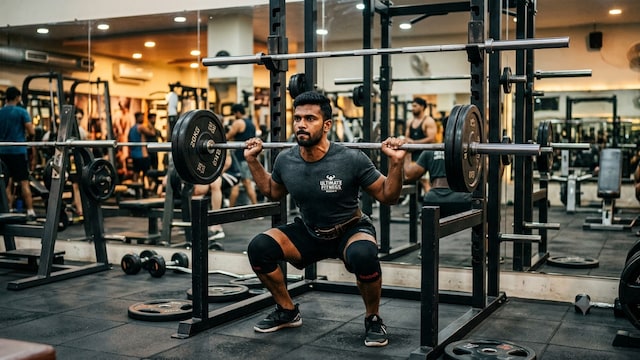
If heavy squats feel unstable or you struggle to generate enough force while coming out of the bottom position, your breathing technique could be playing a bigger role than you realise. Among experienced strength athletes, the Valsalva manoeuvre is commonly used during heavy lifts to create greater trunk stability and help the body handle high loads. The technique involves taking a deep breath and briefly holding it while bracing the abdomen during the most demanding part of a lift. It is particularly relevant when performing heavy compound exercises such as squats and deadlifts. But the Valsalva manoeuvre is not simply about holding your breath. It changes pressure inside the trunk, helping create a more rigid torso that can provide a stronger base for force production. At the same time, it can cause a substantial temporary rise in blood pressure, meaning it is not appropriate for everyone.
What is the Valsalva manoeuvre?
The Valsalva manoeuvre involves taking a deep breath, bracing the abdominal muscles and briefly attempting to exhale against a closed airway. During heavy resistance training, this can increase intra-abdominal and intrathoracic pressure. The resulting increase in trunk stiffness can help the lifter maintain their position when dealing with a heavy external load.
Research published in the Journal of Strength and Conditioning Research says that resistance exercise shows that heavy lifting can produce marked increases in arterial pressure, with the Valsalva manoeuvre contributing to changes in pressure within the chest and abdomen.
In simple terms, think of it as creating a temporary internal brace.
How can it help your squat?
A heavy squat requires more than strong legs. Your trunk needs to remain sufficiently stable while your hips, knees and ankles produce force. When the torso becomes unstable, some of the force generated by the lower body can be lost through unwanted movement. A properly performed brace can help the lifter maintain a more rigid torso and transfer force efficiently. This is particularly important during heavy sets, when maintaining spinal and pelvic position becomes more challenging. The technique may therefore help with:
- Better trunk stability: Increased pressure inside the trunk can make it easier to maintain a rigid torso under load.
- Improved force transfer: A stable torso provides a stronger platform from which the hips and legs can produce force.
- Confidence under heavy loads: Maintaining a solid brace can make a heavy repetition feel more controlled.
- Maintaining technique: A strong brace can help prevent excessive movement of the torso during demanding repetitions.
However, it is important to understand that the Valsalva manoeuvre does not directly increase muscle strength. Strength gains still come from progressive resistance training, adequate recovery and appropriate programming. The latest American College of Sports Medicine position stand notes that heavier loads, particularly at or above around 80 per cent of one-repetition maximum, can be useful for improving maximal strength in healthy adults. (PubMed)
How do you perform it during a squat?
The exact breathing strategy can vary depending on the lifter, load and training experience, but the basic sequence is relatively simple. Before starting a heavy repetition, take a deep breath and expand your abdomen and torso rather than simply lifting your shoulders. Brace your abdominal muscles as if preparing to receive a punch. Maintain that brace while descending and during the most demanding portion of the squat. Once you have passed the sticking point and are able to complete the repetition safely, gradually release the breath and reset before the next repetition. For very heavy squats, the technique is generally more relevant to individual repetitions than to long sets. The goal is not to hold your breath for an unnecessarily long period. It is to create sufficient pressure and trunk stability for the demanding part of the movement.
Why does bracing matter so much in heavy squats?
As the weight on the bar increases, the body needs to resist forces that can cause the torso to bend or lose position. A strong brace helps the muscles around the abdomen and trunk work together to provide stability. This can make it easier to keep the rib cage, pelvis and spine in a controlled position while the legs perform the movement. That is why experienced lifters often treat breathing and bracing as part of the lift itself rather than something separate from their squat technique.
If you are struggling with heavy squats, however, breathing technique should not be the first thing you blame. Poor mobility, insufficient strength, inappropriate load, fatigue or technical problems can also affect performance.
Does holding your breath increase blood pressure?
This is one of the most important aspects of the Valsalva manoeuvre to understand. Resistance exercise itself can produce substantial temporary increases in blood pressure. Adding breath-holding can increase the cardiovascular response further. Acording to a 2026 randomised crossover study published in journal Physiological Reports examining squats found that breath-holding produced higher systolic blood pressure, heart rate, cardiac output and perceived exertion than controlled breathing, even at low-to-moderate exercise intensities in healthy young women.
Another recent study published in journal European Journal of Applied Physiology found that resistance exercise performed with the Valsalva manoeuvre produced a greater acute increase in mean arterial pressure than resistance exercise with paced breathing. This does not mean the technique is inherently dangerous for a healthy, experienced lifter when used appropriately. But it does mean that breath-holding should not be treated casually.
Should beginners use the Valsalva manoeuvre?
Beginners should first learn basic breathing, bracing and squat technique before attempting maximal or near-maximal loads with prolonged breath-holding. If you are still learning how to squat, controlled breathing may be a better starting point. As the load increases and technique becomes more established, a qualified strength coach can teach you how to brace safely and appropriately. There is also no need to use an aggressive Valsalva manoeuvre for every light or moderate set. Your breathing strategy should match the demands of the exercise rather than becoming an automatic habit for every repetition.
Who should be cautious?
Because the manoeuvre can cause substantial temporary changes in blood pressure and cardiovascular responses, people with cardiovascular disease, uncontrolled hypertension or other medical conditions should not start using prolonged breath-holding during heavy lifting without discussing it with their doctor. The same applies if you experience dizziness, chest pain, fainting, unusual shortness of breath or other concerning symptoms while lifting.
A recent review of resistance exercise notes that heavy lifting can produce extreme acute elevations in arterial pressure, highlighting why individual health status and exercise prescription matter.
The Valsalva manoeuvre can be a useful tool for experienced lifters performing heavy squats because it can increase trunk stiffness and help maintain stability when handling high loads. But it is not a shortcut to becoming stronger. Good squat technique, progressive training, adequate recovery and appropriate load selection remain the foundation of strength development. And because the manoeuvre can temporarily raise blood pressure significantly, it should be learned properly rather than copied from an experienced lifter without understanding the risks. If heavy squats are consistently difficult, improving your bracing technique may help, but it is equally important to examine your overall squat form, programming, mobility and strength.
Disclaimer: This content including advice provides generic information only. It is in no way a substitute for a qualified medical opinion. Always consult a specialist or your own doctor for more information. NDTV does not claim responsibility for this information.