

I remember a trip to a rural medical camp a few years ago with some friends. It was held at a local school. As we parked the car and walked towards the school, along with several doctors and nurses, I saw a massive crowd: thousands of people packed inside a small, gated school campus! They were anticipating the arrival of a popular film actor who had also been invited to the medical camp.
I took one look at the scene and declared, "This is high risk. A stampede could happen," and turned back. My friends were intelligent and quickly tuned in. We returned to base safely.
Moral of our experience: The best defence against a stampede is to identify the signs early and get out before things get out of hand.
Why do stampedes happen?
The risk of a stampede or crowd crush increases when too many people are packed into a limited space - this can be a performance hall, place of worship, music concert, political gathering or sports arena. A sudden rush, panic, or crowd movement towards a bottleneck at an entrance or exit can then trigger a chain reaction.
For instance, a lot of people could rush indoors to take shelter if it rained suddenly. People at the back may continue pushing forward without realising that those in front have nowhere to go. Unexpected gradients are a trigger, for instance if the crowd was expecting level ground but there are stairs leading downward into the main area. A narrow section (bottleneck) such as a door can obstruct the flow of people, leading to a stampede. A sudden event such as a person fainting can lead to several people falling over one another. Even an unexpected scream or other perceived or real threats could trigger panic, and people may start running.
Death tolls from various stampedes across the world range from a few individuals to over a thousand.
READ | Bihar Temple Stampede: First Aid Steps To Prevent Brain, Body Trauma In Crowded Places
How does death occur?
When people are packed tightly together, sustained pressure on the chest and abdomen can prevent breathing. This is known as compression asphyxia. When vital organs are deprived of oxygen for too long, irreversible injury and eventually cardiac arrest can occur. In the 1989 Hillsborough Stadium disaster in Sheffield, England, 97 people ultimately died. Forensic investigations identified compression asphyxia as the principal cause of death in most cases.
In addition to asphyxia, people who have fallen may also be physically trampled upon by others who are unable to stop or see what is happening on the ground. This can cause fractures of the chest wall, limbs and spine, punctured lungs, bleeding, head injury, and damage to internal organs.
Those who survive may have crush injuries to internal organs such as the liver, intestines and kidneys. Prolonged compression of muscles can also cause crush syndrome, which may lead to acute kidney injury.
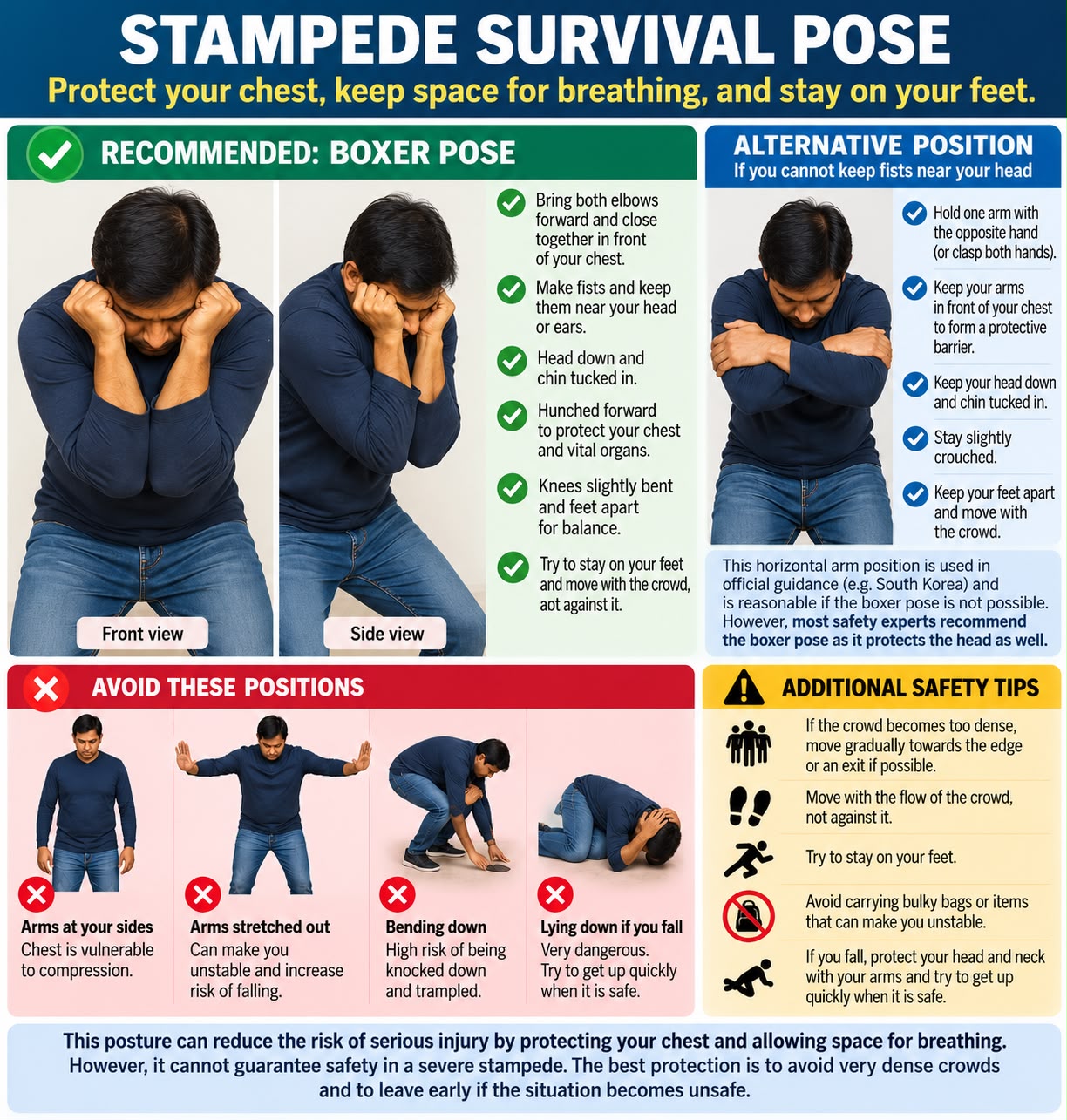
If caught in a stampede, the following are some survival tips:
- Keep your elbows bent in front, "like a boxer," so you can try to preserve some space for breathing. Bring your forearms in front of your chest, with your hands near your face. This protective posture may help resist chest compression, although it cannot guarantee protection when crowd pressure becomes extreme.
- Try your best to stay on your feet. Falling in a densely packed crowd can be fatal, as the pressure from surrounding people can prevent breathing. To avoid this, it is vital to keep your balance and avoid sudden movements. Watch out for people falling nearby, as one fall can trigger a chain reaction.
- To avoid falling, keep your feet apart and your knees slightly bent. This gives you a more stable stance. NEVER push forward. Pushing forward abruptly can increase pressure on people ahead. The resulting crowd movement can destabilise people and cause them to lose their balance and fall backwards. In a tightly packed crowd, it is important to know that people may lose control of their own movements.
- If you fall, try to get up as soon as possible, before more people fall on you and it becomes impossible to escape. In the chaos, it may be difficult to see clearly or communicate. Grab any available support to try to get back on your feet. The priority is to get upright before prolonged compression causes serious injury.
- If you cannot get up, protect your head and neck with your arms. Keep your elbows in front of your chest to preserve some space for breathing, and draw your knees towards your body. Try to make yourself as compact as possible while protecting your vital areas. There is no position that guarantees safety under extreme crowd pressure, so focus on getting back on your feet as soon as conditions permit.
- Go along with the crowd, NEVER against it. Look for opportunities to move diagonally towards a less crowded area or an exit, but without forcing your way through.
- NEVER bend down to pick something up, even if it is a phone, bag or shoe. You could fall and be unable to get up. It is not worth the risk.
Biggest lesson: To survive ANY emergency, we must know what to do BEFOREHAND. Before visiting any unfamiliar place, know exactly where the exits are.
(By Rajeev Jayadevan, M.D, DNB, MRCP(UK), ABIM (American Board Certification in Medicine), ABIM (American Board Certification in Internal Medicine), Fellowship in Gastroenterology (New York Medical College))
Disclaimer: The opinions expressed within this article are the personal opinions of the author. NDTV is not responsible for the accuracy, completeness, suitability, or validity of any information on this article. All information is provided on an as-is basis. The information, facts or opinions appearing in the article do not reflect the views of NDTV and NDTV does not assume any responsibility or liability for the same.