

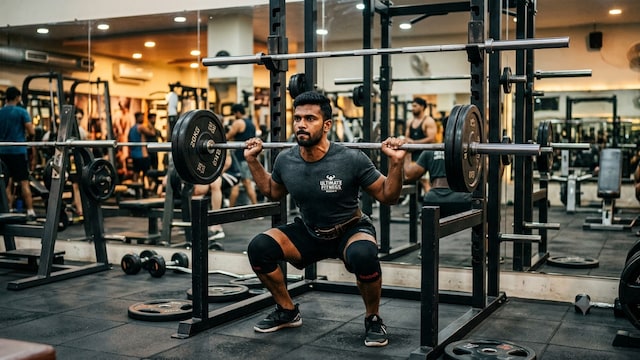
The squat is one of the exercises you can do to build strength in your lower body. It works muscles like the quadriceps, glutes and hamstrings. It also asks your core to help keep your body steady and balanced. No matter if you are just starting out or have been working out for years how deep you go in a squat can change how effort your muscles have to put in. Here's the real question: how low should you go? Should you bring your thighs parallel to the floor?. Go lower so your hips drop below your knees? What if you only do half a squat--does that still build strength and muscle? There's no one-size-fits-all answer. Your personal squat depth should depend on your flexibility your body shape, your experience with lifting what you want to achieve and your ability to keep form. Going deeper can mean a range of motion and more work for certain muscles.. If you force yourself to squat too low and lose control or balance you might risk injury or weaken the benefits. Knowing what depth works best for you can help you get stronger without sacrificing your form.
So what is the ideal squat depth?
"One popular goal is to squat until your thighs are parallel to the floor. That means your hip crease--where your leg meets your torso--should be at the same level as your knees. This depth is often suggested because it gives a balance, between effectiveness and safety.. Remember, it's not a rule you must follow. It's a helpful guide. However, some people can comfortably squat deeper, with their hips moving below their knees. This is commonly referred to as a deep squat," says Yashwardhan, fitness trainer and owner of Fuel Fitness.
"The right depth depends on whether you can maintain control throughout the movement. Your heels should remain grounded, your feet should stay stable, and your knees should move in line with your toes without collapsing excessively inward. For beginners, reaching parallel with good technique can be a useful initial goal. As strength, confidence and mobility improve, you can gradually explore a deeper range of motion," Yashwardhan adds.
Does Squatting Deeper Build More Muscle?
Squatting through a greater range of motion can increase the amount of work performed by the muscles involved in the exercise. Research suggests that training with a fuller range of motion can be beneficial for muscle development, particularly in the lower body. A deeper squat generally increases the contribution of the gluteal muscles and challenges the quadriceps through a greater range of movement. It also requires more coordination and control around the hips, knees and ankles. However, deeper is not automatically better in every situation. The benefit depends on your ability to maintain good technique and tolerate the movement. If your lower back rounds excessively, your heels lift or you lose balance as you descend, forcing yourself lower may reduce the quality of the exercise.
5 Factors That Determine How Deep You Should Squat
1. Hip mobility and anatomy
Your hip structure and individual anatomy can influence how comfortably you squat. Some people can descend below parallel while keeping their torso relatively upright, while others naturally lean forward more. Neither position is necessarily wrong. Your stance width and toe angle may need to be adjusted to find a comfortable movement pattern. The aim is to find a depth that allows your hips to move freely without pain or loss of control.
2. Ankle mobility
Limited ankle dorsiflexion can make it difficult to move the knees forward while keeping the heels on the floor. This may restrict squat depth or cause your heels to lift during the descent.
Exercises such as controlled knee-to-wall ankle mobilisation and calf stretches may help improve ankle mobility. Weightlifting shoes with an elevated heel can also help some lifters achieve a more comfortable squat position. However, footwear should not be used to force a range of motion that your body cannot control.
3. Your training experience
Beginners should prioritise learning the squat pattern before attempting very deep squats with heavy weights. Starting with bodyweight squats, box squats or goblet squats can help develop balance, coordination and confidence. Once you can maintain a stable position, you can gradually increase the depth and resistance. Experienced lifters may be able to use deeper squats effectively, provided their technique remains consistent.
4. Your fitness goal
Your squat depth can also depend on what you want to achieve. If your primary goal is general lower-body strength and muscle development, squatting to parallel or slightly below can be a useful option. Deeper squats may offer additional muscle-building benefits when performed comfortably. If you are training for a particular sport or strength competition, your required squat depth may be determined by the demands or rules of that activity. The important thing is to choose a range of motion that supports your goal without sacrificing control.
5. Pain, injuries and individual limitations
A squat should challenge your muscles, but it should not cause sharp pain in your knees, hips or lower back. If you experience pain at a particular depth, do not force yourself to descend further. Reduce the range of motion, adjust the load and review your technique. People recovering from injuries or managing joint conditions should seek guidance from a qualified physiotherapist or healthcare professional before progressing to heavy or deep squats.
Common Squat Depth Mistakes To Avoid
- Forcing a deeper squat: Going below parallel is not compulsory if you cannot maintain control. Progress gradually instead of chasing depth at the expense of technique.
- Lifting your heels: Your feet should remain stable throughout the movement. If your heels lift, assess your ankle mobility, stance and squat technique.
- Allowing your knees to collapse inward: Your knees should generally track in the direction of your toes. Some movement is natural, but uncontrolled inward collapse under load should be addressed.
- Rounding your lower back excessively: Maintain a controlled trunk position throughout the descent and ascent. Some pelvic movement at the bottom of a deep squat can occur naturally, but excessive spinal flexion under heavy load is best avoided.
Adding too much weight too soon: Increasing the load before mastering the movement can compromise technique. Build strength and control before progressing to heavier weights.
How To Improve Your Squat Depth Safely
If you struggle to reach parallel, work on the movement gradually rather than forcing your body into a deeper position. Begin with bodyweight squats and focus on maintaining balance through your feet. Experiment with a slightly wider stance or a comfortable toe angle if needed. You can also use a goblet squat, holding a dumbbell close to your chest, to make it easier to maintain an upright torso. Include ankle and hip mobility exercises in your warm-up, but remember that mobility alone does not determine squat depth. Strength and control at the bottom of the movement are equally important.
Once you can perform the movement comfortably, gradually increase your range of motion and resistance. Avoid increasing both the depth and weight aggressively at the same time. There is no universal squat depth that everyone must achieve. Squatting to parallel is a useful benchmark, while going below parallel can provide additional range of motion and muscle-building benefits for people who can do it comfortably.
Your ideal depth should allow you to maintain balance, control and stable technique without pain. Instead of chasing the deepest possible squat, focus on developing strength through a range of motion that suits your body and training goals. A well-controlled squat performed consistently is more valuable than a deeper squat performed with compromised technique.
Disclaimer: This content including advice provides generic information only. It is in no way a substitute for a qualified medical opinion. Always consult a specialist or your own doctor for more information. NDTV does not claim responsibility for this information.