

)
Squats are one of the most effective exercises for building lower-body strength, improving balance, and developing the muscles of the thighs, hips, and glutes. They are also a common part of strength-training routines, whether your goal is muscle gain, fat loss, athletic performance, or better functional fitness. However, performing squats with poor technique can reduce their effectiveness and place unnecessary stress on the knees, hips, ankles and lower back. The problem is not always the exercise itself. In many cases, the issue is incorrect form, excessive weight, poor mobility or a lack of control. If you want to make your next leg workout safer and more effective, avoid these seven common squat mistakes.
1. Using Too Much Weight
One of the most common mistakes is loading the barbell with more weight than you can control. Lifting heavy can support strength and muscle growth, but only when the weight allows you to maintain proper technique. If the load is too heavy, you may lean forward excessively, allow your knees to collapse inward or shorten the range of motion. Research published in the journal PLOS One indicates that training the lower body two times a week yields higher strength gains measured by 1-repetition maximum compared to lower or unstructured frequencies.
These compensations can reduce tension on the target muscles and increase stress on other joints. How to avoid it: Start with a manageable weight and increase the load gradually. Choose a weight that allows you to complete your planned repetitions with controlled movement and stable posture.
2. Allowing The Knees To Collapse Inward
During a squat, some people allow their knees to move towards each other as they lower or rise. This movement is often called knee valgus. A small amount of inward movement may occur naturally, but repeated or excessive collapse can affect lower-body alignment and reduce movement efficiency.
Weakness or poor coordination in the hips, glutes and surrounding muscles may contribute to this problem. Foot position and ankle mobility can also influence how the knees move. How to avoid it: Keep your knees tracking broadly in line with your toes. Focus on pushing through the whole foot and maintaining control as you lower and stand up.
3. Lifting Your Heels Off The Floor
Your feet should remain stable during a standard squat. Lifting the heels can shift your weight forward and make it harder to maintain balance. As per a study published in International Journal of Sports Physical Therapy, the leg extension exercise isolates and strengthens the quadriceps, the four-part muscle group located on the front of the thigh.
This mistake may occur because of limited ankle mobility, an overly narrow stance or an attempt to squat deeper than your current mobility allows. When the heels rise, the movement may become less stable and place additional pressure on the front of the foot and knees. How to avoid it: Keep your heels firmly planted and distribute your weight across the heel, base of the big toe and base of the little toe. If ankle mobility is limiting your squat, work on it gradually or use a variation that suits your current range of motion.
4. Rounding Or Overarching The Lower Back
A squat requires a stable torso. Excessive rounding of the lower back, sometimes called a "butt wink", or an exaggerated arch can make it difficult to maintain a strong position under load.
Some movement in the spine can be normal, but losing control of the trunk, especially while lifting heavy weights, may increase strain on the lower back. How to avoid it: Brace your core before beginning the repetition. Keep your ribs and pelvis controlled, maintain a neutral spinal position and avoid forcing yourself into a depth that you cannot manage comfortably. Your ideal squat depth will depend on your anatomy, mobility, training experience and the variation you are performing.
5. Dropping Too Quickly
Another common mistake is descending rapidly and bouncing out of the bottom position. A controlled descent helps you maintain balance, understand your positioning and keep tension on the working muscles. Dropping too quickly can make it difficult to control the knees, hips and torso. Using momentum to rise may also reduce the quality of the repetition. How to avoid it: Lower yourself at a steady pace, pause briefly if needed and drive upwards with control. You do not have to squat slowly for every repetition, but you should always remain in control of the movement.
6. Squatting Only Halfway Without A Clear Reason
Some people perform very shallow squats because they are trying to lift heavier weights or complete more repetitions. While partial squats can have a role in certain training programmes, consistently avoiding a comfortable range of motion may limit muscle development and movement practice. The best depth is not identical for everyone. It depends on body proportions, hip and ankle mobility, training goals and the squat variation. How to avoid it: Aim for the deepest position you can reach while maintaining balance, control and good alignment. For many people, this means lowering until the thighs are at least approximately parallel to the floor, although a different depth may be more appropriate in some cases. Never force depth through pain or by losing spinal and knee control.
7. Ignoring Warm-Up And Recovery
Starting heavy squats with cold muscles is another mistake, particularly before a demanding leg session. A proper warm-up prepares the body for movement, increases body temperature and allows you to practise the technique before adding significant weight. Skipping recovery can also affect performance and increase fatigue during future workouts. How to avoid it: Begin with five to 10 minutes of general movement, followed by bodyweight squats, hip movements, ankle mobility drills and lighter warm-up sets. Increase the weight gradually rather than jumping directly into your heaviest working set. Allow your lower body adequate recovery between intense sessions. Sleep, nutrition, hydration and sufficient protein also support muscle repair and training progress.
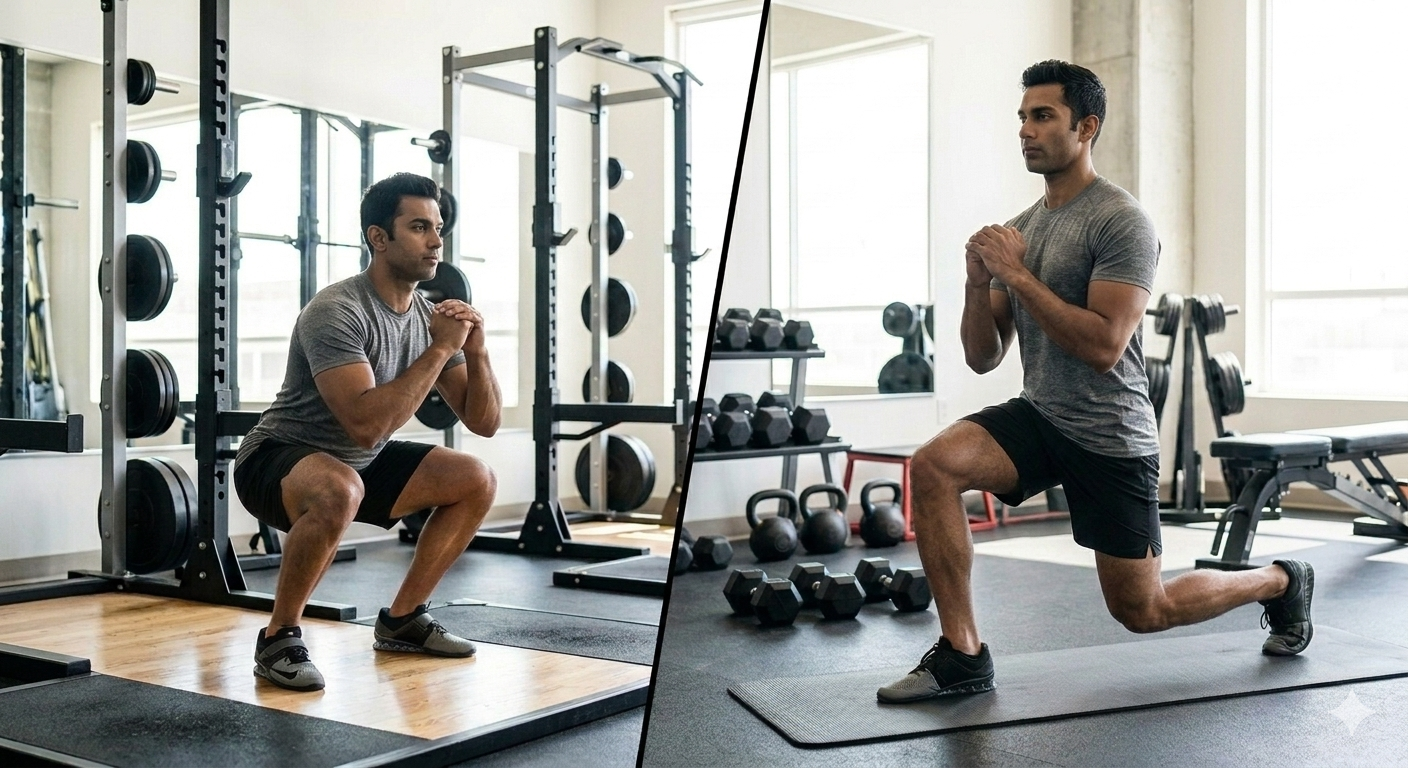
How To Perform A Basic Bodyweight Squat
Before progressing to heavy barbell squats, practise the movement with your body weight.
- Stand with your feet around shoulder-width apart.
- Keep your chest lifted and your core gently braced.
- Push your hips back and bend your knees.
- Lower your body while keeping your feet stable.
- Allow your knees to track in the direction of your toes.
- Descend only as far as you can maintain control.
- Push through your feet to return to the starting position.
Practise in front of a mirror or record your form from the side if you are unsure about your technique. A qualified trainer or physiotherapist can also help identify movement limitations. Squats can be an excellent exercise for building strength and muscle, but technique should always come before heavier weights or more repetitions. Avoid loading the bar excessively, allowing the knees to collapse inward, lifting your heels, losing control of your back or rushing through repetitions.
Choose a comfortable range of motion, warm up properly and progress gradually. If you experience persistent knee, hip, ankle or lower-back pain during squats, stop the movement and seek guidance from a qualified healthcare or fitness professional.
Disclaimer: This content including advice provides generic information only. It is in no way a substitute for a qualified medical opinion. Always consult a specialist or your own doctor for more information. NDTV does not claim responsibility for this information.