

)
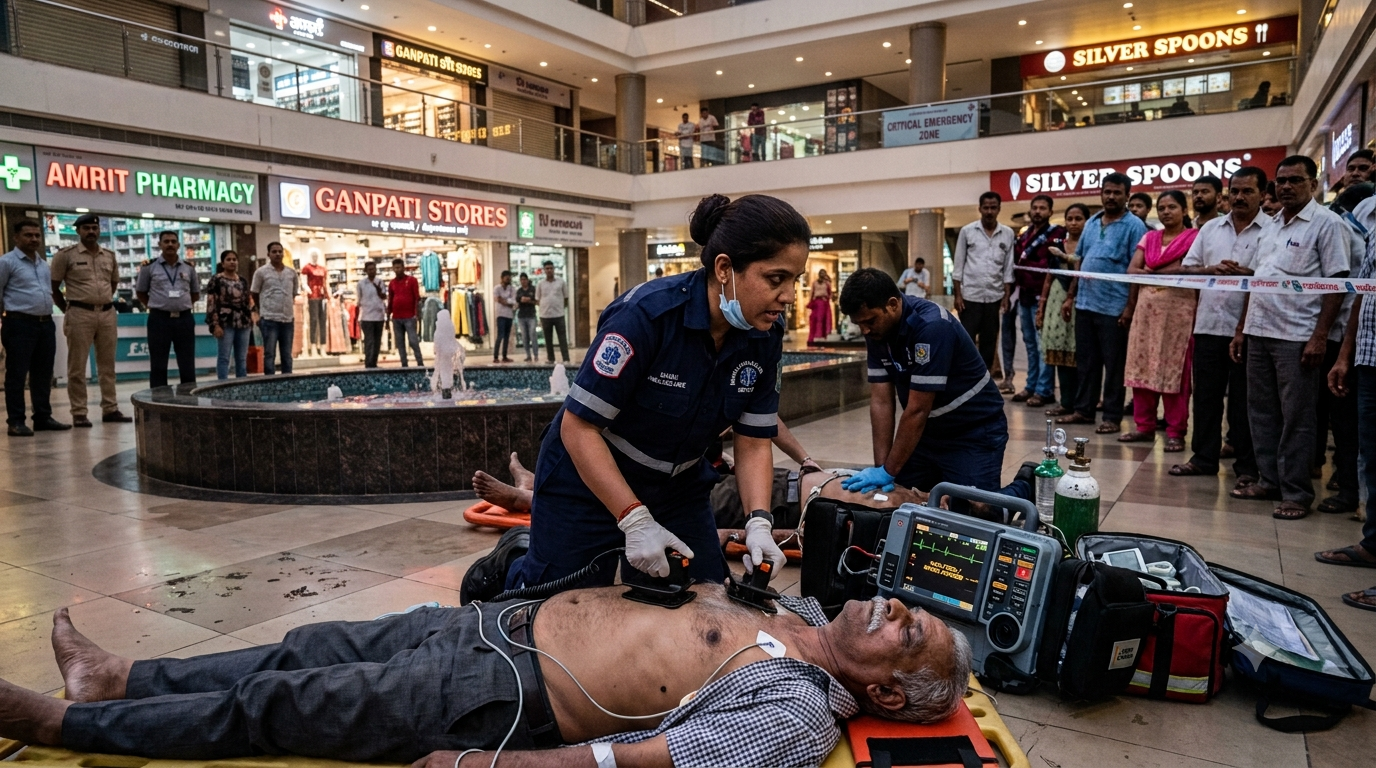
A person collapses at an airport while waiting to board a flight. A teacher suddenly loses consciousness during morning assembly. A shopper falls to the ground in a crowded mall without warning. In each of these situations, every passing minute can mean the difference between life and death.
Sudden cardiac arrest (SCA) is among the leading causes of unexpected death worldwide. Unlike a heart attack, which occurs when blood flow to the heart is blocked, sudden cardiac arrest causes the heart to stop pumping blood effectively. Without immediate intervention, the brain begins to suffer irreversible damage within minutes, and survival chances decline rapidly.
While emergency medical services play a crucial role, they often cannot reach a patient within the first few minutes, especially in crowded public places. This is where bystanders become the first responders. Experts say widespread availability of Automated External Defibrillators (AEDs) and basic CPR training could dramatically improve survival following out-of-hospital cardiac arrest.
According to Dr Arvind Dambalkar, Senior Consultant & Head - Interventional Cardiology at Sarvodaya Hospital, Sector-8, Faridabad, India must begin treating AEDs and CPR preparedness as essential public safety infrastructure, much like fire extinguishers and emergency exits.
Sudden Cardiac Arrest Is Different From A Heart Attack
Although the two terms are often used interchangeably, they are not the same.
- A heart attack occurs when blood flow to part of the heart muscle is blocked. The heart usually continues beating, although medical attention is urgently required.
- A sudden cardiac arrest, on the other hand, is an electrical problem. The heart suddenly stops beating effectively, cutting off blood supply to the brain and other vital organs. Without CPR and defibrillation, death can occur within minutes.
"Sudden cardiac arrest is one of the leading causes of unexpected death worldwide. Unlike a heart attack, it causes the heart to stop beating effectively, cutting off blood flow to the brain and vital organs within seconds," says Dr Dambalkar.
The American Heart Association (AHA) estimates that survival decreases by approximately 7-10% for every minutethat passes without CPR and defibrillation.
Why Every Minute Matters
The first few minutes after cardiac arrest are often called the "golden minutes."
"Every minute without cardiopulmonary resuscitation (CPR) and defibrillation reduces the chances of survival by nearly 7-10%. This is why public spaces such as schools, shopping malls, airports, railway stations, sports complexes, offices and large residential communities must be equipped with Automated External Defibrillators (AEDs) and have staff trained in CPR," explains Dr Dambalkar.
The European Resuscitation Council and International Liaison Committee on Resuscitation (ILCOR) both emphasise the "Chain of Survival":
- Early recognition of cardiac arrest
- Calling emergency medical services
- Immediate high-quality CPR
- Rapid defibrillation with an AED
- Advanced medical care
Breaking any link in this chain significantly reduces survival.
What Is An AED And Can Anyone Use It?
Many people assume defibrillators are complex medical equipment reserved for hospitals. In reality, AEDs are specifically designed for public use.
"An AED is a portable, user-friendly device that analyses the heart's rhythm and, when necessary, delivers an electric shock to restore a normal heartbeat. Modern AEDs provide clear voice prompts and are designed to be used even by individuals without a medical background," says Dr Dambalkar.
These devices assess whether a shock is needed and will not deliver one unless the rhythm is appropriate, making accidental misuse highly unlikely.
According to the AHA, early CPR combined with prompt AED use before an ambulance arrives can significantly improve survival from out-of-hospital cardiac arrest.
Why Schools Should Lead The Way
Schools may not seem like obvious locations for cardiac emergencies, but they bring together hundreds or even thousands of people every day.
"Although cardiac emergencies among children are uncommon, they can occur due to undiagnosed heart conditions, while teachers, staff, parents and visitors may also experience sudden cardiac arrest,"says Dr Dambalkar.
He recommends that schools ensure:
- AEDs are installed in accessible locations
- Teachers and physical education instructors receive CPR training
- Security and administrative staff know how to respond to cardiac emergencies
- Regular emergency response drills are conducted
Quick action before an ambulance arrives could prove lifesaving.
Malls, Airports And Railway Stations Face Unique Risks
High-footfall public places bring together large crowds, older adults, people with chronic illnesses and travellers under physical stress.
"Strategically placing AEDs in easily accessible locations, along with clear signage and trained personnel, can dramatically reduce response times during emergencies," says Dr Dambalkar.
In crowded settings, locating the patient and navigating through people can delay emergency medical teams. Having trained staff already on site helps bridge those crucial first minutes.
Creating CPR-Ready Public Spaces Requires More Than Buying AEDs
Experts say installing an AED is only one part of preparedness. "Creating CPR-ready public spaces goes beyond installing equipment. Regular training sessions, mock emergency drills, periodic maintenance of AEDs and public awareness campaigns are equally important," Dr Dambalkar emphasises.
Staff should know how to:
- Recognise sudden cardiac arrest
- Activate emergency medical services immediately
- Perform effective chest compressions
- Use an AED confidently
- Continue CPR until professional help arrives
Training should also be refreshed periodically to maintain confidence and skills.
India Can Learn From Global Public Access Defibrillation Programmes
Several countries have introduced widespread CPR education and public access defibrillation programmes in airports, schools, railway stations and sports venues.
"Countries that have invested in widespread CPR training and public access defibrillation programmes have reported significant improvements in survival following out-of-hospital cardiac arrest. India has an opportunity to strengthen its emergency response system by making AEDs and CPR training a standard safety requirement in high-footfall public places," says Dr Dambalkar.
International studies have consistently shown that communities with greater public access to AEDs and CPR-trained bystanders report higher survival rates after cardiac arrest.
AEDs Should Become As Common As Fire Extinguishers
Dr Dambalkar believes public attitudes towards cardiac emergencies need to change. "The way fire extinguishers, emergency exits and security systems are considered essential for public safety, AEDs and CPR-trained personnel deserve the same level of importance. A few minutes of preparedness can save a life, turning ordinary citizens and frontline staff into lifesavers when every second counts."
As India expands its public infrastructure, integrating emergency cardiac preparedness into safety planning could save countless lives.
Sudden cardiac arrest leaves little time for hesitation. While emergency medical services remain indispensable, survival often depends on what happens before an ambulance arrives. As Dr Arvind Dambalkar highlights, equipping schools, malls, airports and other high-footfall public spaces with AEDs, and ensuring staff are trained in CPR, can transform bystanders into first responders. Treating AEDs and CPR readiness as essential public safety measures rather than optional additions could significantly improve survival from out-of-hospital cardiac arrest and help build a more resilient emergency response system.
Disclaimer: This content including advice provides generic information only. It is in no way a substitute for a qualified medical opinion. Always consult a specialist or your own doctor for more information. NDTV does not claim responsibility for this information.