

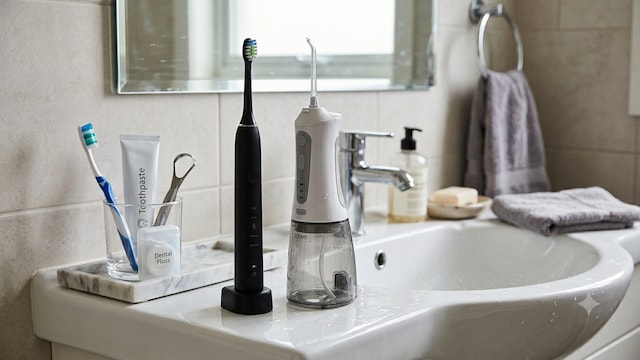
The oral care technology has progressed much farther than a toothbrush and floss. Modern electric toothbrushes have a pressure gauge, a timer and several brush modes, while water-powered flossers use water jets between the teeth and around the gum line to perform a thorough cleaning. Do they aid oral hygiene or are they just an unnecessary cost in your everyday life?
Both devices can be helpful, but neither is required for everyone. The decision of which one is the best depends on the brushing method, health of the gums, dexterity and oral health. Consistency is more important than the cost or technology of an oral care product; research supports some of the benefits of these devices.
Research findings about electric toothbrushes
Electric toothbrushes may be helpful when it comes to plaque removal, especially for those who can't brush well with a regular toothbrush. A Cochrane systematic review of 56 studies and 5,068 participants concluded that powered toothbrushes are more effective at reducing plaque after 1 to 3 months of use (11%) and after more than 3 months of use (21%). The review also revealed a decrease in gingivitis of 6% and 11% respectively. The significance of these differences, however, is not known in the long-term clinical setting.
But using an electric toothbrush is no substitute for correct technique. A manual toothbrush can likewise do great work when used appropriately twice a day for two minutes, accompanied by fluoride toothpaste. An upgrade is most useful when it solves a particular problem instead of being a new technology added to an already successful program.
How do water flossers differ from regular floss?
Water flossers remove food particles from between the teeth and around the gum line with a pressurized stream of water. They might be recommended to those who have a hard time using string floss, like people with braces, bridges or some dental restorations.
Water flossers are an option for patients who have trouble cleaning between their teeth. However, they aren't necessarily better than string floss or interdental brushes. Their effectiveness depends on the gap between the molars, gums and the person's capability to use the device effectively.
READ | What's In Your Toothpaste And How Does It Impact Your Health?
Who's the ideal candidate for upgrade?
Electric toothbrushes might also be beneficial for individuals with limited hand dexterity, substandard brushing skills or those who need support with their brushing routine. Water flossers may be preferable for people with orthodontic appliances, or those who don't feel comfortable using string floss.
There are three factors to consider before buying either device:
- Oral health needs: Some oral issues, such as braces, implants and dental restorations may affect the type of device that's suitable.
- Easy to use: The ideal device is one that can be operated appropriately and daily
- Life-long cost: This should include the cost of replacement brush heads, device maintenance and accessories.
Neither should serve as a substitute for regular dental check-ups or oral health care recommendations by a dentist when there are signs of dental issues, such as bleeding of the gums, persistent bad breath or tooth sensitivity.
Electric toothbrushes and water flossers can enhance the ease with which people maintain oral hygiene, and may be more beneficial to some individuals. There is some evidence that a powered toothbrush can help to remove slight amounts of plaque, and there is some evidence that water flossers can be beneficial in the short-term for the health of gums.
(By Dr. P. Parthasaradhi Reddy, Founder & Chairman, FMS Dental)
READ | WHO Wants To Phase Out Mercury Fillings: Dentist Explains Why
Disclaimer: The opinions expressed within this article are the personal opinions of the author. NDTV is not responsible for the accuracy, completeness, suitability, or validity of any information on this article. All information is provided on an as-is basis. The information, facts or opinions appearing in the article do not reflect the views of NDTV and NDTV does not assume any responsibility or liability for the same.