

)
Citronella oil is a popular natural remedy proven to help repel mosquito bites, making it a common choice for households looking to prevent vector-borne diseases like dengue. With seasonal surges of dengue cases across India, many turn to plant-based options. However, applying just a single drop of citronella oil offers limited, localised protection. Over-reliance or improper use can lead to skin irritation without providing full coverage against daytime-biting Aedes mosquitoes. Every monsoon season, the rising threat of dengue brings a familiar wave of worry to households across the country. As news of seasonal outbreaks spreads, many people naturally turn to home remedies and natural repellents in an effort to keep their families safe.
Among these popular solutions, citronella oil often stands out as a go-to plant-based option. However, a common misconception has taken hold: the belief that applying just a single drop of citronella oil is enough to create an invisible shield against dengue-causing mosquitoes. While this aromatic essential oil does possess natural mosquito-repelling properties, relying on a solitary drop leaves dangerous gaps in protection, exposing individuals to potential bites when they least expect it.
What Is Citronella Oil?
Dr Ananya Sharma, Internal Medicine Specialist, explains, "Citronella oil is an essential oil extracted from the Cymbopogon genus (lemongrass family) that deters mosquito and bug bites. Its natural active compounds, such as citronellal, citronellol, and geraniol, release a strong aroma that masks human scents like carbon dioxide and sweat, making it harder for mosquitoes to locate their targets."
Citronella oil is widely used in commercial bug repellents, though often at low concentrations to ensure skin safety.
Can Citronella Oil Repel Mosquitoes?
Dr Dinesh Kumar, Director of Internal Medicine, Fortis Hospital, highlights, "Yes, citronella oil can repel mosquitoes, including Aedes aegypti, the primary vector responsible for transmitting dengue. However, its effectiveness relies strictly on its volatile scent mask. Because essential oils evaporate rapidly upon skin contact, the protective mechanism is inherently short-lived compared to synthetic alternatives."
Is A Small Drop Of Citronella Oil Enough To Prevent Dengue?
Dr Ananya Sharma, an internal medicine specialist, explains, "A single drop of citronella oil is completely inadequate for preventing dengue infection. There is a vast clinical difference between briefly repelling a mosquito and successfully preventing a disease. A single drop covers an extremely tiny surface area and evaporates within minutes, leaving the rest of the body fully exposed to daytime biters."
- Repelling vs. Preventing: Repelling stops a landing temporarily; preventing dengue requires consistent, full-body protection against infected bites.
- Evaporation Rate: Pure citronella oil dissipates rapidly, requiring reapplication every 30 to 60 minutes.
- Application Radius: A single drop cannot emit a vapour shield wide enough to protect an adult's entire body.
How Does Citronella Oil Prevent Dengue
Dr Dinesh Kumar, Director of Internal Medicine, Fortis Hospital, explains, "While laboratory tests show high initial knockdown rates for citronella against mosquitoes, field conditions tell a different story. Heat, wind, and sweat cause essential oils to evaporate rapidly. Research confirms citronella works as a short-term barrier, but it lacks the persistent chemical stability required for high-risk vector zones."
- Short Vapour Window: Essential oils lose potency quickly as body heat accelerates evaporation.
- Environmental Degradation: Outdoor airflow severely reduces the concentration of protective scent vapours around the body.
Citronella Oil vs Other Mosquito Repellents
Dr Ananya Sharma explains the effectiveness of citronella oil when compared to other repellents: "When evaluated against vector control standards, plant-based oils require constant reapplication. Formulations containing DEET, picaridin, or oil of lemon eucalyptus (OLE) remain the clinical standard for prolonged protection against Aedes bites."
Here are the reasons behind each of the mosquito repellents for their effect in preventing mosquito bites.
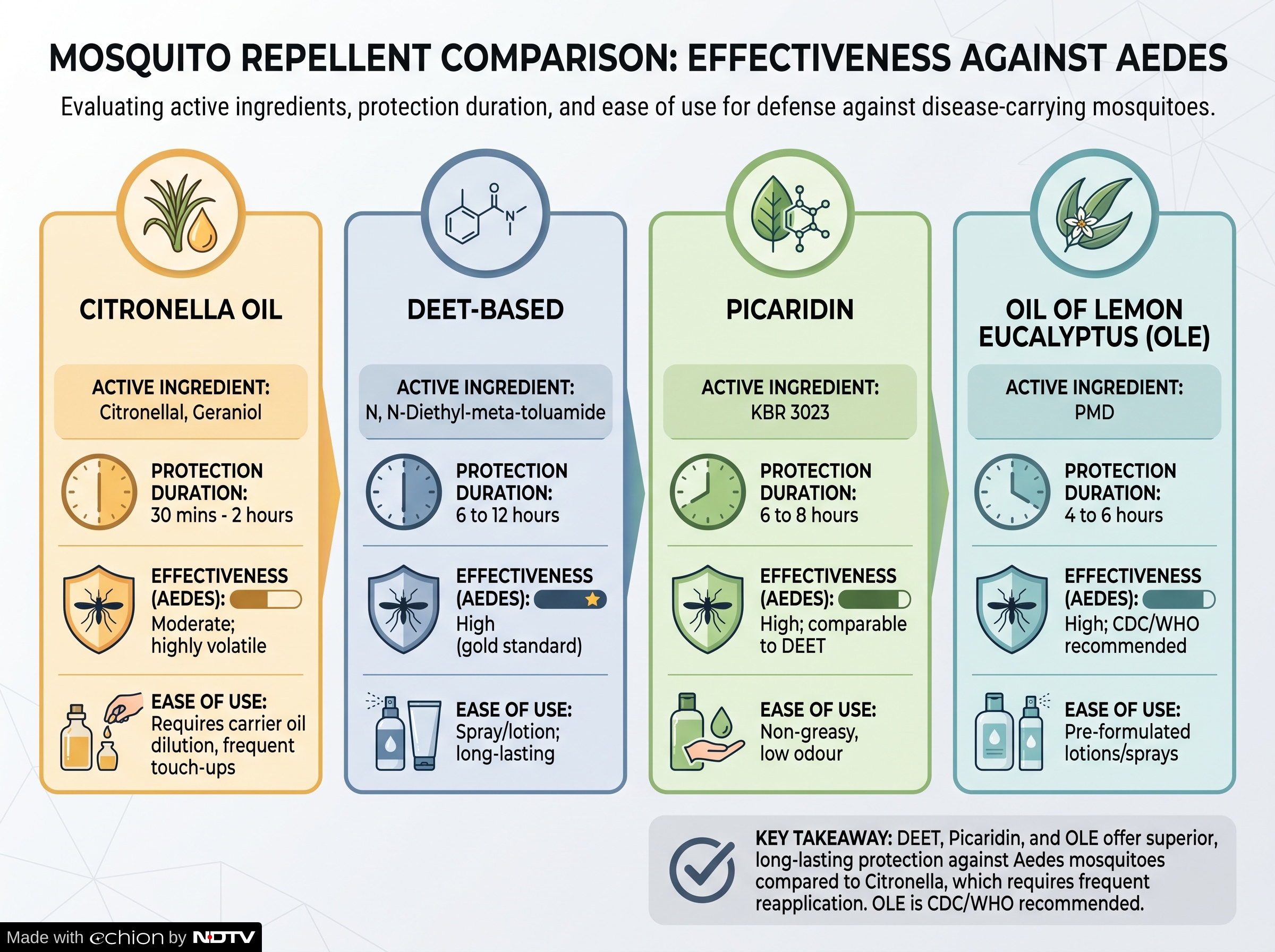
Dr Dinesh Kumar, Director of Internal Medicine, Fortis Hospital, explains, "Preventing dengue demands a multi-layered defence system. Relying solely on a topical essential oil leaves dangerous gaps in your protection. You must combine personal repellents with environmental source reduction." Here are his recommended ways to protect yourself from dengue:
- Apply Recommended Repellents: Use EPA/WHO-approved repellents (DEET, picaridin, or OLE) on exposed skin during peak Aedes feeding times (early morning and late afternoon).
- Wear Protective Clothing: Dress in light-coloured, long-sleeved shirts and full-length trousers.
- Eliminate Stagnant Water: Scrub and empty flower pots, coolers, and containers weekly to destroy mosquito breeding sites.
- Use Barrier Nets: Install window screens and use bed nets, especially for daytime sleeping infants and young children.
Can Citronella Oil Be Used Safely?
Dr Ananya Sharma, Internal Medicine Specialist, explains, "Essential oils are potent organic chemicals. Applying concentrated, undiluted citronella oil directly to the skin frequently triggers severe contact dermatitis, redness, and chemical burns. Proper dilution in a carrier oil is non-negotiable." Here is how you can do so:
- Skin Sensitivity: Direct application can lead to itching, rash, and redness.
- Patch Testing: Always blend citronella with a neutral carrier oil (like coconut or jojoba oil) and test a small area on your inner arm 24 hours prior to full application.
- Special Populations: Avoid applying essential oils to infants or young children under two years old. Pregnant women should consult their doctor before use.
Common Myths About Dengue Prevention
Dr Dinesh Kumar, Director of Internal Medicine, Fortis Hospital, explains, "Misinformation surrounding dengue prevention often leads to severe health outcomes. Busting these popular myths with evidence-based medical facts is vital for public safety."
He also explains, "While citronella oil can serve as a mild, short-term supplementary deterrent, it must never be relied upon as your sole defence against dengue. Protecting your family requires recommended long-lasting repellents, protective clothing, and stagnant water removal."
Disclaimer: This content including advice provides generic information only. It is in no way a substitute for a qualified medical opinion. Always consult a specialist or your own doctor for more information. NDTV does not claim responsibility for this information.