

India's latest intervention to rein in cancer drug prices promises affordability to patients with sharp price reductions in several generic and biosimilar medicines. But the revised prices also reveal a major gap: many high-cost cancer drugs, including the widely used immunotherapy Keytruda, priced at Rs 2.16 lakh a vial, remain untouched by the latest revision, raising questions about how much the trade-margin cap can do to ease patients' treatment bills.
The National Pharmaceutical Pricing Authority (NPPA) has revised the maximum retail prices (MRPs) of 543 cancer drug brands and pack sizes after the government capped trade margins on 137 non-scheduled anti-cancer medicines at 30 per cent. The new prices will come into effect from November 9.
The biggest cuts are concentrated in medicines where the difference between the manufacturer's price and the final retail price was substantial. For expensive drugs with limited competition, however, restricting what distributors and other intermediaries can charge has done little to bring down the listed price.
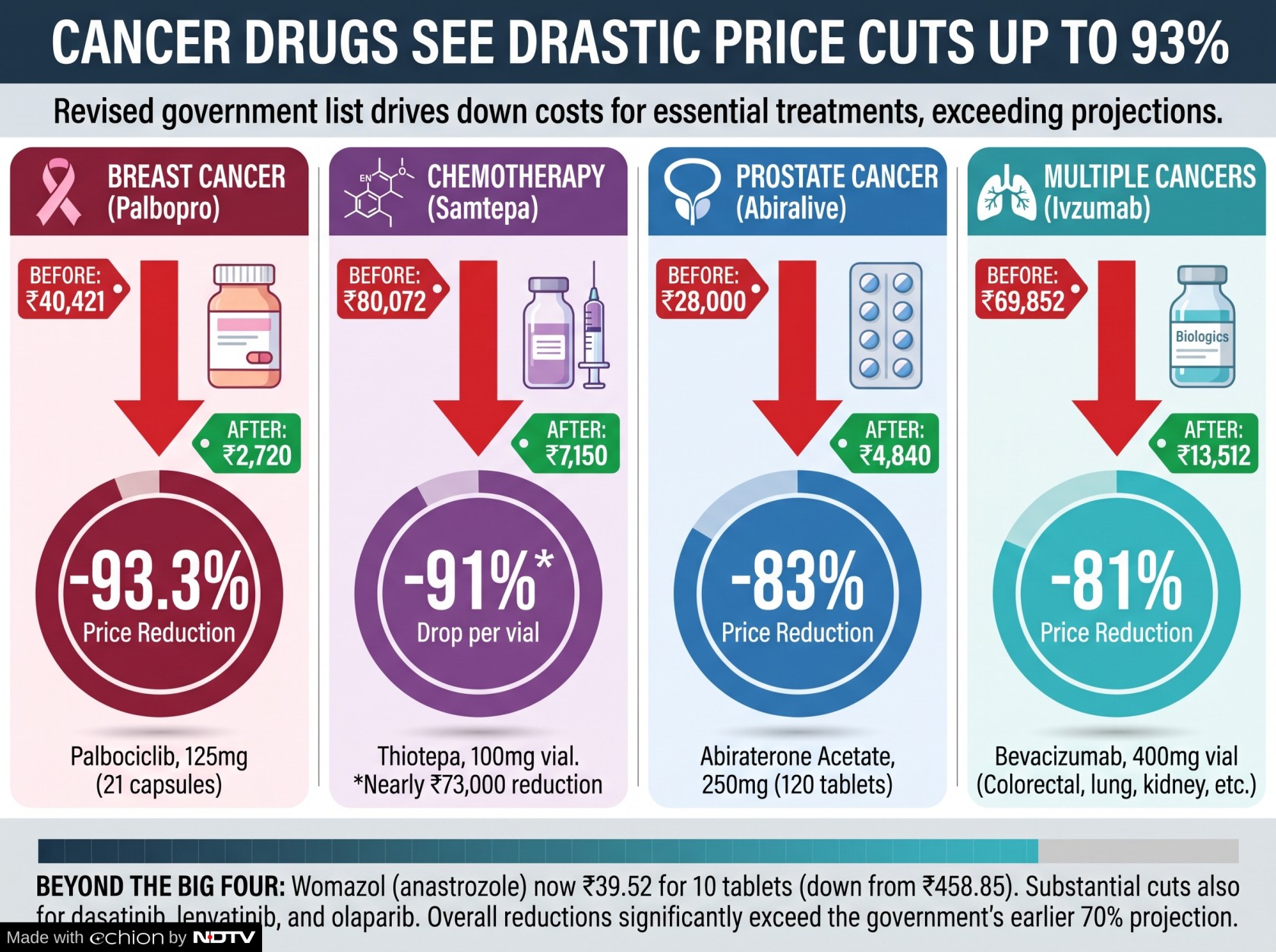
Some Cancer Drugs Become Over 90% Cheaper
The revised list includes steep reductions in several medicines used to treat breast, prostate and other cancers.
- Palbopro, a brand of palbociclib used for certain types of breast cancer, has seen the price of its 125 mg pack of 21 capsules fall from Rs 40,421.33 to Rs 2,720-a reduction of about 93.3 per cent.
- The price of Samtepa, a 100 mg vial of the chemotherapy drug thiotepa, has dropped from Rs 80,071.86 to Rs 7,150.33. That is a reduction of nearly Rs 72,922 per vial.
- Other major cuts include Abiralive, a brand of abiraterone acetate used in prostate cancer, whose 250 mg pack of 120 tablets has fallen from Rs 28,000 to Rs 4,840, a reduction of about 83 per cent.
- Womazol, an anastrozole brand used in breast cancer treatment, is now listed at Rs 39.52 for a 10-tablet pack, down from Rs 458.85. The price of Ivzumab, a brand of bevacizumab used to treat several cancers, including colorectal, lung and kidney cancers, has fallen by about 81 per cent, from Rs 69,852.12 to Rs 13,512 for a 400 mg vial.
- The NPPA list also records substantial reductions in brands of dasatinib, lenvatinib and olaparib. In some cases, the cuts are significantly greater than the government's earlier projection of reductions of up to 70 per cent.
But the benefit is not uniform, even for medicines containing the same active ingredient.
While Ivzumab has become considerably cheaper, another bevacizumab brand, Avastin, remains listed at around Rs 1.24 lakh for a 400 mg vial. Similarly, the price of the 100 mg pack of palbociclib brand Paleno has fallen only marginally, from Rs 5,717.81 to Rs 5,624.10.
These differences matter because patients' actual savings depend on the brand prescribed, the dosage and duration of treatment, and the prices charged by the hospital or pharmacy.
READ | Cancer Drug Prices Slashed: New Rates For 543 Drug Brands From November 9

Why Keytruda And Other Expensive Drugs Remain Unchanged
While several generic and biosimilar brands have recorded sharp price reductions, at least 65 high-cost, single-source cancer medicines remain unchanged in the comparison of pre-cap and revised prices.
One of the most prominent examples is Keytruda, the immunotherapy drug containing pembrolizumab. Used across more than 21 cancer types, it remains priced at Rs 2,16,500 for a 100 mg vial.
Other originator brands whose listed prices have not changed include Tagrisso, used for certain lung cancers; Tecentriq; Darzalex; and Imfinzi. Ribociclib, sold as Kryxana and used in breast cancer treatment, remains listed at Rs 24,435.
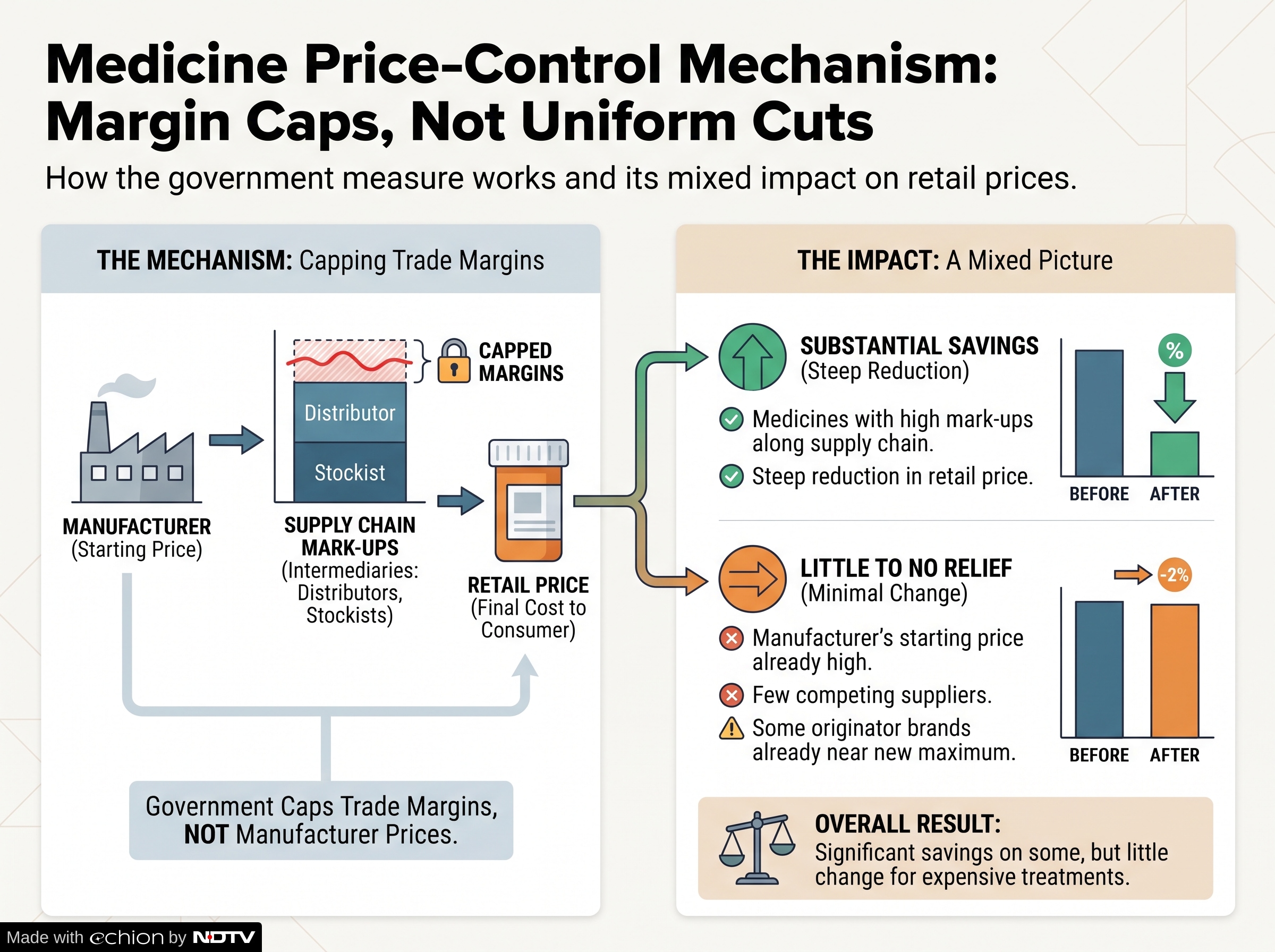
The distinction lies in how the price-control measure works. The government has capped the trade margin that distributors, stockists and other intermediaries can add to the price of these medicines. It has not imposed a uniform reduction on the price charged by every drug manufacturer.
Where a medicine's retail price includes substantial mark-ups along the supply chain, limiting those margins can lead to a steep reduction. But if the manufacturer's starting price is already high and there are few competing suppliers, the same intervention may deliver little or no relief.
Some originator brands may also already have listed prices close to the maximum permitted under the new rules.
The result is a mixed picture: substantial savings on some medicines, but little change in the cost of several expensive treatments.
What The NPPA Order Changes
The latest revision follows an October 17 NPPA order capping trade margins on 137 non-scheduled anti-cancer medicines at 30 per cent of the maximum retail price. Non-scheduled medicines are not subject to the same routine price ceilings that apply to drugs covered by the National List of Essential Medicines.
The revised list reflects price information submitted by pharmaceutical companies up to October 27. Prices for 27 of the 137 medicines were not reflected in the company filings available so far. These include abemaciclib, cabozantinib, dabrafenib, lazertinib, selpercatinib, sotorasib and vemurafenib.
Companies are required to submit revised price details even when a medicine's MRP remains unchanged. They must also circulate and publish updated price lists and maintain existing production levels. Manufacturers planning to reduce production must obtain prior permission from the regulator.
The order also covers medicines supplied directly to hospitals. Hospitals purchasing the drugs from manufacturers are treated as distributors for the purpose of applying the trade-margin cap.
READ | Centre Expects Anti-Cancer Drug Prices To Fall 20-70 Per Cent Under Proposed Trade Margin Cap
Will The Cuts Translate Into Lower Treatment Bills?
The revised prices could bring substantial savings for patients prescribed affected brands, particularly those who need repeated doses or long courses of treatment. The reduction in the price of a single vial of thiotepa, for instance, could make a considerable difference over a course of therapy.
But a lower MRP does not automatically translate into the same percentage reduction in a patient's total treatment bill. The impact will depend on the medicine and brand used, the treatment regimen, and whether the revised price is reflected in what patients are ultimately charged.
Cancer care costs extend well beyond medicines to include surgery, radiation, diagnostic tests, hospitalisation and follow-up treatment. For families paying out of pocket, even a significant reduction in one drug may not be enough to make the overall cost of care affordable.
The latest price revision also comes amid wider scrutiny of medicine pricing. The Supreme Court has questioned the government over the high cost of cancer drugs and trade margins in the treatment supply chain. It is considering a broader proposal to cap trade margins on all non-scheduled medicines, with its order in the case reserved. That could have implications beyond cancer treatment, although the scope and outcome of any wider intervention remain uncertain.
For now, the revised NPPA list shows both the potential and the limits of trade-margin controls: they can sharply reduce prices where supply-chain mark-ups are high, but they cannot, by themselves, guarantee lower prices for every expensive medicine. For patients, the key question is not just how many brands have become cheaper, but whether the drugs they actually need will cost less.
Disclaimer: This content including advice provides generic information only. It is in no way a substitute for a qualified medical opinion. Always consult a specialist or your own doctor for more information. NDTV does not claim responsibility for this information.