



Ayurveda, one of the world's oldest systems of traditional medicine, has historically been rooted in Indian and other South Asian cultures, offering holistic perspectives on health and well-being. In December 2025, the World Health Organization (WHO) co-hosted the Second WHO Global Summit on Traditional Medicine in New Delhi, alongside India's Ministry of AYUSH. The summit brought together delegates, ministers, researchers and Indigenous knowledge holders from over 100 countries, aiming to shape a scientifically credible and globally accepted role for traditional medicine.
At the heart of the summit was the Delhi Declaration on Traditional Medicine, a collective pledge by Member States to integrate safe, evidence-based traditional medicine (including Ayurveda) into national health systems. Complementing this political commitment, WHO has also published Global Benchmarks for the Practice and Training of Ayurveda, which define minimum global standards for quality, safety, education and regulatory oversight. The AYUSH Ministry also launched the Ayush Mark standard on the last day of this global summit.
These developments are aligned with the WHO Global Traditional Medicine Strategy 2025-2034, adopted by the 78th World Health Assembly, which sets out to strengthen evidence, safety, regulation and system integration of traditional, complementary and integrative medicine (TCIM) worldwide.
Also Read: What Is Ayush Mark? The Newly Launched Global Standards For Traditional Medicine Explained
What The Delhi Declaration Means
The Delhi Declaration, adopted at the conclusion of the 2025 summit, provides a roadmap for action rather than a standalone guideline. Key commitments include:
- Strengthening Evidence Base: Member States pledged to expand ethical, pluralistic research on traditional medicine modalities, including Ayurveda, and support the WHO Traditional Medicine Global Library, a digital repository with over 1.5 million scientific resources.
- Ensuring Safety and Quality: Countries agreed to develop risk-based regulation and robust safety monitoring for traditional medicine products and practices.
- Integration into Health Systems: Plans were made to bring proven traditional therapies into primary health care, backed by international standards and workforce development.
- Better Data and Collaboration: The Declaration calls for interoperable data systems, shared research platforms and meaningful participation of communities and Indigenous peoples.
The Declaration advances the goals of the Global Traditional Medicine Strategy 2025-2034, which aims for universal access to safe, effective and people-centred traditional medicine services globally.
WHO Benchmarks for Ayurveda: Safety, Standards and Training
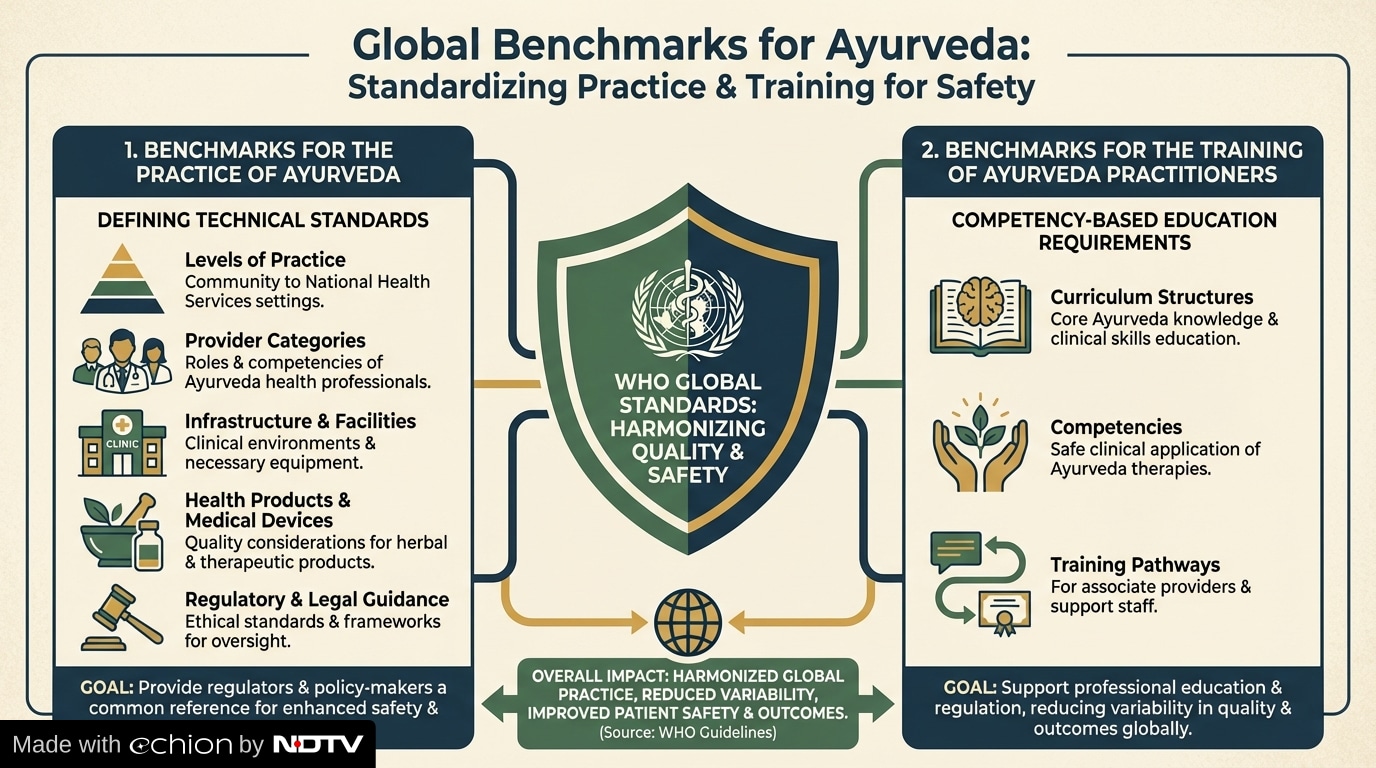
To operationalise these commitments, WHO released two landmark technical documents specifically for Ayurveda:
1. Benchmarks for the Practice of Ayurveda
These guidelines define minimum technical standards for Ayurvedic practice across member states, including:
- Levels of practice, from community to national health service settings.
- Provider categories, or roles and competencies of Ayurveda health professionals.
- Infrastructure and facilities, necessary clinical environments and equipment.
- Health products and medical devices, quality considerations for herbal and therapeutic products.
- Regulatory and legal guidance, ethical standards and frameworks for oversight.
- This benchmark document aims to harmonise practice standards globally, providing regulators and policy-makers with a common reference point that enhances safety and helps protect patients.
2. Benchmarks for the Training of Ayurveda Practitioners
This complementary set defines competency-based education requirements, including:
- Curriculum structures for core Ayurveda knowledge and clinical skills.
- Competencies for safe clinical application of Ayurveda therapies.
- Training pathways for associate providers and support staff.
Together, these benchmarks support professional education and regulation, helping standardise Ayurveda training across countries and reducing variability in quality and outcomes.
Also Read: Traditional Medicine Must Gain Trust Through Science To Expand Reach, Says PM Modi
Global Health and Evidence-Based Integration
The benchmarks and the Delhi Declaration are forward-looking but evidence-oriented. They align with WHO's broader strategy to integrate traditional medicine into universal health coverage, especially in settings where these practices already play a significant role in community health.
The launch of the WHO Traditional Medicine Global Library further accelerates this by providing policymakers and researchers with access to a vast corpus of research, safety data and policy documents.
The Delhi Declaration and WHO's Global Benchmarks for Ayurveda represent a historic global health moment, a pivot from siloed traditional practices toward evidence-based, regulated and integrated health services that can contribute to public health goals worldwide. By standardising education and practice and prioritising safety and data, WHO and Member States are building a framework where ancient systems like Ayurveda can be responsibly trusted, studied, and implemented alongside other health modalities.
Disclaimer: This content, including advice, provides generic information only. It is in no way a substitute for a qualified medical opinion. Always consult a specialist or your own doctor for more information.
Track Latest News Live on NDTV.com and get news updates from India and around the world

