





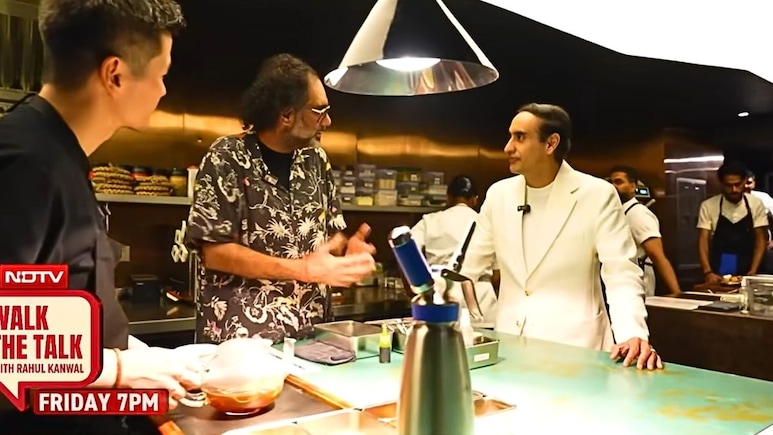
After years of waiting, multiple attempts and a long stint cooking Indian food outside the country, Gaggan Anand has finally opened his first restaurant in India. Raga, his much-awaited Delhi restaurant, opened its doors on August 26 at Janpath, marking a homecoming for the Kolkata-born chef. In a conversation with NDTV CEO and Editor-in-Chief Rahul Kanwal on Walk The Talk, Anand spoke about Raga, his relationship with Delhi, the ideas behind some of the dishes on the menu and why, despite being known for elaborate tasting menus, he wants the food here to remain simple at heart. There was one confession that perhaps summed up Anand's approach best: “I hate my food.”
Also Read: Video: Swiggy's Raksha Bandhan Idea Turns Delivery Bag Handles Into Rakhis
The chef was explaining that even he sometimes wants something familiar and comforting. In Bangkok, he often heads to the restaurant above his flagship, Ms Maria and Mr Singh, for the kind of food he describes as easy comfort food. Raga, however, is an attempt to take the memories of Indian food he has carried with him for decades and translate them into something new.
"I am taking least risk. I'm following the KISS formula: keep it simple and straight," Anand told Kanwal.
For him, that means not trying to reinvent what he does simply because he is now cooking in India. Instead, he wants to use something that was once a limitation in Bangkok as an advantage in Delhi: Indian ingredients.
"Something like pyaz ki kachori will taste better here because yahan ka atta aur yahan ka pyaz," he explained.
Why Raga Is Different From Gaggan In Bangkok
Raga is not meant to replicate Anand's celebrated Bangkok restaurant. The chef explained that while the philosophy remains similar, the experience is deliberately different.
At Gaggan in Bangkok, the experience is more theatrical and immersive. Phones are not allowed and the meal is designed almost like a Broadway performance. Raga, on the other hand, is meant to be a city restaurant - somewhere people can come with family, friends or a partner and spend time at the table.
"Gaggan is once in your life experience," Anand said. "And here is like you can be with your family and you can come once a week if you want the food."
That distinction also explains the name. Raga comes from the names of Anand and his longtime collaborator and co-founder, Rydo Anton, while also referring to the musical form. Anand, who once wanted to be a musician, sees cooking in much the same way.
"I am a conductor of chaos," he said. "When I write a menu, I am putting myself that I know what Rydo does, I know what that guy does, I know what that girl does, and who does what, and I'm writing a symphony."
The 22-course menu follows that philosophy, but Anand insists that it should not leave diners feeling weighed down.
"I think we live in a very healthy India," he said, pointing to the way people today track everything from their steps to their health. "So I want to make my dishes long menu. There are 22 courses to be done, but you don't feel bloated, you don't feel rich, and yet get the essence of our cooking."
From Yogurt Explosion To Aloo Bonda
One of the first dishes Kanwal tried was Pink Blossom, a reworking of Anand's famous Yogurt Explosion. The idea remains familiar - a delicate exterior giving way to an explosion of flavours - but the dish has been reworked for Delhi.
Anand described Raga's food through what he calls a five-S philosophy: sweet, salty, spicy, sour and surprise.
That idea appears again in a dish inspired by Bombay's street-food culture. It looks like a sandwich but isn't made with bread. Inside is an aloo bonda, accompanied by green chutney and dried garlic chutney - flavours associated with vada pav.
"It looks like a sandwich, it holds like a sandwich, and there's no bread in it," Kanwal observed.
For Anand, that is exactly the point.
"People wear clothes. Food is fashion," he said. "The most seductive dress in the world is a saree. I want to make Indian food look Indian."
The dish may look like something familiar, but the moment it enters the mouth, the diner is forced to reconsider what they are eating.
The Jhalmuri Cookie Inspired By NDTV
One of the more unusual dishes on the menu has an even more unusual origin story.
Anand revealed that NDTV's Bengal election coverage inspired his Jhalmuri Cookie. While following the election coverage, he saw Vir Sanghvi eating jhalmuri in the NDTV studio. The image stayed with him.
"I said, this is such a political statement. I need to put jhalmuri in my menu in Delhi," Anand recalled.
The result looks nothing like a traditional bowl of jhalmuri. The cookie resembles a walnut, or akharot, but contains the flavours of the Kolkata snack.
During the episode, Kanwal suggested they take the dish outside to a local jhalmuri vendor and let him try it. The vendor initially struggled to identify the familiar flavour, before acknowledging that there was some jhalmuri taste.
Restaurateur Zorawar Kalra, who is associated with Raga, was less convinced about its authenticity, pointing out that the dish did not have the characteristic mustard oil flavour of jhalmuri.
For Anand, however, that tension is part of the idea. Raga is not trying to reproduce street food literally. It is taking the memory of a dish and rebuilding it through technique.
Nalli Nihari, But Without The Grease
The same approach appears in Raga's Nalli Nihari.
Instead of the layer of fat usually associated with the dish, the team emulsifies the fat into the preparation. A specialised cooking system allows the kitchen to control pressure, temperature, water and oil while significantly reducing cooking time.
Anand said the aim was not to strip away the flavour but to change the way it is experienced.
The dish is served alongside rice with spinach and baby corn, with sesame oil adding another layer. The crispy bits at the bottom are reminiscent of the socarrat of Spanish cooking - or, as Anand puts it, jalaawa chawal.
Again, the vocabulary is deliberately familiar.
"That's what I said in the beginning, KISS. Keep it simple and straight and just give straight honest food with our techniques," he said.
A Chef Who Wanted To Be A Musician
Anand's connection with music runs deeper than the name of his restaurant.
If he had not become a chef, he told Kanwal, he would have wanted to be a drummer. He keeps a drum kit in his restaurant and at home, using it as a way to disconnect when he is angry or stressed.
That same energy, he believes, eventually finds its way into his cooking.
His food may involve sophisticated equipment, specially designed ceramics and painstaking techniques, but Anand does not see the technology as the star. The machines simply allow his team to execute an idea more precisely.
As he put it while discussing Raga's saffron-pistachio soft serve: you can have the best car, but without the right driver and the right fuel, it will not move.
Also Read: Content Creator Buys Groceries To Cook Indian Food In Japan, Shows Struggles
The same applies to the kitchen.
At Raga, Anand has Rydo Anton beside him, with whom he has worked for years. Restaurateur Zorawar Kalra, meanwhile, told Kanwal that his decision to bring Anand to Delhi came after experiencing his Bangkok cooking firsthand.
The partnership, Anand said, began with conversations about dreams rather than money.
And now, after years of trying to bring his cooking back to India, Anand finally has a permanent address in the country.
Perhaps that is why Raga feels less like another restaurant opening and more like the closing of a very long loop - from Kolkata to Bangkok and finally to Delhi.
"I was born in Calcutta as a Punjabi kid, living on Bengali food and Calcutta chaat cultures," Anand said while describing the influences that shaped him. "I studied culinary cooking in Kerala... And then I was here in Delhi."
Raga, in many ways, is the result of that journey: a restaurant rooted in Indian memories, filtered through years of cooking abroad and served through Anand's unmistakably theatrical lens.
Track Latest News Live on NDTV.com and get news updates from India and around the world

