





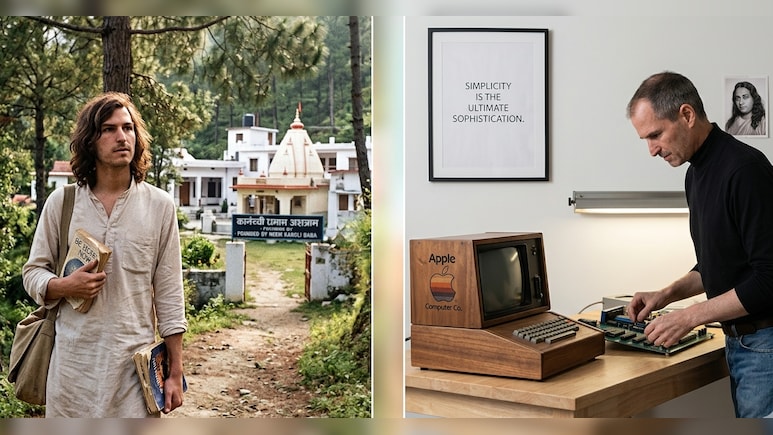
As Apple celebrates its 50th birthday today, we look back at the little-known spiritual pilgrimage a 19-year-old Steve Jobs made to Neem Karoli Baba's ashram in 1974, a journey that Walter Isaacson's authorised biography confirms helped forge the philosophy behind one of the world's most iconic companies.
Apple Turns 50
According to Apple's newsroom, the company was founded on 1 April 1976 and built on the belief that progress comes from challenging convention. Today marks 50 years since Steve Jobs and Steve Wozniak first joined hands, running their early operations out of the garage at Jobs' family home. As the world looks back on five decades of innovations, from the Mac to the iPod and the iPhone-one lesser-known chapter of the Apple story also resurfaces: the months a young Jobs spent wandering barefoot through India in 1974, searching for a spiritual teacher he ultimately never met.
A Restless Young Man
In 1974, Jobs had quit his job to follow his calling in the East. "For me, it was a serious search," he later told biographer Walter Isaacson. "I'd been turned on to the idea of enlightenment and trying to figure out who I was and how I fit into things."
Jobs first met Daniel Kottke when they were both undergraduates at Reed College in 1972. In 1974, Kottke and Jobs made a trek in search of spiritual enlightenment to India to visit Neem Karoli Baba at his Kainchi ashram.The trip was motivated in part by both men reading Ram Dass's influential book "Be Here Now," which captured the spirit of a generation of young Americans turning towards Eastern spirituality.
Who Was Neem Karoli Baba?
Neem Karoli Baba, also known to his followers as Maharaj-ji, was a Hindu guru and devotee of the deity Hanuman. Born Lakshman Narayan Sharma around 1900 in Uttar Pradesh, he built his main ashram at Kainchi Dham, in the Kumaon hills of Uttarakhand, in 1964. His teachings centred on love, compassion and selfless service, and he attracted a wide circle of Western spiritual seekers during the 1960s and early 1970s. Neem Karoli Baba died at around 1:15 a.m. on 11 September 1973, in a hospital at Vrindavan, India, after slipping into a diabetic coma.
Arriving to Find the Guru Gone
According to Business Today, when Jobs and Kottke reached the Neem Karoli ashram, it was almost deserted because Neem Karoli Baba had died in September 1973. They then made a long trek up a dry riverbed to an ashram of Haidakhan Babaji. Despite this, Jobs stayed at Kainchi Dham and drew inspiration from Neem Karoli Baba's teachings.
According to the book Steve Jobs by Walter Isaacson, Jobs often roamed barefoot with little money in his pockets. He lived in temples, dormitories, and sometimes with families in villages.
What India Taught Him
According to The Juggernaut, Steve Jobs went from Haridwar to Nainital and Manali, visiting holy places across northern India. His time with local people helped him understand differences between East and West.
In his own words, recorded by Isaacson, Jobs said of his 1974 visit: "The people in the Indian countryside don't use their intellect like we do, they use their intuition instead, and their intuition is far more developed than in the rest of the world. Intuition is a very powerful thing, more powerful than intellect, in my opinion. That's had a big impact on my work."
According to CBS News, Isaacson later observed that the simplicities of Zen Buddhism Jobs encountered also deeply informed his design sense, including the notion that simplicity is the ultimate sophistication.
Seven Months, One Transformation
Jobs spent seven months in India, embracing its culture and undergoing a profound personal transformation. Upon returning to the United States, he described himself as "unrecognisable" to his parents.
One book accompanied him throughout the journey. According to Isaacson's biography, Jobs had first read Paramahansa Yogananda's "Autobiography of a Yogi" as a teenager, then reread it in India, and continued to read it once a year for the rest of his life.
From Ashram to Apple
After his return, Jobs and Steve Wozniak started building and selling a primitive computer for hobbyists. With a $1,300 investment, they founded Apple Computer in his parents' garage.
Kottke, who had shared the India journey with Jobs, later became Apple's employee number 12 after graduating from Columbia University in 1977. The influence of that Himalayan ashram, and of a guru Jobs never got to meet, stayed with him for decades. According to Isaacson, India deeply influenced Jobs' intuition, minimalism, and emotional awareness, qualities that later shaped Apple's design philosophy and Jobs' leadership style.
Today, on Apple's 50th birthday, that quiet hillside ashram in Uttarakhand stands as an unlikely part of the company's origin story.
Track Latest News Live on NDTV.com and get news updates from India and around the world

