




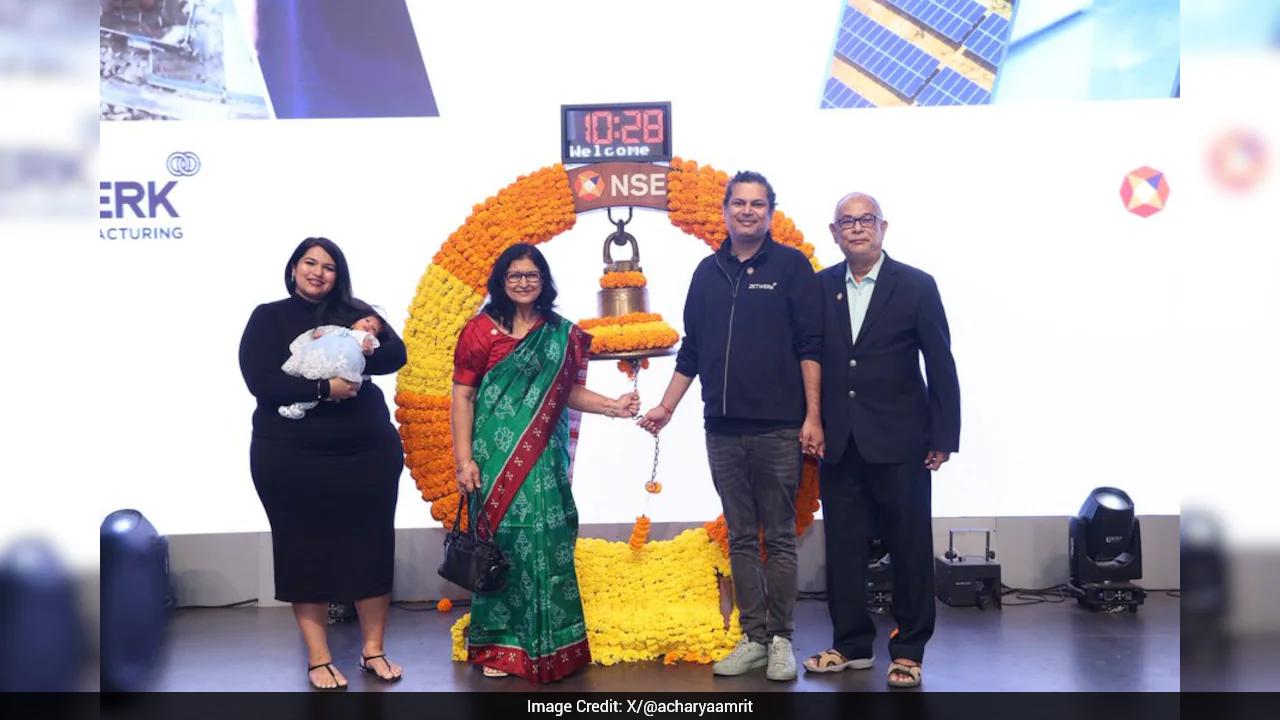
Moving to the US to pursue the American Dream has been the standard template for Indians venturing abroad in the last few decades. So when Amrit Acharya decided to give up his career and return with his wife Sharanya to start a company at the age of 29, his father, a professor, was not too happy. Scepticism followed, and yet 10 years later, Acharya stood alongside his father last week as they rang the bell at the National Stock Exchange (NSE), marking the listing of his company, Zetwerk.
Acharya, co-founder of the manufacturing firm, shared the inspiring story in a post on X (formerly Twitter), detailing the numerous challenges he faced, which ultimately helped him build something of his own that is now listed on the stock market.
“Last month, we welcomed our daughter. Last week, we took the company public. It is yet to sink in," said Acharya.
Acharya, an IIT Madras alumnus, described his journey as the story of today's India, where young founders from small towns, without any family connections, managed to raise capital, build a business and go public within a decade.
"When I moved back, my father, a professor, was sceptical. I had walked away from the traditional Indian dream of a job abroad. But our story is also that of today's India, where my cofounders and I, 20-somethings from small towns, without family connections, can raise capital, build a business, take it global and take it public, all within a decade," said Acharya.
The Bengaluru-based entrepreneur said the world is on the cusp of enormous progress, from defence modernisation and the energy transition to space exploration and AI buildout. However, he added that much of it faces one bottleneck: building physical things in the real world.
"But the manufacturing systems of the past won't build the future. Manufacturing must modernise to catch up with the industries it serves," he said.
I was 29 when we started Zetwerk. My wife Sharanya and I had just returned from the US to build our lives in India. Last month, we welcomed our daughter. Last week, we took the company public. It is yet to sink in. When I moved back, my father, a professor, was sceptical. I had walked away from the traditional Indian dream of a job abroad. But our story is also that of today's India, where my cofounders and I, 20-somethings from small towns, without family connections, can raise capital, build a business, take it global and take it public, all within a decade. The world today is on the cusp of enormous progress: defence modernisation, energy transition, space exploration and AI buildout. Much of this progress faces a common bottleneck: building physical things in the real world. But the manufacturing systems of the past won't build the future. Manufacturing must modernise to catch up with the industries it serves. At Zetwerk, we always believed there is enough depth in Indian manufacturing whether it is within the small workshop in Peenya which is great at tooling or it is in the new plants we have set up to drive scaled production. Our approach combines real-world engineering with a digital stack to unify ~7000 suppliers, 25+ owned facilities, 1000+ customers and 3000+ employees into a single layer that operates with the predictability of a world-class factory, standardising quality and delivery. We call it the Universal Factory. Our ambition is to build a world-class industrial institution bringing together two distinct worlds: software and hardware. Think of your day today. You may have made coffee, worn headphones, taken the metro or a flight, or opened your laptop. There is a little bit of Zetwerk in all of these. We want our customers placing complex, multimillion-dollar orders to have an experience that is "boringly predictable" - simple, transparent and reliable. We have over ₹15,900 crore in revenue, more than 80% repeat customers and a manufacturing order book of ₹13,000 crore. We've come a long way, but also have a long way to go. On IPO day, my father stood beside me as we rang the bell at the National Stock Exchange. He is not sceptical any more :) Someone wise once said “You make your own reality. And once you've done it, everyone's of the opinion it was all so obvious”. That is how the future works. Before something transformative exists, people call it improbable. Afterwards, they call it inevitable. This is the spirit in which we are building Zetwerk: with a relentless commitment to the future. Great industrial institutions that came before us, like GE, L&T and Tata, helped make the modern world possible. Today, Indian manufacturing is having its moment, and we intend to build what comes next. A big thank you to our investors, customers, employees, their families, our bankers and partners who helped us get here. We are committed to building a world-class industrial institution out of India.
— Amrit Acharya (@acharyaamrit) October 28, 2026
Acharya said Zetwerk combines real-world engineering with a digital stack. It brings together about 7,000 suppliers, over 25 owned facilities, more than 1,000 customers and over 3,000 employees into a single layer. He revealed that Zetwerk reported revenue of over Rs 15,900 crore and a manufacturing order book of Rs 13,000 crore, with 80 per cent repeat customers, resulting in the IPO being worth Rs 5,000 crore.
"Our ambition is to build a world-class industrial institution bringing together two distinct worlds: software and hardware. Think of your day today. You may have made coffee, worn headphones, taken the metro or a flight, or opened your laptop. There is a little bit of Zetwerk in all of these," he said.
Reflecting on the road ahead, Acharya quoted a line that people call something improbable before it exists and inevitable afterwards. He named GE, L&T and Tata as the institutions that came before, saying Indian manufacturing is having its moment. As for his father's reaction, Acharya signed off with a smile: “My father stood beside me as we rang the bell at the National Stock Exchange. He is not sceptical any more :)"
Track Latest News Live on NDTV.com and get news updates from India and around the world

