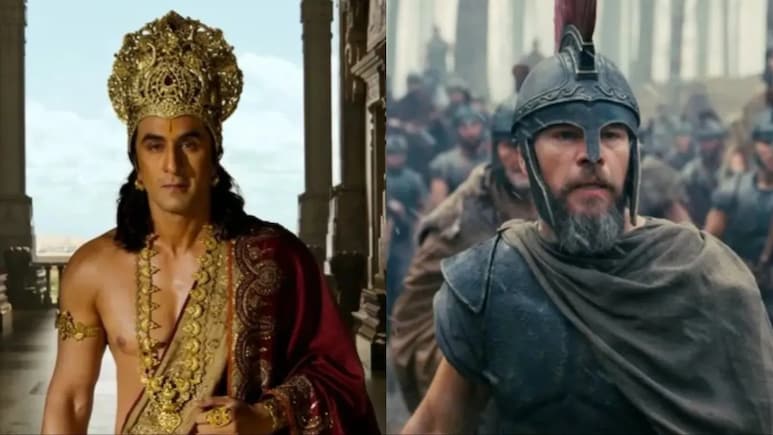
Christopher Nolan's much-awaited epic action fantasy The Odyssey has hit the cinemas. While Homer's Greek epic may belong to a different civilisation, the tale of exile, war, and a long journey home may feel similar to Indian audiences who grew up with the tale of the Ramayana.
While The Ramayana and The Odyssey are two completely different epics written in different timelines, when placed side by side, there are some similarities that are hard to ignore. Here are some key similarities that Nolan's The Odyssey shares with the Ramayana:
Homecoming
In The Odyssey, Odysseus, the Greek king of Ithaca, spends 10 years fighting in the Trojan War before embarking on another decade-long journey home. During the journey, he is met with various roadblocks, including shipwrecks and monsters, as well as temptations, before finally returning to his wife Penelope and son Telemachus.
The Ramayana followed a similar pattern when Rama, along with his wife Sita and brother Lakshman, was exiled from Ayodhya for 14 years. The journey takes them through forests, across the sea, and into a war with Ravana after Sita is abducted.
Supernatural Forces
In both epics, the protagonists were taken beyond the ordinary human world. Odysseus encounters the Cyclops, Scylla, and Charybdis; the Sirens; and Circe, while Lord Rama faces Ravana and his formidable forces. In The Odyssey, the enchanting voices lure sailors towards destruction, similarly to how the golden deer in the Ramayana draws Rama away from Sita. In both epics, supernatural forces are used to create illusions that distract and test the protagonists.
Wife In Captivity
In both tales, the protagonist's wife is held captive. While Sita is abducted by Ravana and held captive in Lanka, Odysseus' wife, Penelope, continues to live inside her palace but is constantly surrounded by suitors who try to woo her into marrying them so that, in the absence of Odysseus, Ithaca has a king again. However, both women wait patiently and hold their deep beliefs that their respective husbands will come to save them.
Stringing Of The Bow
Stringing of the bow serves as a competition in both tales. In The Odyssey, Penelope conducts a stringing of the bow competition for her suitors, but none of them manage to achieve the feat until it is only the returning Odysseus, disguised as a beggar, who succeeds at it. Similarly, in Ramayana, the competition is held at Sita's swaymvar, where a host of men are unable to even move Lord Shiva's celestial bow. It is only Rama who not only manages to lift the bow but also breaks it into two halves while trying to string it, securing Sita's hand in marriage.
Incorporation Of Gods
In both epics, gods play crucial roles in guiding and obstructing the protagonists. Athena, the Greek goddess of wisdom and warfare, constantly helps Odysseus while Poseidon works against him.
In the Ramayana, Lord Shiva and Lord Brahma are central to the larger story of Rama's life and mission.
